
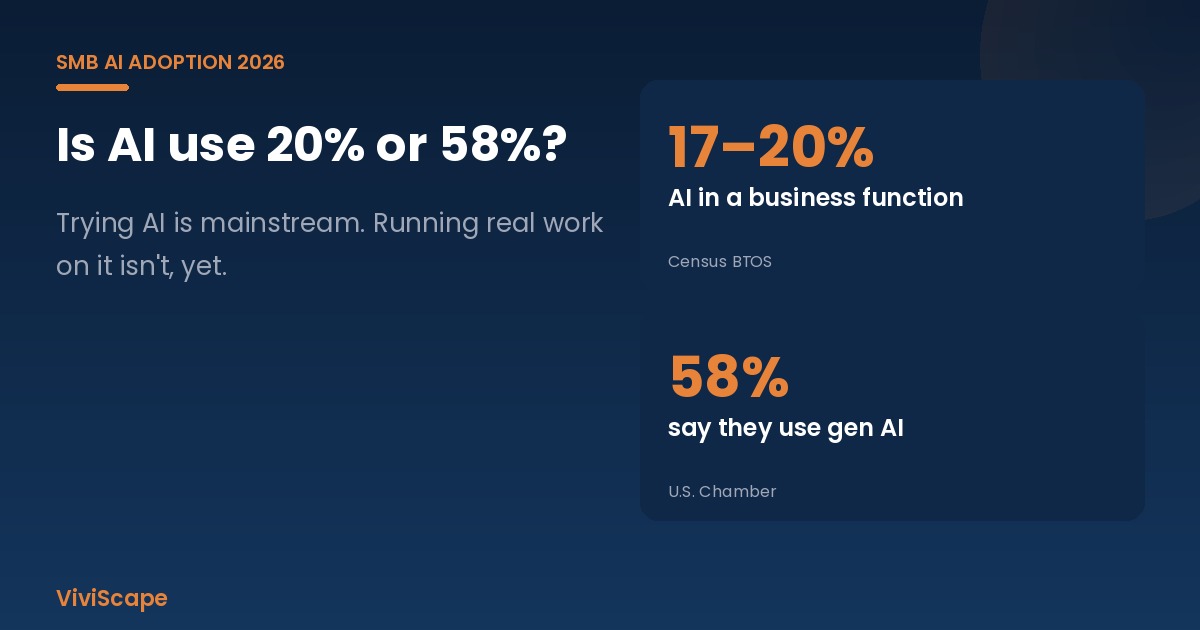
It depends on what you count. The U.S. Census Bureau found that 17% to 20% of U.S. businesses used AI in a business function between December 2025 and May 2026, while 58% of small businesses told the U.S. Chamber of Commerce they use generative AI. The gap is the distance between trying AI and running real work on it.
Key facts
| Fact | Figure | Source |
|---|---|---|
| U.S. businesses using AI in a business function (past two weeks), Dec 2025 – May 2026 | 17%–20% (19.8% as of May 3, 2026) | U.S. Census Bureau, BTOS (May 2026) |
| Where use is growing | Firms with 20+ employees; no significant change below 20 | U.S. Census Bureau (May 2026) |
| Firms using AI, by size | 32% (100–249 employees); 37% (250+) | U.S. Census Bureau (May 2026) |
| Small businesses (<250 employees) that self-identify as using generative AI | 58% (40% in 2024, 23% in 2023) | U.S. Chamber of Commerce, Empowering Small Business (Aug 2025) |
| Generative-AI-using small businesses that use it regularly | 22% (51% occasionally, 27% experimenting) | Gusto (Jul 2025) |
| Top barriers to AI for U.S. small businesses | Privacy/security 36%; not knowing what AI can do 28%; bias/errors 26% | Intuit, 2026 AI Impact Report (Jan 2026 wave) |
| Organizations using AI regularly vs. reporting enterprise EBIT impact | 88% vs. 39% | McKinsey, The State of AI (Nov 2025) |
Frequently asked questions
How many small businesses use AI in 2026?
It depends on the survey. The Census Bureau measured 17%–20% of all U.S. businesses using AI in a business function from December 2025 to May 2026, with higher rates among firms with 20 or more employees. In the U.S. Chamber's 2025 survey, 58% of small businesses said they use generative AI. Both can be true.
Why do AI adoption statistics disagree so much?
They differ on what counts, who is asked, and when. The Census survey is nationally representative and asks whether a business used AI in any business function in the past two weeks. The Chamber asks small businesses whether they use generative AI at all, which includes occasional chatbot use.
Which industries use AI the most?
In Census data as of May 3, 2026, the Information sector (39.7%) and Finance & Insurance (33.9%) were above the national rate of 19.8%. Retail Trade was below it, at about 14%. These are national aggregates, not company examples.
What stops small businesses from adopting AI?
In Intuit's January 2026 survey wave, the top U.S. barriers were privacy and security (36%), not knowing what AI can do (28%), and concern about bias or errors (26%). Cost ranked lower. Gusto's 2025 survey also flags a lack of technical expertise, and found more than 80% of small businesses have no formal AI strategy.
Does using AI mean cutting staff?
Not in the U.S. Chamber's 2025 sample: 82% of small businesses using AI increased their workforce over the prior year. For most growing companies, AI is a way to add capacity for work they already can't staff.
Two numbers, both true
If you've read two articles about AI adoption this year, you've probably seen two very different numbers. One says most small businesses already use AI. The other says only about one business in five does. Both are right, because they measure different things.
The Census number (17%–20%). The U.S. Census Bureau's Business Trends and Outlook Survey is a nationally representative, biweekly survey of U.S. businesses. Since late 2025 it has asked whether a business used AI "in any business function" in the past two weeks. From December 2025 to May 2026, the answer hovered between 17% and 20%, and was 19.8% as of May 3, 2026. Between 20% and 23% expected to be using AI within six months.
The Chamber number (58%). The U.S. Chamber of Commerce's Empowering Small Business report, published in August 2025 from a June 2025 survey, found that 58% of small businesses (fewer than 250 employees) self-identify as using generative AI, up from 40% in 2024 and 23% in 2023. That's a broader question. An owner who uses a chatbot to draft a few customer emails counts as a user.
Gusto's July 2025 survey shows how shallow much of that use is. Among small businesses using generative AI, only 22% use it regularly; 51% use it occasionally and 27% are still experimenting.
Put the numbers side by side and the picture is clear. Trying AI is now mainstream for small businesses. Using it as a regular part of how the business runs is still a minority activity.
Where use is actually growing
The Census data adds two useful details.
Size. Between December 2025 and May 2026, AI use increased among firms with at least 20 employees but didn't change significantly among firms with fewer than 20. Larger firms are further along: 32% of firms with 100 to 249 employees and 37% of firms with 250 or more reported using AI. One plausible reason is volume. Once a business has enough orders, invoices, tickets, or schedules that the same manual steps repeat hundreds of times a month, automating them starts to pay, and the business usually has several systems that people re-key data between.
Sector. As of May 3, 2026, Census reported AI use of 39.7% in the Information sector and 33.9% in Finance & Insurance, against a national rate of 19.8%. Retail Trade sat at about 14%. Document-heavy, rules-driven work tends to adopt first. A lower sector rate doesn't mean less opportunity; it often means the opportunity sits in back-office work rather than in front of the customer.
What's holding businesses back
If most small businesses have tried AI, why are so few running work on it? The surveys agree that the main blockers are trust and know-how, not price.
- Privacy and security. In Intuit's 2026 AI Impact Report (January 2026 wave), 36% of U.S. small businesses named privacy and security as a barrier, the top answer. Gusto found about 40% worried about data privacy and security.
- Not knowing what AI can do. 28% of Intuit's respondents cited limited knowledge of AI's capabilities. Gusto's respondents named a lack of technical expertise among their biggest barriers, and more than 80% had no formal AI strategy.
- Errors and quality. 26% in Intuit's survey worried about bias or errors. Among small businesses not using AI, the U.S. Chamber found concern about the quality of AI tools was rising compared with prior years, alongside cost, legal and compliance concerns, not knowing enough, not seeing how it helps, and training or talent gaps.
- Cost, but less than you'd think. Cost ranked about fourth in Intuit's data (roughly one in five), and 22% of Gusto's respondents worried about implementation cost.
Every one of those blockers gets smaller when AI is pointed at one specific, well-understood workflow, with defined access to data, a person who reviews exceptions, and a before-and-after number.
Adoption isn't impact
McKinsey's 2025 State of AI is the bridge between the two worlds. It found that 88% of organizations use AI regularly in at least one business function, but only about a third have begun to scale it, and just 39% report any enterprise-level EBIT impact.
The Chamber data shows why. Among small businesses using AI, 63% rely mostly or entirely on tools built by other companies, and only 8% mainly build their own. Most small-business AI today is a general-purpose tool sitting next to the work, not inside it. When the upside is real, it can be large: Gusto found four in five generative-AI-using small businesses reported productivity gains of 20% or more, and more than 40% saw revenue grow 20% or more. The difference is whether AI is doing work that shows up in your numbers.
A simple way to see where your company stands is a four-rung ladder:
- Personal tools. Individuals use chatbots for writing, research, and summaries. Useful, but invisible on the P&L.
- Team assistants. A team standardizes on AI for a task, such as drafting quotes or answering common questions. Gains are real but hard to measure.
- AI inside a workflow. AI reads incoming orders, invoices, or emails and writes the result into your system of record. People review exceptions. Now you can count transactions, errors, and cycle time.
- Agents that own a job. An agent handles a whole queue end to end, with defined permissions, an audit trail, and a named person who approves what needs approval.
Most occasional users are on rungs one and two. Moving to rung three usually depends on integration: AI can't do work inside systems it can't reach.
How to move from "we use ChatGPT" to AI that does the work
You don't need a strategy deck. You need one workflow and a baseline.
- Inventory what's already happening. Ask each team which AI tools they use and for what. You'll likely find more personal use than you expected, and a few tasks worth standardizing.
- Pick one high-volume workflow. Look for work that repeats daily, involves re-keying data between systems, and has a clear system of record: order entry, invoice processing, scheduling, status updates.
- Price the manual work first. Count the hours, errors, and rework that workflow costs today. Without this number, you can't show what AI changed. (Our guide on how to measure the ROI of automation and AI walks through the formula.)
- Answer the privacy question up front. Decide which data the AI may read and write, where it's processed, and what's logged. This is the top blocker in the surveys, so settle it before anything runs.
- Name who approves what. Assign the person who handles exceptions and set what the AI may and may not do on its own.
- Measure, then expand. Compare cost per transaction, error rate, and cycle time 30 to 90 days after launch. Expand only what the numbers support.
What the numbers mean for you
Whether 20% or 58% of businesses "use AI" is the wrong argument. The useful question is how much of your operation AI actually runs, and whether you can prove what it saved. The Census data says larger small businesses are moving. McKinsey says most organizations still can't show the return. The ones that close that gap start with a priced, specific workflow rather than another tool. (For a broader take on small-business returns, see The Real ROI of AI for Small Business.)
Two free checks before you spend anything
See how ready your data, systems, and processes are for AI, then put a number on the manual work it should take over.
Take the AI readiness check Calculate my Manual Work TaxSources
- U.S. Census Bureau, "Large Firms With at Least 20 Employees Biggest AI Users," May 26, 2026 (Business Trends and Outlook Survey, Dec 14, 2025 – May 3, 2026). https://www.census.gov/library/stories/2026/05/ai-use-businesses.html
- U.S. Chamber of Commerce, Empowering Small Business: The Impact of Technology on U.S. Small Business, Aug 18, 2025 (fielded Jun 6–26, 2025). https://www.uschamber.com/assets/documents/Empowering-Small-Business-Report-2025.pdf
- Gusto, "How small businesses are using AI in 2025," Jul 17, 2025 (vendor research). https://gusto.com/resources/gusto-insights/smbs-using-ai-2025
- Intuit, 2026 AI Impact Report (Jan 2026 wave; vendor research). https://digitalasset.intuit.com/render/content/dam/intuit/sbseg/en_us/Blog/Downloadable-assset/2026-ai-impact-report.pdf
- McKinsey & Company, The State of AI in 2025, Nov 5, 2025. https://www.mckinsey.com/capabilities/quantumblack/our-insights/the-state-of-ai-2025