
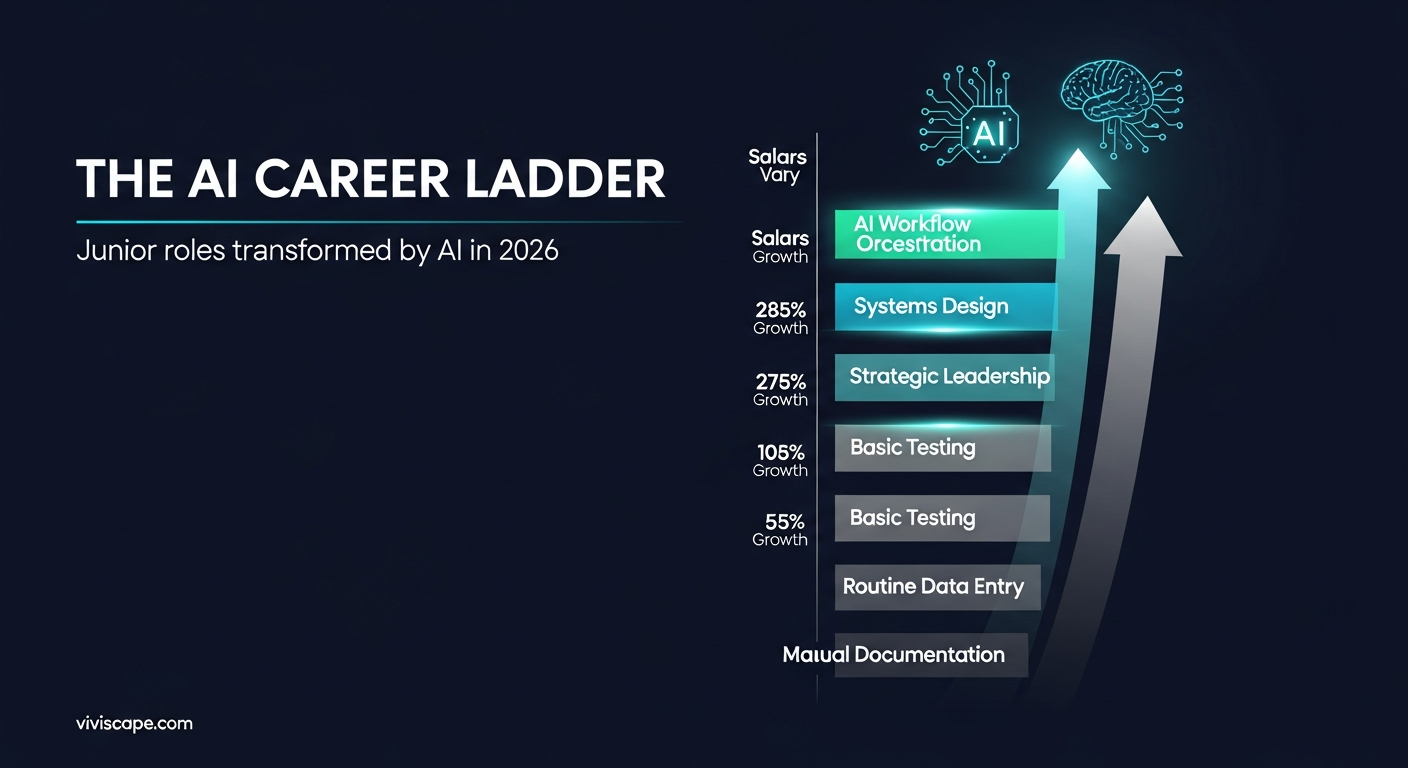
The intern class of 2025 arrived to find that their entry-level job description was written for a different era.
Not because the jobs disappeared — but because the tasks that defined those jobs did. The first-draft writing. The data entry. The basic research summaries. The QA test pass documentation. The initial client brief. These are the building blocks that entry-level roles were designed around, and they are precisely the tasks that AI tools handle in seconds now.
72% of companies reduced entry-level hiring in 2025. Entry-level job postings are down 35% year over year in finance, legal, and consulting — the sectors where junior roles were most defined by high-volume repetitive knowledge work. 26% of all tasks in knowledge work are now automatable, according to Goldman Sachs, and the impact is concentrated at the bottom of the professional hierarchy.
The question is not whether this is happening. It is: what does a career ladder look like when the first rung has been redesigned by AI — and what do the organizations getting it right look like?
What Actually Disappeared: The Tasks, Not the Roles
The important nuance in the entry-level disruption story is that roles did not vanish — the task composition of those roles changed fundamentally. A junior analyst still exists. The work they did to fill that role in 2022 has largely been automated.
What AI tools handle at scale, in real enterprise workflows today:
- First-draft content creation: Research summaries, briefing documents, initial report structures, email drafts, and presentation outlines that used to be the primary output of junior knowledge workers are now produced by AI in minutes.
- Data entry and processing: Ingesting, cleaning, and formatting data — work that filled early-career roles in finance, operations, and analytics for decades — is automated. Junior analysts who spent 40% of their time on structured data work now do that in 10%.
- Basic QA and testing: Initial test pass documentation, regression testing frameworks, and bug report drafting are generated by AI tools in the software development workflow. Agentic coding tools handle test generation as a standard build artifact.
- Initial research synthesis: Pulling together competitive landscape summaries, regulatory background, market sizing estimates — work that was a full junior task — is now a 15-minute prompt.
What remains for junior professionals — and what AI cannot do — is the judgment layer. The client call where tone matters. The analysis that requires understanding organizational context. The creative direction that depends on brand intuition. The recommendation that needs to account for organizational politics. These are not first-year skills in the traditional model. In the AI-native organization, they are the first-year job.
Building a team where junior staff use AI tools to work on higher-value problems from day one?
ViviScape operates this way internally — our junior developers use agentic tools so they ship features from the start. Talk to ViviScape
The Companies Getting It Right
The organizations that are navigating the entry-level disruption successfully share a common design principle: they redesigned the junior role around AI augmentation rather than trying to preserve the task composition that no longer exists.
At AI-native firms, junior staff use AI agents to handle the automatable work, which means their actual work product from week one is more closely aligned with what 3–5 year employees produced in the traditional model. A junior developer at an agentic coding shop is shipping features because the AI handles test generation, boilerplate, and initial implementation — they are reviewing, directing, and refining output rather than producing it from scratch. A junior analyst at an AI-native consulting firm is spending their time on client interaction, hypothesis generation, and recommendation framing, because the AI handles the literature synthesis and data structuring underneath.
The result is not just productivity. It is retention. Companies that invest in AI-augmented junior roles report 2.3x higher retention in the first two years compared to organizations that have not restructured the entry-level experience. The reason is straightforward: junior professionals who are doing meaningful, judgment-requiring work from day one are learning faster and building skills that matter. They are not staying for the career prospect of eventually getting to do interesting work after years of repetitive training tasks — they are doing interesting work now.
AI-skilled entry-level workers earn 56% more than their non-AI-skilled peers according to WEF data. The premium reflects what the market has already priced: organizations are paying for the junior professional who can operate productively with AI, not the one who needs the traditional task progression to develop.
The Reskilling Gap
Only 17% of employers have a formal AI skills pathway for junior employees. That number — from Deloitte’s 2026 workforce survey — is the central problem in the entry-level disruption story.
Organizations are eliminating entry-level roles at the task level without redesigning them at the role level. They are automating the repetitive work that used to train junior talent without creating the structured environment where junior professionals learn to operate at the judgment layer. The result is a talent pipeline failure: the entry-level class that should be developing into mid-career professionals in 2–3 years is not developing the skills that the mid-career roles require.
The WEF Future of Jobs 2025 report projects 92 million jobs displaced by 2030 and 170 million new roles created — a net positive at the macro level. But the new roles require different skills than the displaced roles. Without structured pathways to develop those skills, organizations that eliminated traditional entry-level training pipelines will face a talent shortage at the 3–5 year level in the late 2020s, because they did not build the junior foundation.
What HR and Hiring Managers Should Do
The design problem is solvable. The organizations that will come out of the next three years with strong mid-career talent pipelines are the ones making deliberate choices now about what entry-level roles look like in an AI-augmented environment.
Redesign job descriptions around the judgment layer. A junior analyst role that requires AI proficiency and lists “client-facing communication” and “hypothesis development” as primary responsibilities is more accurate to the actual work than a job description that still lists “data entry” and “report compilation.” Candidates who can operate effectively at the judgment layer are the ones who will develop into your 5-year employees.
Build AI-augmented onboarding. The traditional 90-day onboarding plan was built around gradual task introduction. The AI-native onboarding plan looks different: early emphasis on AI tool proficiency, structured exercises in reviewing and refining AI output rather than producing first drafts, and guided client interaction from the first month rather than month six. The goal is to accelerate the transition to judgment-layer work, not to delay it behind task-layer training that the AI now handles.
Create explicit skill development paths for AI collaboration. What does a 1-year junior professional need to know to become a productive 3-year professional at your organization? Map that path explicitly, identify where AI tools are part of the workflow at each stage, and build the structured learning that connects the entry-level role to the mid-career role. The 83% of employers who have not done this are building toward a mid-career talent gap.
Evaluate for AI-adjacent skills in hiring. Critical thinking applied to AI output — the ability to evaluate whether a generated analysis is correct, spot where AI reasoning fails, and direct AI tools toward better output — is now a first-year professional skill. Communication and client empathy are more important at year one, not less, because the work that used to be done before client interaction is now automated. Hire for the skills that matter in the redesigned role.
How ViviScape Approaches This
ViviScape’s junior developers use agentic coding tools in production from the first week. They are not filing bugs while they wait for the interesting work. They are reviewing AI-generated implementations, directing agents toward correct architecture, and shipping features — work that used to require two to three years of skill development in the traditional model.
The result is a development team where early-career professionals are working at a higher level earlier, developing skills that compound faster, and producing output that reflects it. When the entry-level role is redesigned around augmentation rather than replaced by automation, the professional development accelerates rather than stalls.
Key Takeaways
- 72% of companies reduced entry-level hiring in 2025; entry-level postings are down 35% in finance, legal, and consulting — the AI disruption at the bottom of the career ladder is real and current
- What disappeared is the task composition of entry-level roles, not the roles themselves — first-draft writing, data entry, basic research, and QA documentation are now automated
- AI-native organizations that redesigned junior roles around AI augmentation report 2.3x higher retention in the first two years — junior staff doing meaningful work from day one develop and stay
- AI-skilled entry-level workers earn 56% more than non-AI-skilled peers (WEF) — the premium reflects what the market already knows about who can operate effectively in the redesigned role
- Only 17% of employers have a formal AI skills pathway for junior employees (Deloitte 2026) — the organizations that build this now will have the mid-career talent in 2028–2030 that others will lack
- The design playbook: redesign job descriptions around the judgment layer, build AI-augmented onboarding, create explicit skill development paths, and hire for AI-adjacent critical thinking skills
Building a Team That Works With AI, Not Around It?
ViviScape has built an internal development culture where junior staff use AI agents from day one — shipping features, developing judgment skills, and building the experience that compounds into senior capability. If you’re thinking about what your team looks like in the AI-augmented era, let’s talk.
Schedule a Free Consultation