
What does it mean when 46% of your codebase was written by AI — and the quality went up?
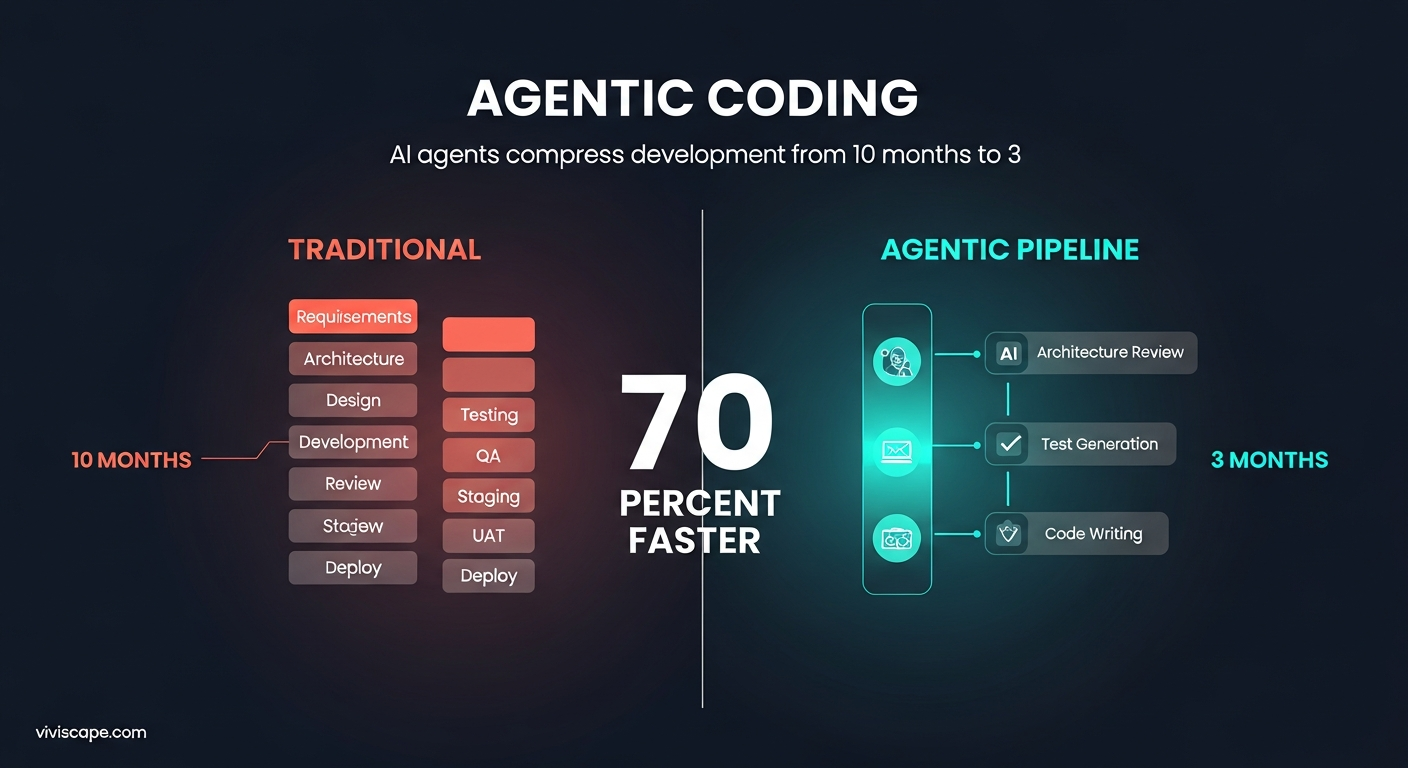
That is not a hypothetical. As of Q1 2026, 46% of all new code written by professional developers involves AI tools — Claude Code, GitHub Copilot, Cursor, and their peers. 55% of developers now regularly use AI coding agents in their daily work. And the projects using these tools are delivering two to three times faster than projects that do not, at 60–70% lower cost.
The shift from AI-assisted coding to agentic coding happened between 2024 and 2026, and it changed the economics of custom software development permanently. Enterprises that understood this shift — and chose development partners who operate with this stack — are now buying faster timelines and lower costs than were possible three years ago. Enterprises that have not updated their assumptions are overpaying and waiting too long.
From Copilot to Agent: What Actually Changed
AI coding tools went through two distinct phases. The first phase — copilot-style assistance — made individual developers faster by autocompleting code, suggesting function implementations, and catching basic errors. Developers still owned the architecture, wrote the tests, reviewed the security, and managed the overall structure of the codebase. AI was an accelerant, not a participant.
The second phase changed that. Agentic coding tools operate as participants in the development process. They do not just complete lines — they can take architectural requirements, generate implementation plans, write multi-file code, create test suites, identify security issues, write documentation, and review pull requests. A developer orchestrating Claude Code or a comparable agent is not doing the same job as a developer typing faster. They are operating at a fundamentally different level of abstraction.
The result: an experienced developer working with agentic tools can deliver what previously required a small team. The output per developer-hour increased by a factor most organizations have not yet recalibrated their procurement models to reflect.
What does 3x faster delivery and 60% lower cost look like for your next project?
ViviScape uses agentic coding tools in production on every project. Real numbers from real projects — let’s talk about what that means for your timeline and budget. Talk to ViviScape
The Economics: A Before and After
The cost and timeline shift is not theoretical. Across the enterprise software market, the numbers show a structural change:
| Project Type | Traditional Development | Agentic Coding Stack |
|---|---|---|
| SMB custom application | 6–10 months / $80K–$150K | 2–3 months / $25K–$50K |
| Enterprise integration project | 12–18 months / $250K–$500K | 4–6 months / $80K–$175K |
| Quality at first QA pass | Baseline | 3x fewer bugs |
| Code review time | Baseline | 40% reduction via automated PR analysis |
The quality improvement alongside the speed and cost improvement is the most important number in that table. The assumption that faster means lower quality does not hold for agentic coding. AI-assisted code has three times fewer bugs at first QA pass compared to fully manual development. Code review time drops by 40% through automated PR analysis and security scanning. The reason is structural: agentic tools catch entire categories of errors — security vulnerabilities, type mismatches, missing edge cases — that human review finds inconsistently.
82% of new enterprise software projects now use AI-assisted development according to Gartner’s 2026 data. The development firms that are not using this stack are not competing on the same terms.
What This Means for the Build vs. Buy Decision
The Build vs. Buy analysis we published July 8 documented that 35% of enterprises have already replaced SaaS with custom builds and 78% plan to build more in 2026. The economics driving that shift are exactly what agentic coding enabled: the cost crossover between SaaS licensing costs and custom development costs now happens at much lower volumes and shorter timeframes than it did three years ago.
A workflow automation tool that costs $18,000 per year in SaaS fees has a different build-vs-buy calculation at $150,000 to build (3+ years to break even) than at $45,000 to build (under 3 years). Custom software that took 12 months to build previously excluded itself from consideration for many projects purely on time grounds. At 4 months, the timeline objection dissolves.
Enterprises that are still using the old cost and timeline assumptions to evaluate custom software options are systematically undervaluing the build option. The procurement models have not caught up with the production reality.
The Developer Role Evolution
The question we hear most often about agentic coding is: what happens to developers? The answer is the same as what happened to architects when CAD replaced drafting tables. The output per person went up, the nature of skilled work shifted toward judgment and orchestration, and the profession became more productive overall.
Developers working with agentic tools spend less time on implementation mechanics — writing boilerplate, translating requirements into code, manually constructing tests — and more time on architecture, requirements translation, system design, and quality judgment. The skills that matter are understanding what the AI should produce, evaluating whether it produced it correctly, identifying where autonomous generation fails, and designing systems that are robust to the failure modes AI introduces.
This is harder in some ways and easier in others. The ceiling on what a single developer can deliver in a given timeframe increased substantially. The skill set required to operate effectively at the top of that ceiling is different from what was required before.
How ViviScape Uses Agentic Coding in Production
ViviScape uses Claude Code, Cursor, and integrated security scanning in the production development workflow on every project. That means: AI agents that handle implementation of specified features, automated test generation for every component, PR review that includes security scanning and architecture validation, and documentation generated as a build artifact rather than as a post-delivery task.
The practical output: faster delivery, lower cost, higher quality at first QA, and documentation that exists from day one. When a client asks why our timelines and pricing look different from what they have seen from other firms, this is the answer.
Key Takeaways
- 46% of all new code is now AI-generated; 55% of developers use AI coding agents weekly — the shift from copilot to agent happened in 2024–2026
- Projects using agentic coding tools deliver in 2–3 months vs. 6–10 months for traditional development; costs dropped 60–70%
- AI-assisted code has 3x fewer bugs at first QA pass and reduces code review time by 40% — faster delivery does not mean lower quality
- 82% of new enterprise software projects now use AI-assisted development (Gartner 2026); development firms not using this stack are competing on unequal terms
- The cost crossover in the build vs. buy decision now happens at much lower volumes because agentic coding reduced custom software costs by 60–70%
- The developer role shifted from implementation mechanics to orchestration and quality judgment — the skill set required at the productivity ceiling is different, not lesser
See What Agentic Coding Means for Your Project’s Timeline and Cost
ViviScape uses agentic coding tools in production on every engagement. The timeline and cost numbers are real. Let’s discuss what your next project looks like with this stack — and whether the build option makes more sense than you thought.
Schedule a Free Consultation