
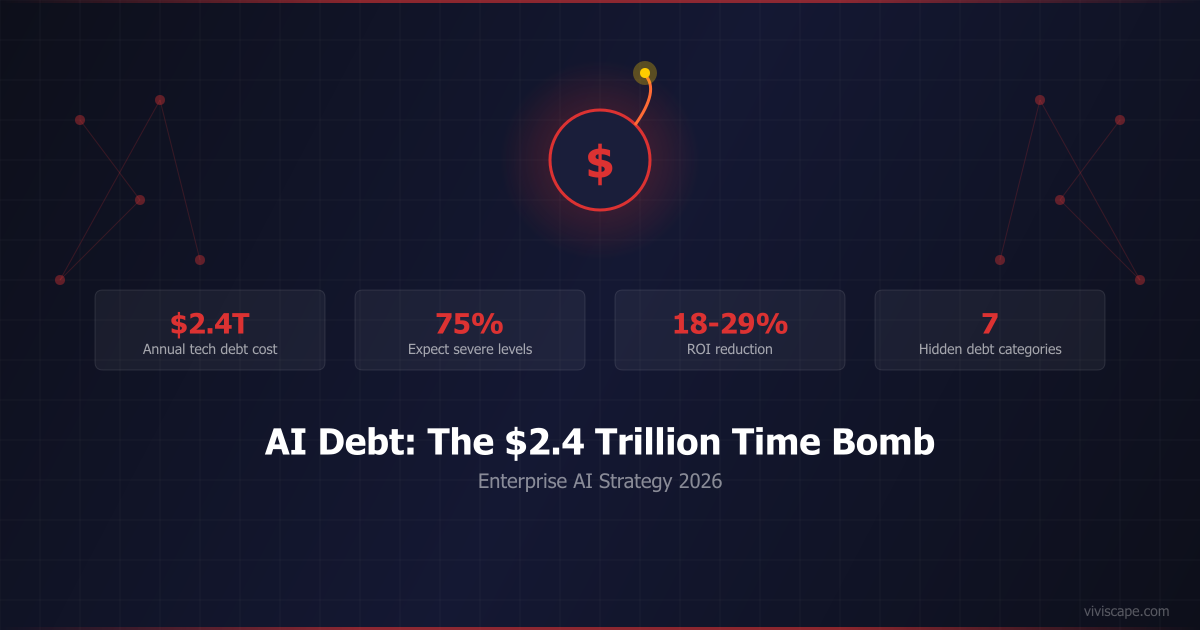
Technical debt costs the US economy $2.4 trillion annually. And AI is making it worse — not better.
Seventy-five percent of technology decision-makers anticipate that technical debt will reach "severe" levels by the end of 2026. Not because organizations are ignoring it. Because AI — the technology leaders are betting their futures on — is creating new categories of debt that accumulate faster, cost more to service, and are harder to detect than anything enterprises have dealt with before.
This is not the same tech debt your engineering team has been managing for years. This is AI debt — a distinct, more aggressive strain that stretches across infrastructure, data pipelines, model operations, and organizational processes. And for most enterprises, it is growing faster than the value their AI investments are generating.
The Two Dimensions of AI Debt
Accenture's Senior Managing Director Koenraad Schelfaut describes the problem with clarity that should alarm every CIO: "The first is your existing technical debt, which is preventing you from deploying AI at scale. The second is that while deploying AI, things that were not technical debt become technical debt."
This is the fundamental insight most AI strategies miss. AI does not just inherit your existing technical debt. It creates new debt. And it does so across two dimensions simultaneously.
Dimension One: AI Exposes Legacy Debt
Legacy systems, siloed data, outdated APIs, and outmoded architectures — these existed before AI. But they were manageable, or at least tolerable, when your systems operated at human speed and human scale. AI amplifies every weakness in your infrastructure. A data silo that caused minor reporting delays now prevents your AI models from accessing the training data they need. An outdated API that handled 100 requests per hour now buckles under 10,000 agent-initiated requests per minute.
The data debt problem is the most visible expression of this dimension. Up to 90 percent of enterprise data remains locked in unstructured silos. When AI needs clean, connected, real-time data to function — and your data architecture was designed for batch reporting — the debt compounds exponentially.
Dimension Two: AI Creates New Debt
This is the dimension that catches enterprises off guard. Every AI deployment creates infrastructure obligations that did not exist before the deployment:
Model maintenance debt. Models drift. Prompts that worked three months ago produce different outputs today. The monitoring, evaluation, and retraining infrastructure required to keep AI systems performing at baseline is a permanent operational cost that most initial deployments do not account for.
Pipeline debt. Data preparation and system maintenance consume the majority of effort in production ML systems — not model development. The pipelines that feed data to models, process outputs, and connect AI to business systems require ongoing engineering investment that scales with the number of models in production.
Integration debt. In organizations with 200 engineers across 30 teams, hundreds of integration points emerge — each configured individually, each requiring credential management, each vulnerable to API breaking changes. Token expiration, duplicate connections with inconsistent permissions, and configuration drift across teams create a maintenance burden that grows with every new agent or model deployed.
Organizational debt. AI changes workflows, decision processes, and role definitions. When the organization does not adapt its processes to match its AI capabilities, the gap between what AI can do and what the organization allows it to do becomes its own form of debt — a drag on both productivity and ROI.
The Numbers That Should Worry Your CFO
An IBM Institute for Business Value study of 1,300 senior AI decision-makers found that organizations ignoring technical debt saw AI project returns drop by 18 to 29 percent, with timelines expanding by up to 22 percent.
For a $20-billion enterprise putting 20 percent of IT spend into AI, technical debt can add more than $120 million per year in hidden implementation costs — leaving a three-year AI program delivering far less value than planned.
The enterprise AI spending crisis documented the broader ROI challenge: $665 billion in AI spending, 73 percent failing to deliver returns. AI debt is a primary driver of that failure. When 29 percent of your AI implementation budget is consumed by debt remediation, you are spending nearly a third of your investment just servicing the problems your investment created.
Organizations carrying heavy AI debt ship features 50 percent slower and spend 40 percent more on maintenance than their agile competitors. The productivity gains that justified the AI investment are being consumed by the maintenance burden the investment created. This is not a technology problem. It is a strategic trap.
Is your AI investment generating returns or generating debt?
Most enterprises cannot answer this question because they are not measuring the right things. Talk to ViviScape about building AI infrastructure that creates value without creating obligations you cannot service.
The Seven Hidden Infrastructure Debts of Agentic AI
As enterprises scale from AI experiments to production agent systems, seven categories of hidden infrastructure debt emerge. Most organizations do not recognize these as debt until they reach production scale — and by then, the remediation cost is an order of magnitude higher than building it right would have been.
1. Integration Debt
Every agent needs connections to CI/CD systems, cloud providers, data sources, and business tools. Without centralized credential management, teams create duplicate connections with inconsistent permissions. Token expiration, API breaking changes, and configuration drift create a maintenance burden that scales linearly with team count.
2. Context Debt
Agents making decisions without accurate runtime context produce inconsistent, unreliable outputs. Context debt manifests as stale data, fragmented decision traces, and agents that cannot learn from previous successes or failures. No one owns the context layer because no one planned for it.
3. Registry Debt
In an enterprise with 200 engineers, the agent count can reach 5 to 10 times the number of human employees — created daily across various platforms, with unclear ownership and no centralized catalog. Invisible agents performing duplicate work, unclear promotion paths from experiment to production, and no lifecycle management create an operational blind spot that compounds with every deployment.
4. Measurement Debt
Without tracking agent improvement over time, there is no data to justify continued investment to leadership. Missing ROI data, absent quality baselines, and no feedback loops mean the organization is investing in AI without knowing whether it is getting better, getting worse, or standing still.
5. Governance Debt
Unscoped credentials, unaudited actions, and unconstrained spending create risk that accumulates silently. The agent governance stack addressed the framework question. Governance debt is what happens when the framework is not implemented — or is implemented for the first ten agents but not the next hundred.
6. Orchestration Debt
Silent failures mid-workflow. Broken handoffs between agents. Unclear ownership of multi-step processes. The orchestration trap described the coordination challenge. Orchestration debt is the long-term cost of solving that challenge with duct tape instead of architecture.
7. Human-in-the-Loop Debt
Hard-coded approval checkpoints that cannot be modified from a single location. Oversight processes designed for ten agents that break at a hundred. The balance between agent autonomy and human oversight requires infrastructure — and when that infrastructure is hand-wired into individual agent configurations, every change requires touching every agent.
As one engineer put it: "You can build this infrastructure now, or you can build it after an agent leaks customer data or burns $300 in tokens overnight."
The Three Scaling Thresholds
AI debt does not accumulate linearly. It hits critical thresholds at three scaling phases:
Phase 1: Exploration. One team, a few agents, minimal integration. Debt is negligible because scope is limited. This is where most POCs live — and why POC results rarely translate to production value.
Phase 2: Team Adoption. Multiple teams deploying agents across different use cases. Integration debt and context debt become visible. Teams start duplicating infrastructure because there is no shared platform. AI FinOps becomes a concern as costs multiply across uncoordinated deployments.
Phase 3: Production Scale. Agents embedded in business-critical workflows. Governance, orchestration, and measurement debt become existential risks. The cost of remediation at this stage is five to ten times what proactive investment would have cost at Phase 2.
Most enterprises recognize AI debt when they hit Phase 3. By then, the debt is structural — woven into the architecture, the processes, and the organizational assumptions that the AI program was built on. Remediation at this stage is not a project. It is a transformation.
Managing AI Debt: A Strategic Framework
AI debt cannot be eliminated. Like financial debt, it can be managed — but only if the organization treats it as a first-class strategic concern rather than a technical afterthought.
Measure It
You cannot manage debt you do not measure. Establish metrics for each category of AI debt: integration complexity, context freshness, agent inventory accuracy, model performance drift, governance coverage, orchestration reliability, and oversight scalability. Track these alongside your AI ROI metrics so the true cost of your AI program is visible.
Budget for It
AI implementation budgets must include ongoing debt service costs. If 29 percent of your budget is going to remediation, that is not a surprise — it is a planning failure. Include infrastructure investment, monitoring tooling, and technical debt reduction as line items in every AI program budget, not as afterthoughts when the budget is already spent.
Architecture for It
Build the platform before you scale the agents. Centralized integration management, shared context infrastructure, agent registries, governance frameworks, and orchestration layers are not premature optimization. They are the foundation that determines whether your AI program creates sustainable value or unsustainable obligations.
Audit Continuously
AI debt compounds. A quarterly audit cadence is too slow for systems that change daily. Build automated monitoring into your AI infrastructure that surfaces debt accumulation in real time — the same way your agent security gap monitoring surfaces security risks.
The Bottom Line
AI is not reducing technical debt. It is creating a new, more complex form of it. The organizations that will extract lasting value from AI are not the ones with the most models in production or the most agents deployed. They are the ones that manage the debt their AI investments create as deliberately as they manage the investments themselves.
Seventy-five percent of enterprises expect technical debt to reach severe levels this year. The ones that planned for AI debt will navigate it. The rest will spend the next three years paying down obligations they did not know they were accumulating — at the cost of the innovation those AI investments were supposed to enable.
The question is not whether your organization has AI debt. It does. The question is whether you are managing it or whether it is managing you.
AI that creates more problems than it solves is not an investment — it is a liability.
ViviScape builds AI infrastructure with debt management built in from day one. Architecture that scales without accumulating obligations you cannot service.
Schedule a Free Consultation