
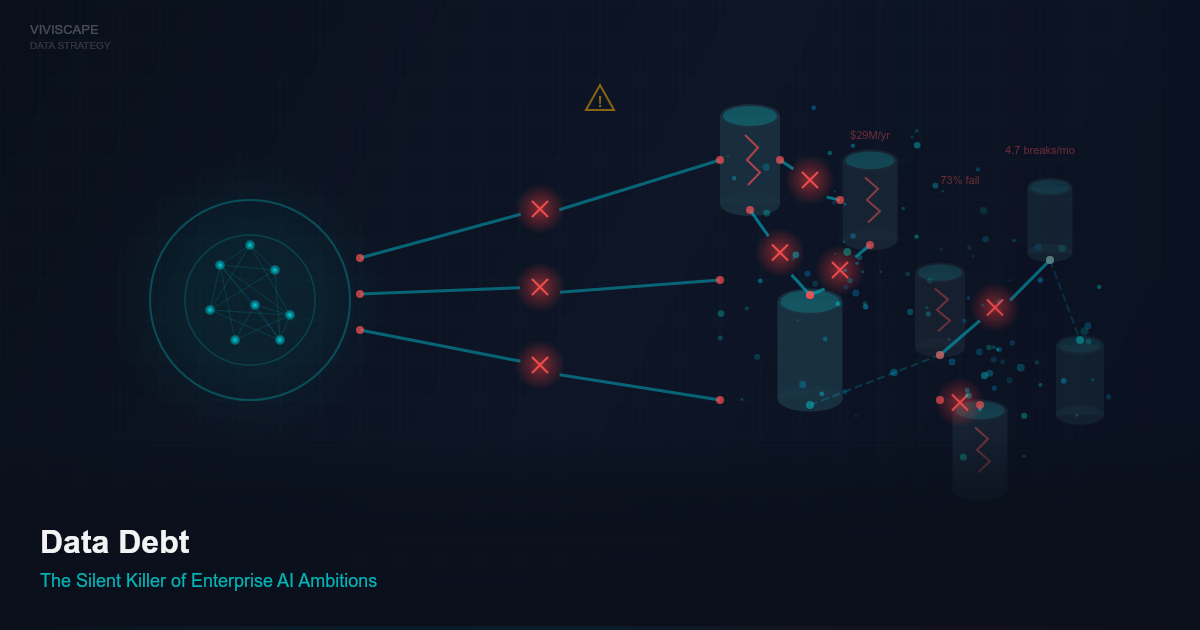
- The average enterprise spends $29.3M/year on data programs, yet 73% of organizations say their data initiatives fall short of ROI expectations. Gartner projects 60% of AI projects will be abandoned by 2026 due to lack of AI-ready data.
- Data pipelines break 4.7 times per month on average (8.3x in large enterprises), causing 60+ hours of monthly downtime at $49,600–$75,200 per hour. Stale data alone costs $36M–$54M per enterprise per year.
- Three silent killers of enterprise AI: decision lag from fragmented data, quiet failures that accumulate without triggering alerts, and compute waste (up to 60% of cloud spend on data janitorial work, not inference).
- You cannot answer the AI ROI question while your data infrastructure is this fragile. Fix the foundation before adding more AI on top.
Your AI models are not the problem.
Enterprises are deploying increasingly sophisticated large language models, building agentic workflows, and investing heavily in AI platforms. The technology has never been more capable. Yet 73% of organizations report their data initiatives falling short of ROI expectations — and only 27% exceed their targets.
The gap between AI ambition and AI results has a name: data debt.
Data debt is not a storage problem. It is the accumulated cost of fragmented architectures, broken pipelines, manual workarounds, and governance gaps that compound every time you try to scale AI on infrastructure that was never designed for it. And it is quietly killing enterprise AI ambitions at a rate most leadership teams do not fully understand.
The $29 Million Problem Nobody Talks About
The average enterprise spends $29.3 million per year on data programs, according to Fivetran's 2026 Enterprise Data Infrastructure Benchmark Report. Data integration alone consumes $4.2 million of that budget. Engineers spend $2.2 million annually maintaining pipelines — with 53% of engineering time devoted to maintenance rather than building anything new.
These are not innovation budgets. They are maintenance budgets disguised as data strategy.
And the maintenance is not even working. Data pipelines break an average of 4.7 times per month — rising to 8.3 times in large enterprises — causing 60.4 hours of monthly downtime at a cost of $49,600 per hour. In large organizations, that figure reaches $75,200 per hour.
When pipelines break, AI stops. Models trained on stale data produce stale decisions. Dashboards go dark. Automated workflows stall. The estimated annual business impact from stale data alone ranges from $36 million to $54 million per enterprise.
The AI ROI reckoning boards are demanding cannot be answered when the data infrastructure underneath the AI is this fragile.
Model-Rich, Data-Poor
Here is the paradox most enterprises are living: they have access to the most powerful AI models ever built, and they cannot use them effectively because their data is not ready.
Eighty percent of enterprise AI initiatives struggle to scale due to fragmented data silos. Gartner projects that 60% of AI projects will be abandoned by 2026 specifically because organizations lack AI-ready data infrastructure. The models are not failing. The foundation underneath them is.
This is what researchers at Hexalytics call operating "model-rich, data-poor" — deploying advanced LLMs and agentic systems on top of data architectures that cannot provide the real-time, cross-system visibility those systems require. It is like installing a Formula 1 engine in a car with flat tires.
Poor data quality and siloed architectures cost organizations between $12.9 million and $15 million annually. A quarter of enterprises lose over $5 million per year from data integrity issues alone.
The Three Silent Killers
Data debt does not announce itself with a system crash. It operates through three mechanisms that are easy to miss until the damage is done:
1. Decision Lag
When data is fragmented across systems, AI models make decisions based on partial information. A demand forecasting model that cannot see real-time inventory data across all warehouses produces forecasts that are directionally correct but operationally useless. The decisions arrive, but they arrive too late or too incomplete to act on.
This connects directly to the resilience gap we identified earlier: systems optimized for efficiency on clean data become brittle the moment data quality degrades — which, in most enterprises, is constantly.
2. Quiet Failures
Data debt creates failures that do not trigger alerts. A pipeline that delivers data 30 minutes late does not crash — it just makes every downstream AI model slightly wrong. A customer record that exists in three systems with three different formats does not produce an error — it produces a recommendation engine that contradicts itself.
These quiet failures accumulate. Nobody notices one slightly wrong prediction. But thousands of slightly wrong predictions per day add up to significant revenue leakage, customer dissatisfaction, and operational drift — all invisible to traditional monitoring.
3. Compute Waste
Unstructured, poorly governed data inflates cloud costs dramatically. When AI systems must clean, transform, and reconcile data before they can use it, the compute overhead can reach 60% of total cloud spending. Organizations are paying for AI inference when they are actually paying for data janitorial work.
Is your data infrastructure ready for the AI workloads you are planning?
Most enterprises discover the answer too late.
From Passive Storage to Active Intelligence
The solution to data debt is not buying more storage or adding another data lake. It is fundamentally rethinking what enterprise data infrastructure is for.
As Abhas Ricky, Chief Strategy Officer at Cloudera, frames it: data must shift "from passive storage into an active intelligence layer that can contextualize information, enforce policy, audit decisions, and preserve traceability."
This shift requires three architectural changes:
Unified governance across hybrid infrastructure. Most enterprises operate across cloud, on-premise, and edge environments. Sergio Gago, CTO at Cloudera, notes that "hybrid infrastructure is no longer a compromise between legacy and cloud systems. It has instead become the architectural backbone." Data governance must work seamlessly across all environments — not just the ones that are easiest to govern.
Agent-ready data access. As organizations deploy AI agents at scale, their data architecture must support agent-specific needs: clear data access controls, security permissions, observability into agent actions, and agent registries for workflow versioning. The shadow agent governance crisis becomes exponentially worse when ungoverned agents have ungoverned data access.
Managed integration over DIY pipelines. Fivetran's research shows that organizations using fully managed ELT (Extract, Load, Transform) infrastructure are nearly twice as likely to exceed ROI targets — 45% versus 27% for legacy or DIY setups. The engineering hours saved on pipeline maintenance convert directly into innovation capacity. The organizations still building and maintaining their own data pipelines are paying a premium in both money and opportunity cost.
The Data Debt Audit: Five Questions
Before your next AI investment, ask whether your data infrastructure can answer these:
- What percentage of engineering time goes to pipeline maintenance versus new development? If it is above 40%, your data debt is consuming your innovation budget.
- How many times per month do your data pipelines break? Industry average is 4.7. If you are above that, your AI systems are running on unreliable foundations.
- Can your data infrastructure support real-time, cross-system queries? If AI models must wait for batch processing to see current data, your decisions are always based on yesterday's reality.
- Do you have a unified governance framework across all data environments? If governance is fragmented by system, so is your AI's understanding of the business.
- What is your stale data exposure? If you do not know, the annual impact is likely in the tens of millions.
The Bottom Line
Enterprise AI is only as good as the data underneath it. And for most organizations, that data is fragmented, stale, poorly governed, and maintained by engineers who spend more than half their time keeping the lights on.
Data debt is not a technical inconvenience. It is the single largest barrier between AI investment and AI ROI. Every dollar spent on AI models, every agent deployed, every automation built — all of it depends on data infrastructure that most enterprises have systematically underinvested in.
The organizations that solve data debt first will be the ones that scale AI successfully. The rest will keep wondering why their models are so capable and their results so disappointing.
ViviScape helps enterprises eliminate data debt and build AI-ready infrastructure that scales. If your data architecture is holding your AI strategy back, let's talk.
Ready to build an AI-ready data foundation?
ViviScape eliminates data debt and builds the infrastructure your AI actually needs — so your models stop running on yesterday's reality.
Book a Free Consultation