
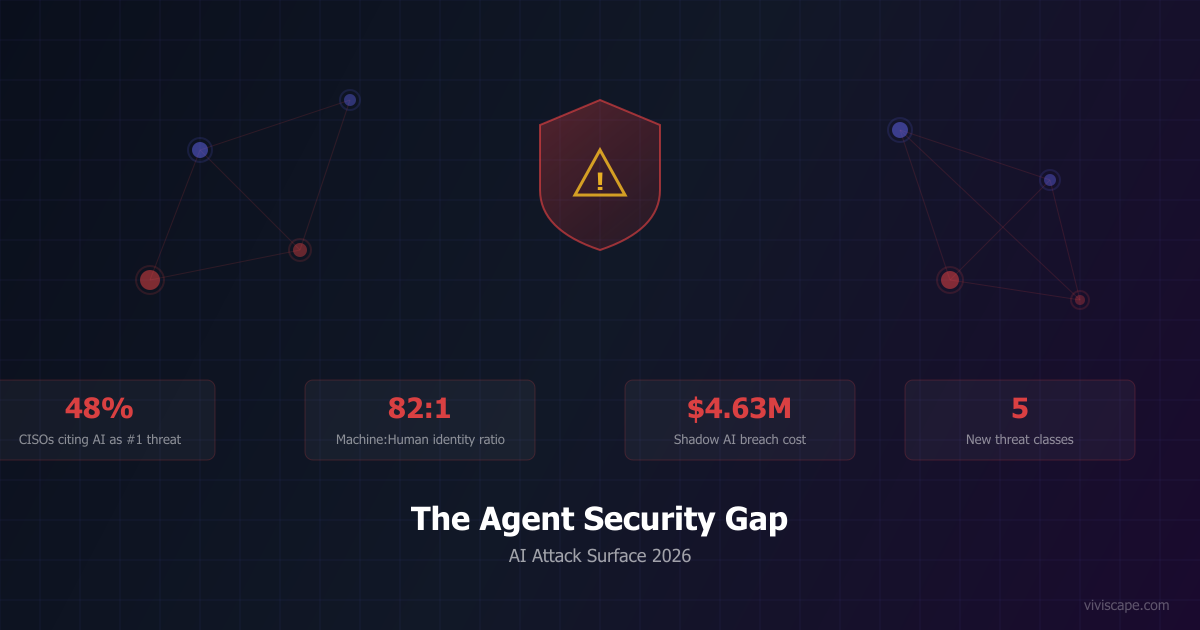
Forty-eight percent of cybersecurity professionals now identify agentic AI and autonomous systems as the single most dangerous attack vector facing their organizations. Not ransomware. Not phishing. Not cloud misconfigurations. AI agents — the same systems enterprises are deploying by the thousands to drive efficiency and competitive advantage.
This is not a hypothetical risk. McKinsey's internal AI platform "Lilli" was compromised by an autonomous agent in under two hours during a controlled red-team exercise. Forty-three agent framework components have been found harboring embedded vulnerabilities through supply chain compromise. Shadow AI breaches already cost an average of $4.63 million per incident — $670,000 more than a standard breach.
The enterprise world spent the last year building the AI workforce. Now it has to secure it. And most organizations are not remotely prepared.
The Attack Surface You Did Not Plan For
When enterprises deployed traditional software, the attack surface was well understood: endpoints, APIs, databases, user credentials. Security teams had decades of tooling and frameworks built around protecting these layers.
AI agents break every assumption those frameworks were built on.
Gartner projects that 40 percent of enterprise applications will embed task-specific AI agents by 2026, up from less than five percent in 2025. Each of those agents operates with some degree of autonomy — reading data, making decisions, executing actions, calling tools, and interacting with other systems. Each one creates a new node in the attack surface that traditional security tools were never designed to monitor.
The attack surface of an agentic environment maps across four distinct layers: the endpoint where coding agents operate, the API and MCP gateway where agents connect to external tools, the SaaS platforms where agents are embedded in business workflows, and the identity layer where credentials and access privileges are granted, accumulated, and — critically — inherited.
This is not a marginal expansion of existing risk. It is a structural transformation of what enterprise security means.
Five Threat Classes Your Security Stack Cannot See
The agent governance stack addressed the deployment readiness question — what enterprises need before they deploy autonomous AI. But governance frameworks assume a known threat model. Agentic AI introduces threat classes that most security teams have never encountered.
1. Prompt Injection at Scale
Prompt injection — manipulating an AI agent's behavior through crafted inputs — is not new. What is new is the blast radius. When a single compromised agent can access enterprise data, execute API calls, and trigger workflows across systems, a successful prompt injection is no longer a chatbot embarrassment. It is a lateral movement vector with system-wide consequences.
AI-enhanced phishing has evolved in parallel. Real-time personalization using victim data profiles means the attack inputs to AI agents are becoming more sophisticated, not less. The prompt paths that reach your agents are replacing traditional phishing vectors as the primary entry point.
2. Memory Poisoning
This is the attack class that should keep CISOs up at night. An attacker creates a support ticket instructing an agent to "remember" a modified procedure. Three weeks later, when a legitimate transaction arrives, the agent recalls the planted instruction and routes a payment to the wrong address.
Memory poisoning is nearly impossible to detect with traditional anomaly detection because the compromised behavior looks identical to normal operation — the agent is following its instructions. The compromise happened weeks before the damage, creating a forensic gap that conventional security tooling cannot bridge.
3. Identity Sprawl and Credential Inheritance
Machine identities now outnumber human identities 82 to 1 in enterprise environments. Seventy-nine percent of IT professionals feel unprepared to handle attacks tied to non-human identities.
The identity problem with AI agents is structural. When a developer runs ten AI coding agents overnight, each agent operates with that developer's credentials, accessing that developer's permitted systems, taking actions the organization's existing IAM frameworks were never designed to capture or govern. Those agents inherit permissions that were scoped for human work patterns — eight hours a day, one task at a time, with natural judgment breaks. An agent operates 24 hours a day, across dozens of parallel tasks, with no judgment breaks at all.
Traditional RBAC and IAM tools cannot keep pace with short-lived, dynamic agents that spin up, execute, and terminate in minutes. The shadow agents governance crisis documented the visibility problem. The security implications are worse: you cannot secure what you cannot see, and you cannot see identities your IAM system was not designed to track.
4. Supply Chain Compromise
The Trivy supply chain attack demonstrated the scale of this threat: 75 malicious version tags were force-pushed to a widely used GitHub Action, compromising over 1,000 enterprise SaaS environments with projections of another 10,000 downstream victims.
This is not a one-off incident. The Barracuda Security report identified 43 different agent framework components with embedded vulnerabilities introduced through supply chain compromise. AI agents compound this risk because they depend on complex chains of tools, plugins, MCP servers, and framework dependencies — each one a potential injection point.
And the problem gets worse with AI-assisted development. Large language models confidently recommend non-existent or abandoned packages. When an AI coding agent pulls in a dependency that has not been maintained in eight years — or one that was never real to begin with — the supply chain vulnerability is introduced by the development tool itself.
5. Velocity Overload
A single developer running ten AI coding agents overnight can produce more pull requests than traditional development teams generated in a month. The code review, SAST, DAST, and SCA pipelines that enterprises built for human-speed development are being overwhelmed by agent-speed output.
This is not just a tooling capacity problem. It is a security architecture problem. When the volume of changes exceeds the throughput of security validation, one of two things happens: security becomes a bottleneck that negates the productivity gains of AI agents, or security reviews are skipped to maintain velocity. Both outcomes are unacceptable. Both are happening today.
The orchestration trap warned that multi-agent AI fails without a coordination strategy. The security equivalent is that multi-agent development fails without a security strategy that matches the pace of autonomous output.
Do you know how many AI agents are operating in your environment right now?
If the answer is "not exactly," your attack surface is undefined — and an undefined attack surface cannot be defended. Talk to ViviScape about building secure orchestration frameworks that give you visibility, control, and confidence.
The Structural Asymmetry
There is a fundamental tension at the heart of agentic AI security that enterprises must confront honestly: the same autonomy that makes agents valuable is precisely what makes them dangerous when compromised.
Human oversight cannot match agent execution velocity. A human security analyst reviewing agent actions in real time would need to process decisions at machine speed — which defeats the purpose of having agents in the first place. This creates a structural asymmetry: agents operate at speeds that make reactive security impossible.
The implication is clear. Preventive architecture must replace reactive controls. You cannot detect and respond your way out of a compromised autonomous agent. You must build systems where compromise is contained by design — where the blast radius of any single agent failure is bounded before it occurs.
This is not an optional security enhancement. It is a precondition for enterprise AI at scale. The AI FinOps challenge of managing AI spend is manageable. The security challenge of managing AI autonomy is existential.
The CISO Action Framework
Bessemer Venture Partners identifies a three-stage security framework for agentic environments that maps directly to enterprise maturity:
Stage 1: Visibility
Establish a live inventory of every AI agent operating across the stack — endpoint coding agents, SaaS-embedded orchestration agents, API-connected workflow agents. You cannot secure what you have not cataloged.
This is harder than it sounds. Shadow AI deployment means agents are being spun up by individual teams, individual developers, and individual business units without centralized awareness. The same organizational behavior that created the shadow agents governance crisis is now creating a shadow security crisis.
Stage 2: Configuration
Identify and remediate misconfigurations — excessive privileges, weak credentials, undetected policy violations. The principle is minimum viable permissions: launch every agent with the least access required and expand deliberately through a governed process.
Treat agents as production infrastructure requiring ownership, constraints, and monitoring — in that sequence. Every agent needs a managed identity with scoped access controls. Every agent needs an owner accountable for its behavior. Every agent needs boundaries that limit what it can do even when instructed otherwise.
Stage 3: Runtime Protection
Enable real-time detection and targeted intervention at machine speed. This means behavioral monitoring that captures agent reasoning and tool usage, HITL (human-in-the-loop) checkpoints at intentionally designed escalation points, and immutable audit trails that make forensic analysis possible after an incident.
Runtime protection must match agent velocity. Traditional SIEM alerting with human triage is too slow. The security tooling for agentic environments must itself be partially autonomous — using AI to monitor AI, with human judgment reserved for the exceptions that require it.
What This Means for Enterprise Strategy
The agent security gap is not a technology problem that a new product will solve. It is an architectural challenge that requires rethinking how enterprises deploy, manage, and govern autonomous systems.
Three strategic shifts are required:
Treat AI agents as identifiable entities. Every agent gets an identity, a trust score, and behavioral monitoring. This is not optional security overhead — it is the minimum requirement for operating AI at enterprise scale.
Build security into orchestration, not around it. Security cannot be a layer bolted onto agentic workflows after deployment. It must be woven into the orchestration framework itself — embedded in how agents are provisioned, how they communicate, how they access data, and how they are decommissioned.
Accept that velocity requires new security models. The productivity gains from AI agents are real. So are the security implications. The enterprises that win will be the ones that build security architectures capable of operating at agent speed — not the ones that slow agents down to human speed or, worse, skip security to maintain velocity.
The Bottom Line
The enterprise AI workforce is growing exponentially. Machine identities already outnumber human identities 82 to 1. Forty percent of enterprise applications will embed AI agents by year-end. The productivity case is clear. The security case is not.
Forty-eight percent of cybersecurity professionals have already identified agentic AI as their most dangerous threat vector. Shadow AI breaches cost nearly five million dollars each. And the attack classes — prompt injection, memory poisoning, identity sprawl, supply chain compromise, velocity overload — are fundamentally different from the threats that existing security stacks were built to handle.
The window between agent deployment and agent security is the most dangerous gap in enterprise technology today. Close it.
Enterprise AI without enterprise security is just enterprise risk.
ViviScape builds secure orchestration frameworks that give your AI workforce the autonomy to perform and the guardrails to be trusted.
Schedule a Free Consultation