
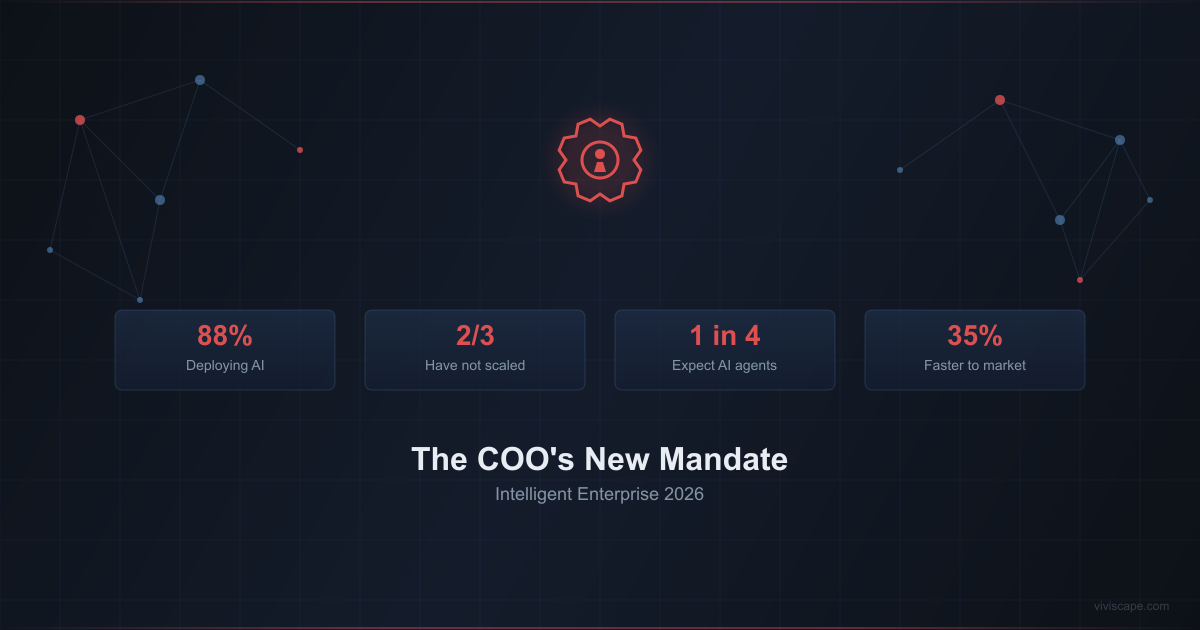
Eighty-eight percent of organizations told McKinsey they are deploying AI. Nearly two-thirds have not yet begun scaling it across the enterprise. That gap — between deployment and scale — is not a technology problem. It is an operations problem. And it is redefining the most underestimated role in the C-suite.
The chief operating officer has historically been the guardian of execution: ensuring processes run, supply chains deliver, and the operational machine functions predictably. That mandate is being replaced. In 2026, the COO is becoming the architect of the intelligent enterprise — the executive responsible for integrating AI into the operating model itself, not just bolting it onto existing workflows.
This is the most significant expansion of the COO role since the digital transformation era. And most organizations are not structured for it.
Why the COO, Not the CIO
The instinctive organizational answer to "who owns AI at scale?" has been the CIO or the newly minted Chief AI Officer. Over 40 percent of Fortune 500 companies now have a CAIO role. But there is a growing recognition that the scaling challenge is not about technology selection or model performance. It is about operational redesign.
McKinsey's research identifies COOs as the best end-to-end thinkers in the enterprise — executives who understand across procurement, product development, planning, distribution, logistics, and manufacturing while also understanding sales and marketing. The decision boundary between the CIO and COO is getting blurrier, and that is not because the CIO's role is expanding. It is because the operations function is absorbing technology as a core operating element, not a support service.
The CIO can deploy AI. Only the COO can redesign operations to make AI productive.
One in four leaders told McKinsey they expect AI agents to act as autonomous team members in the near term. Those agents will not live in the IT department. They will live in procurement, logistics, manufacturing, planning, customer operations, and supply chain — the COO's domain. The executive who understands how work actually gets done is the executive best positioned to redesign how work gets done with AI.
Three New Domains of the AI-Era COO
The traditional COO managed processes. The AI-era COO manages three interconnected domains that did not exist a decade ago.
1. AI-Powered Process Architect
The first domain is redesigning core business processes to embed intelligence — not as an overlay, but as a structural element of how the process functions.
This is where most enterprises fail. They automate existing workflows instead of redesigning them. They add an AI layer to a process designed for human speed and human judgment, then wonder why the results are incremental rather than transformative. The orchestration trap documented this failure mode in multi-agent AI: coordination strategy matters more than individual agent capability.
The same principle applies to operations. A procurement process designed around manual vendor evaluation does not transform by adding an AI scoring layer. It transforms when the process is redesigned to start with AI-generated market intelligence, use automated qualification, and reserve human judgment for the strategic decisions that require it.
Process architecture is not automation. It is rethinking which decisions need human involvement, which can be delegated to agents, and where the handoff points create value instead of bottlenecks.
2. Orchestrator of the Human-Machine Workforce
The second domain is workforce orchestration — strategically allocating tasks between human capability and autonomous AI agents. This is where the operational rubber meets the AI road.
The rise of the AI workforce documented the deployment trend: enterprises are standing up thousands of AI agents across functions. But deploying agents is not the same as orchestrating them. Without deliberate workforce design, organizations end up with human employees and AI agents operating in parallel rather than in coordination — duplicating effort, creating confusion about accountability, and missing the productivity gains that integration promises.
Effective human-machine orchestration requires the COO to answer questions that operations teams have never faced:
- Which decisions require human judgment at every instance, and which only require human oversight at exception points?
- How are agents supervised when they operate faster than any human can review?
- What happens when an agent's output contradicts a human team member's assessment?
- How do you measure the productivity of a workforce that is half-human, half-silicon?
These are not technology questions. They are operational design questions. And they fall squarely in the COO's domain.
3. Champion of Data Governance
The third domain is often the least glamorous and most consequential: owning the data infrastructure that makes AI operational.
Every AI system is only as good as the data it operates on. The COO who is redesigning processes and orchestrating human-machine workforces must also ensure that the data flowing through those processes is clean, connected, accessible, and governed. Without this foundation, the other two domains fail.
The data debt problem is primarily an operations problem, not a technology problem. Data sits in silos because operational teams built independent systems over decades. The COO who understands those systems end-to-end is uniquely positioned to create the data architecture that AI requires — because they understand where the data comes from, what it means, and how it flows through the business.
Is your COO equipped to lead your AI transformation?
The gap between AI deployment and AI scale is an operations gap. Talk to ViviScape about building the intelligent operations infrastructure that bridges it.
From Reactive to Predictive: The Operational Paradigm Shift
The traditional COO operated in reactive mode: when a supply chain disrupted, they managed the response. When demand shifted, they adjusted capacity. When quality issues emerged, they implemented fixes. The cycle was detect, respond, recover.
AI inverts this cycle. Machine learning forecasts equipment failures and supply chain bottlenecks weeks in advance. Predictive analytics anticipate demand shifts before they materialize. Quality control algorithms detect drift before it becomes a defect.
Coca-Cola Europacific Partners uses AI-driven predictive analytics for demand forecasting, inventory management, and distribution optimization — not as experimental tools, but as core operational infrastructure. Amazon's "anticipatory shipping" pre-positions products near predicted buyers before orders are placed. These are not technology showcases. They are operational redesigns that happen to use AI as the enabling infrastructure.
The shift from reactive to predictive operations is not incremental. It changes the fundamental operating rhythm of the enterprise. And it requires a COO who understands both the technology's capabilities and the operational context in which those capabilities create value.
The Governance Imperative
Scaling AI across operations without governance is scaling risk. The COO's expanded mandate includes ensuring that operational AI systems are auditable, controllable, and bounded.
Organizations implementing centralized orchestration layers experience 35 percent faster time-to-market for new AI capabilities compared to fragmented point solutions. But the governance dimension matters as much as the speed: without proper checkpoints, unmanaged AI systems can generate catastrophic costs. A single self-correction loop without spending limits can produce $10,000 or more in API charges within minutes.
The agent governance stack defined the framework. The AI FinOps challenge defined the cost dimension. The COO is the executive who must operationalize both — embedding governance into workflows, not layering it on top as an afterthought.
The agentic maturity model provides a useful framework for COOs navigating this progression:
- Level 1: Chatbots and basic retrieval — low risk, low value
- Level 2: Single-step tool operations — API permission sprawl emerges
- Level 3: Multi-agent workflows with central control — context management becomes critical
- Level 4: Self-correcting autonomous agents — recursive cost escalation and governance become existential concerns
Most enterprises are between Levels 2 and 3. The COO's role is to build the operational infrastructure that enables progression to Level 4 without the governance, cost, and reliability risks that come with ungoverned scale.
The Cross-Functional Nerve Center
IMD research recommends that COOs build cross-functional "nerve centers" that combine operations experts, data scientists, and IT professionals into integrated teams. This is not a new organizational structure — it is a new operating model.
The nerve center model acknowledges that AI-driven operations cannot be managed by any single function. Operations provides process expertise and business context. Data science provides technical capability and model management. IT provides infrastructure and integration. The COO provides the strategic authority and end-to-end perspective to unify them.
This is the operational equivalent of what the AI debt crisis warned about: without integrated management, AI investments create fragmented infrastructure, disconnected workflows, and compounding technical obligations. The nerve center model addresses the organizational dimension of that risk.
The Talent Question
The COO's transformation creates a talent challenge that extends beyond hiring data scientists. The entire operations function needs to evolve.
COOs must transition from purely physical process management to data-centric decision-making — mastering technological acumen while championing organizational change leadership and continuous learning cultures. This does not mean every operations manager needs a computer science degree. It means every operations manager needs to understand what AI can and cannot do, how to supervise AI-driven processes, and how to design workflows that leverage both human and machine intelligence.
The reskilling requirement is not optional. Operations teams that cannot work alongside AI agents will become bottlenecks in the intelligent enterprise. And the COO who fails to invest in workforce development will find that the AI systems they deploy are limited not by technology, but by the organization's ability to use them.
The Bottom Line
The COO is the most important AI executive in the enterprise — not because they understand AI best, but because they understand operations best. And in 2026, AI at scale is an operations challenge.
Eighty-eight percent of organizations are deploying AI. Two-thirds have not scaled it. The gap between deployment and scale is not a technology gap. It is an operations gap that requires redesigned processes, orchestrated human-machine workforces, governed data infrastructure, and an executive who can see the entire picture.
The COO who treats AI as a tool to optimize existing operations will deliver incremental improvements. The COO who redesigns operations around AI's capabilities will build the intelligent enterprise.
The former is a technology upgrade. The latter is a competitive transformation.
The intelligent enterprise does not happen by deploying more AI. It happens by redesigning operations to make AI productive.
ViviScape builds the orchestration infrastructure that COOs need to bridge the gap between AI deployment and AI at scale.
Book a Free Consultation