
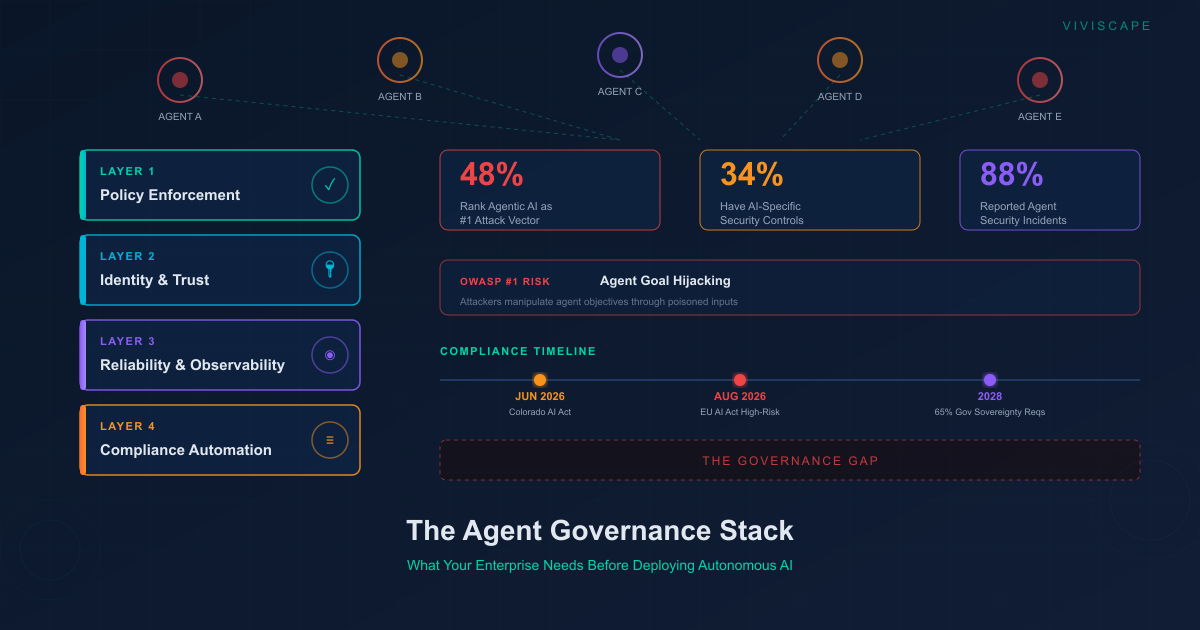
- 48% of cybersecurity professionals rank agentic AI as the #1 attack vector of 2026 — ahead of deepfakes, ransomware, and supply chain. Only 34% of enterprises have AI-specific security controls in place.
- The OWASP Top 10 for Agentic Applications identifies Agent Goal Hijacking as the top risk: attackers manipulate an agent's objectives through poisoned inputs and redirect it to cause harm using its own legitimate tools.
- The governance stack has four layers: Policy Enforcement (default deny, explicit allow at sub-ms speed), Identity and Trust (agents as first-class identities, not shared API keys), Reliability and Observability (circuit breakers, error budgets, full audit trails), and Compliance Automation.
- Compliance clock: EU AI Act high-risk obligations take effect August 2026; Colorado AI Act becomes enforceable June 2026. Enterprises without comprehensive agent audit trails face regulatory exposure on a timeline measured in months.
Forty-eight percent of cybersecurity professionals now rank agentic AI as the number-one attack vector heading into 2026 — ahead of deepfakes, ransomware, and supply chain compromise. Yet only 34 percent of enterprises have AI-specific security controls in place.
That gap is not an oversight. It is a structural failure. Enterprises have spent the last two years building and deploying AI agents at breakneck speed while governance tooling lagged a full generation behind. The result: shadow agents operating without oversight, security incidents climbing, and a compliance deadline approaching that most organizations are not ready for.
The good news is that 2026 is the year the governance stack caught up to the agent stack. The bad news is that most enterprises have not started building it.
The OWASP Wake-Up Call
In December 2025, OWASP released the Top 10 for Agentic Applications — a peer-reviewed framework developed by more than 100 security researchers that catalogs the most critical risks facing autonomous AI systems. It is the first authoritative attempt to formalize what can go wrong when AI systems do not just generate text but call APIs, execute code, move files, and make decisions with minimal human oversight.
The top risk is Agent Goal Hijacking: attackers manipulate an agent's objectives through poisoned inputs — emails, documents, web content — and redirect the agent to perform harmful actions using its legitimate tools and access. Because agents cannot reliably distinguish instructions from data, a single malicious input can compromise an entire workflow.
Three of the top four risks revolve around identities, tools, and delegated trust boundaries. This is critical because it means the attack surface for agentic AI is fundamentally different from traditional LLM security. Prompt injection is a content problem. Agent hijacking is an infrastructure problem. And infrastructure problems require infrastructure solutions.
The OWASP framework makes one thing clear: the security model that worked for chatbots does not work for agents. Enterprises that treat agent governance as an extension of their existing AI safety programs are building on the wrong foundation.
What the Governance Stack Actually Looks Like
Until recently, "governing AI agents" meant writing policies that humans would manually enforce. That approach fails at scale — you cannot manually review every action taken by hundreds or thousands of autonomous agents operating across your enterprise.
What enterprises need is a runtime governance layer: infrastructure that intercepts, evaluates, and controls agent actions before they execute, at machine speed. Microsoft's release of the Agent Governance Toolkit on April 2, 2026 — an open-source, seven-package system — provides the first comprehensive reference architecture for what this stack looks like in production.
The architecture breaks down into four layers that every enterprise deploying autonomous agents needs to address:
Layer 1: Policy Enforcement
Every agent action must pass through a policy engine before execution. Not after. Not during review. Before. The enforcement layer evaluates each action against organizational rules, regulatory requirements, and safety constraints in sub-millisecond time.
This is where most enterprises fail first. They deploy agents with broad permissions and plan to add constraints later. By the time "later" arrives, the agents have already created dependencies, accumulated access, and established patterns that are difficult to roll back.
The principle is simple: default deny, explicit allow. Every tool call, every API request, every data access should require policy approval. The challenge is making this enforcement fast enough that it does not degrade agent performance — and flexible enough that it does not require rewriting agent code every time a policy changes.
Layer 2: Identity and Trust
The shadow agents crisis revealed that 45.6 percent of organizations rely on shared API keys for agent-to-agent authentication, and only 21.9 percent treat agents as independent identity-bearing entities. This is the equivalent of giving every employee the same badge and hoping nothing goes wrong.
Agents need their own cryptographic identities — not borrowed human credentials, not shared service accounts. Each agent should have a verifiable identity that tracks across its entire lifecycle, from deployment through every action it takes to eventual decommission.
Beyond identity, agents need dynamic trust scoring. An agent that has operated reliably for months within defined boundaries earns higher trust than a newly deployed agent with broad permissions. Trust should be earned incrementally and revoked instantly when anomalies are detected. The concept of execution rings — inspired by CPU privilege levels — provides a practical model: agents operate at the minimum privilege level required for their current task, with elevation requiring explicit authorization.
Layer 3: Reliability and Observability
Production AI agents need the same reliability engineering that production software systems demand — and then some. Circuit breakers prevent cascading failures when one agent's error triggers chain reactions across connected systems. Error budgets establish acceptable failure rates and automatically throttle agent autonomy when thresholds are exceeded.
Is your enterprise deploying AI agents without a governance stack?
You are not alone — but the compliance clock is ticking. The EU AI Act high-risk obligations take effect in August 2026.
Observability is not optional. Every agent decision, every tool invocation, every data access must be logged, traceable, and auditable. This is not just good engineering practice — it is a regulatory requirement. The AI compliance countdown is real: the EU AI Act's high-risk obligations take effect in August 2026, and the Colorado AI Act becomes enforceable in June 2026. Organizations without comprehensive agent audit trails will face regulatory exposure on a timeline measured in months, not years.
Layer 4: Compliance Automation
Manual compliance verification does not scale. Enterprises deploying dozens or hundreds of agents need automated governance verification that continuously maps agent behavior against regulatory requirements — EU AI Act, HIPAA, SOC2, and the emerging patchwork of AI-specific regulations.
This layer should generate compliance evidence automatically, not through periodic audits but through continuous monitoring. When a regulator asks how your agents handle personal data, the answer should come from your governance infrastructure, not from a frantic investigation.
The Confidence-Incident Paradox
The most dangerous finding from the 2026 security landscape is not the volume of incidents — it is the confidence gap. Eighty-two percent of executives feel confident that existing policies protect against unauthorized agent actions. Meanwhile, 88 percent of organizations reported confirmed or suspected AI agent security incidents.
This paradox exists because executives are evaluating agent risk through the lens of traditional software security. They see access controls, encryption, and network policies and assume their agents are governed. They are not. Agents introduce a new category of risk — autonomous decision-making with real-world consequences — that existing security controls were never designed to address.
The OWASP Agentic Top 10 is not an incremental update to the LLM security framework. It is a fundamentally different threat model. And it requires a fundamentally different response.
The Build-Versus-Buy Decision
Open-source governance tooling like Microsoft's Agent Governance Toolkit provides a strong foundation — but a foundation is not a finished building. The toolkit covers the horizontal capabilities that every enterprise needs: policy enforcement, identity management, observability, compliance mapping.
What it does not cover is the vertical integration that makes governance actually work in your specific environment: your data classification scheme, your regulatory exposure profile, your agent topology, your escalation workflows, your existing identity infrastructure.
This is where the orchestration trap applies directly to governance. Off-the-shelf governance tools solve generic problems. Your enterprise has specific agents, specific data flows, specific compliance obligations, and specific risk tolerances. The governance stack that protects your organization needs to reflect those specifics.
The enterprises that will navigate the agentic era successfully are those that build governance as a first-class engineering discipline — not a checkbox exercise bolted on after deployment.
The Compliance Clock
The regulatory timeline is no longer theoretical:
- June 2026: Colorado AI Act becomes enforceable
- August 2026: EU AI Act high-risk AI obligations take effect
- 2028: Gartner predicts 65 percent of governments will have introduced technological sovereignty requirements
Organizations deploying autonomous agents without governance infrastructure are not just accepting security risk — they are accepting regulatory risk on a defined timeline. And unlike security incidents, which can sometimes be contained, regulatory non-compliance has consequences that compound.
The question for every enterprise leader is straightforward: do you have a governance stack that can demonstrate — to auditors, regulators, and your board — exactly what your agents are doing, why they are doing it, and what controls prevent them from doing what they should not?
If the answer is no, the time to build it is before the compliance deadline, not after.
The Bottom Line
The agent governance gap is closing — but it is closing through tooling and architecture, not through policy documents and committee meetings. The enterprises that will lead in autonomous AI are not the ones deploying the most agents. They are the ones deploying agents they can actually govern.
The governance stack is not a tax on innovation. It is the infrastructure that makes innovation sustainable. Without it, every agent you deploy is a liability waiting to be discovered — by an attacker, a regulator, or your own audit team.
Build the governance stack first. Then deploy the agents. The order matters.
ViviScape builds custom governance infrastructure for enterprises deploying autonomous AI agents — from policy engines to compliance automation. If your agent deployments are outpacing your governance capabilities, let's fix that before the deadline.
Ready to govern your AI agents?
ViviScape builds custom governance infrastructure for enterprises deploying autonomous AI — from policy engines to compliance automation that scales with your agent deployments.
Book a Free Consultation