
Interest in multi-agent AI systems surged 1,445% between Q1 2024 and Q2 2025. By the end of 2026, 40% of enterprise applications will feature task-specific AI agents — up from less than 5% in 2025.
And 40% of those agent projects will fail by 2027.
That is not a contradiction. It is a pattern. The same technology generating the most enterprise excitement is also generating the most enterprise failures — and the reason is not the agents themselves. It is the absence of what sits between them.
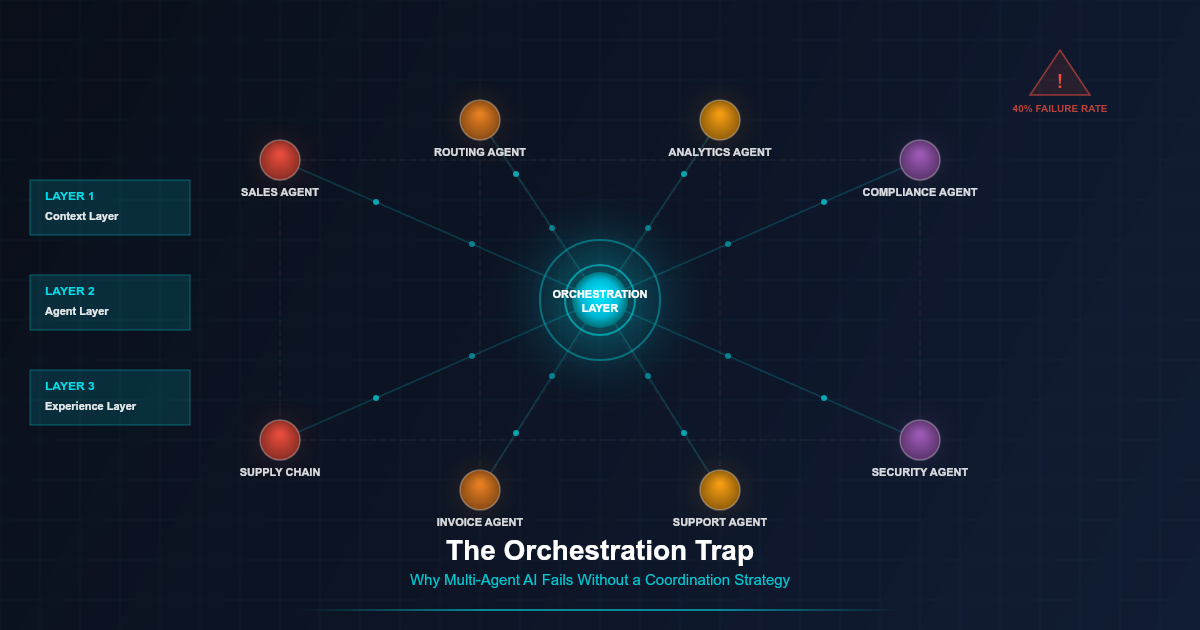
Welcome to the orchestration trap: the gap between deploying individual AI agents and coordinating them into a system that actually works.
The Rush and the Reckoning
The scale of enterprise agent adoption is staggering. Gartner projects agentic AI will generate approximately 30% of enterprise software revenue by 2035, exceeding $450 billion — up from 2% in 2025. Seventy-three percent of organizations are expected to adopt "agent assist" capabilities by year-end.
But adoption speed and deployment maturity are two different things. While 80% of enterprise leaders say their organization has mature basic automation, only 28% say the same for automation combined with AI agents, according to Deloitte's survey of 550 US cross-industry leaders.
The maturity gap reveals the trap: organizations are deploying agents at the pace of their ambition, not the pace of their readiness. And the cost of getting it wrong is not just a failed project — it is agent sprawl, ungoverned proliferation, and the shadow agent crisis we have already documented.
As Anushree Verma, Senior Director Analyst at Gartner, notes: "AI agents are evolving rapidly, progressing from basic assistants to task-specific agents by 2026 and ultimately multiagent ecosystems by 2029." The question is whether enterprises will build the coordination infrastructure to keep pace with that evolution — or let it outrun them.
Why Individual Agent Success Does Not Scale
Here is the scenario playing out across thousands of enterprises: a team deploys an AI agent to handle customer inquiry routing. It works brilliantly. Another team deploys an agent for invoice processing. Also excellent. A third builds an agent for supply chain anomaly detection.
Each agent succeeds in isolation. But when you have dozens — then hundreds — of agents operating across an organization, new problems emerge that individual agent performance cannot solve:
Agents conflict. A sales optimization agent promises delivery dates that a supply chain agent knows are impossible. A cost reduction agent cancels a vendor contract that a compliance agent flagged as mandatory. Without shared context and coordination, agents optimize for their own objectives at the expense of organizational coherence.
State becomes invisible. When Agent A passes a task to Agent B, what happens to the context? Who tracks whether the handoff succeeded? What if Agent B fails silently? In most enterprise deployments, the answer is: nobody knows. The data debt problem is compounded when agents generate data that other agents consume without governance.
Governance becomes impossible. Individual agent governance is manageable. Governing an ecosystem of agents — each with different permissions, different data access, different decision boundaries — requires infrastructure that most organizations have not built. Only 28% consider their agent automation mature, and only 12% expect ROI from automation-plus-agents within three years, compared to 45% for basic automation alone.
The Three-Layer Architecture
Deloitte's research identifies a three-layer enterprise architecture that separates orchestrated agent deployments from chaotic ones:
Layer 1: The Context Layer
Before agents can coordinate, they need shared understanding. The context layer provides knowledge graphs, ontologies, and taxonomies that give every agent in the ecosystem a consistent view of the business — shared definitions, shared relationships, shared constraints.
Without this layer, every agent operates on its own interpretation of reality. The sales agent and the supply chain agent are not just making different decisions — they are making decisions based on different understandings of the same data.
Layer 2: The Agent Layer
This is where most enterprises focus — and where most stop. The agent layer handles safety, autonomy, and interoperability with modular design and advanced telemetry. But the critical insight is that agent-level excellence is necessary but insufficient. A perfectly designed agent in a poorly orchestrated ecosystem still fails.
The emerging inter-agent protocols — Google's A2A (Agent-to-Agent), Cisco's AGNTCY, and Anthropic's MCP (Model Context Protocol) — are beginning to standardize how agents communicate and coordinate. Deloitte expects these to converge to two or three leading standards, which will define the interoperability landscape for the next decade.
Layer 3: The Experience Layer
The experience layer provides human oversight through agent status dashboards with explainability features. This is not just monitoring — it is the mechanism through which humans maintain appropriate control as agents take on more autonomous decision-making.
The human oversight model is evolving along a spectrum: humans in the loop (approving every decision), humans on the loop (monitoring with intervention capability), and humans out of the loop (fully autonomous). Advanced organizations are shifting to "on the loop" in 2026 — maintaining oversight without bottlenecking agent operations.
How many AI agents are running in your organization, and who is coordinating them?
If there is no clear answer, you have an orchestration gap.
The Five-Stage Evolution You Need to Plan For
Gartner maps the agent evolution trajectory that enterprises should be architecting toward:
- 2025: Assistants. AI handles prompts and basic tasks under direct human supervision.
- 2026: Task-specific agents. Agents operate autonomously within bounded domains — the stage most enterprises are entering now.
- 2027: Collaborative agents. Multiple agents coordinate on complex workflows, requiring the orchestration infrastructure most enterprises have not yet built.
- 2028: Cross-platform ecosystems. Agents operate across organizational boundaries — partners, vendors, customers — demanding standardized protocols and shared governance.
- 2029: Worker-created agents. Fifty percent of knowledge workers will create and govern agents on demand, democratizing agent deployment while exponentially increasing the governance challenge.
The organizations building orchestration infrastructure now are not over-investing. They are building for Stage 3 before they get there — which is the only way to be ready when they arrive.
CIOs face what Gartner calls a three-to-six-month window to define their AI agent strategy or risk competitive disadvantage. That window is not about choosing agents. It is about choosing orchestration.
The Failure Modes
For organizations that deploy agents without coordination strategy, three failure modes are predictable:
Agent sprawl. Departments deploy agents independently, creating an ungoverned ecosystem that nobody can map, monitor, or manage. This is the shadow agent problem at organizational scale.
Vendor lock-in through walled gardens. Platform vendors offer orchestration as part of their agent ecosystem, creating dependencies that reduce flexibility and increase switching costs. Organizations that adopt vendor-specific orchestration without an abstraction layer find themselves locked into architectures that may not align with the converging protocol standards.
Regulatory non-compliance. The EU AI Act and emerging regulations require traceability, explainability, and human oversight for autonomous systems. Agent ecosystems without centralized governance infrastructure cannot demonstrate compliance at audit time — and the penalties for high-risk AI systems are substantial.
The Bottom Line
The autonomous AI agent market is projected to reach $8.5 billion by 2026 and $35 billion by 2030. The organizations that capture that value will not be the ones deploying the most agents. They will be the ones that build the orchestration layer that makes multi-agent systems coherent, governed, and aligned with business outcomes.
Every agent you deploy without a coordination strategy is a bet that individual optimization will somehow produce organizational results. The evidence says otherwise. The ROI comes from orchestration — and orchestration requires architecture, not just ambition.
The trap is thinking that more agents equals more capability. The reality is that more agents without coordination equals more chaos. Build the orchestra before you hire the musicians.
ViviScape specializes in multi-agent orchestration — designing the coordination infrastructure that turns individual AI agents into coherent enterprise systems. If your agent deployments need an orchestration strategy, let's build one.
Ready to orchestrate your AI agents?
ViviScape designs multi-agent coordination infrastructure that turns individual AI agents into coherent enterprise systems — governed, aligned, and delivering real business outcomes.
Book a Free Consultation