
For two hundred years, we have been automating tasks. Looms, assembly lines, spreadsheets, software. Each wave made a specific job faster, and each one still needed a person standing next to the machine, feeding it.
That is starting to change. We are moving from automating tasks to delegating outcomes — and that is a different kind of shift. It does not just change how fast the work gets done. It changes who, or what, does the doing.
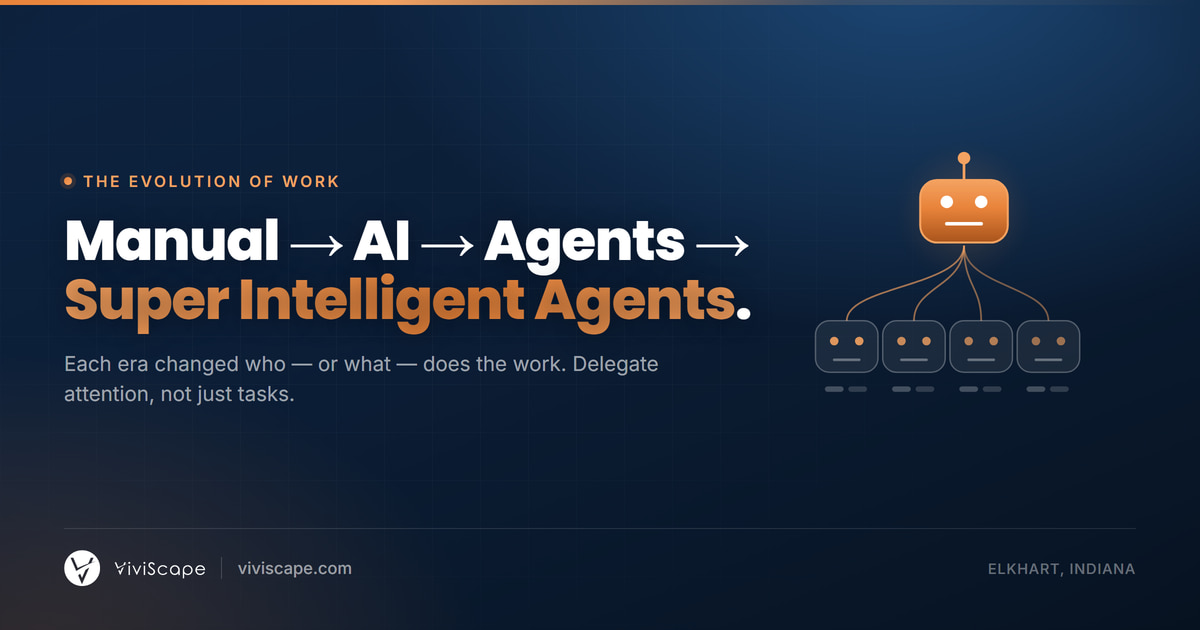
The clearest way we have found to see it is as four eras: Manual → AI → Agents → Super Intelligent Agents. And the thread running through all four is the one we talk about with every client: the Manual Work Tax — the hours, the retyping, the chasing, and the headcount you add just to keep the machine fed.
Every era has shrunk that tax. The question for your business is which era your operations are actually built for.
Era 1: Manual — Human Power Drives Progress
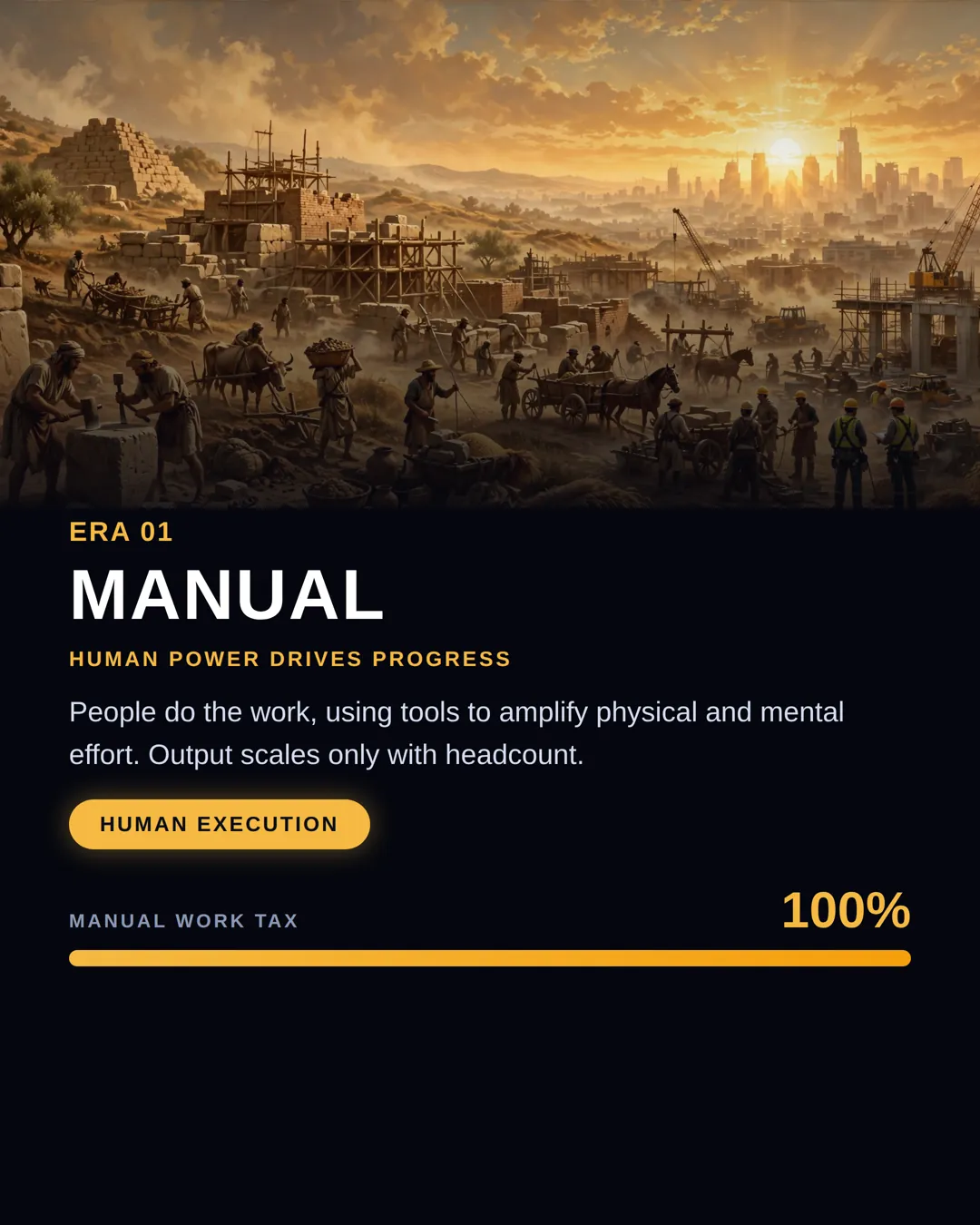
In the manual era, people do the work and tools amplify their effort. A better tool makes a good worker faster, but the work still moves at the speed of the person holding it.
The defining trait of this era is simple: output scales with headcount. Want twice the throughput? Hire twice the people. That is not a failure of management — it is the physics of the model.
Most businesses would say they left this era years ago. Most have not. Look closely at any operation and you will find it still running underneath the software: the person who copies numbers from one system into another every morning, the spreadsheet that is really a database, the status update that only exists because someone walks over and asks. That is the Manual Work Tax at its full rate — 100% of the effort, carried by people.
Era 2: AI — Intelligence Amplifies Humans
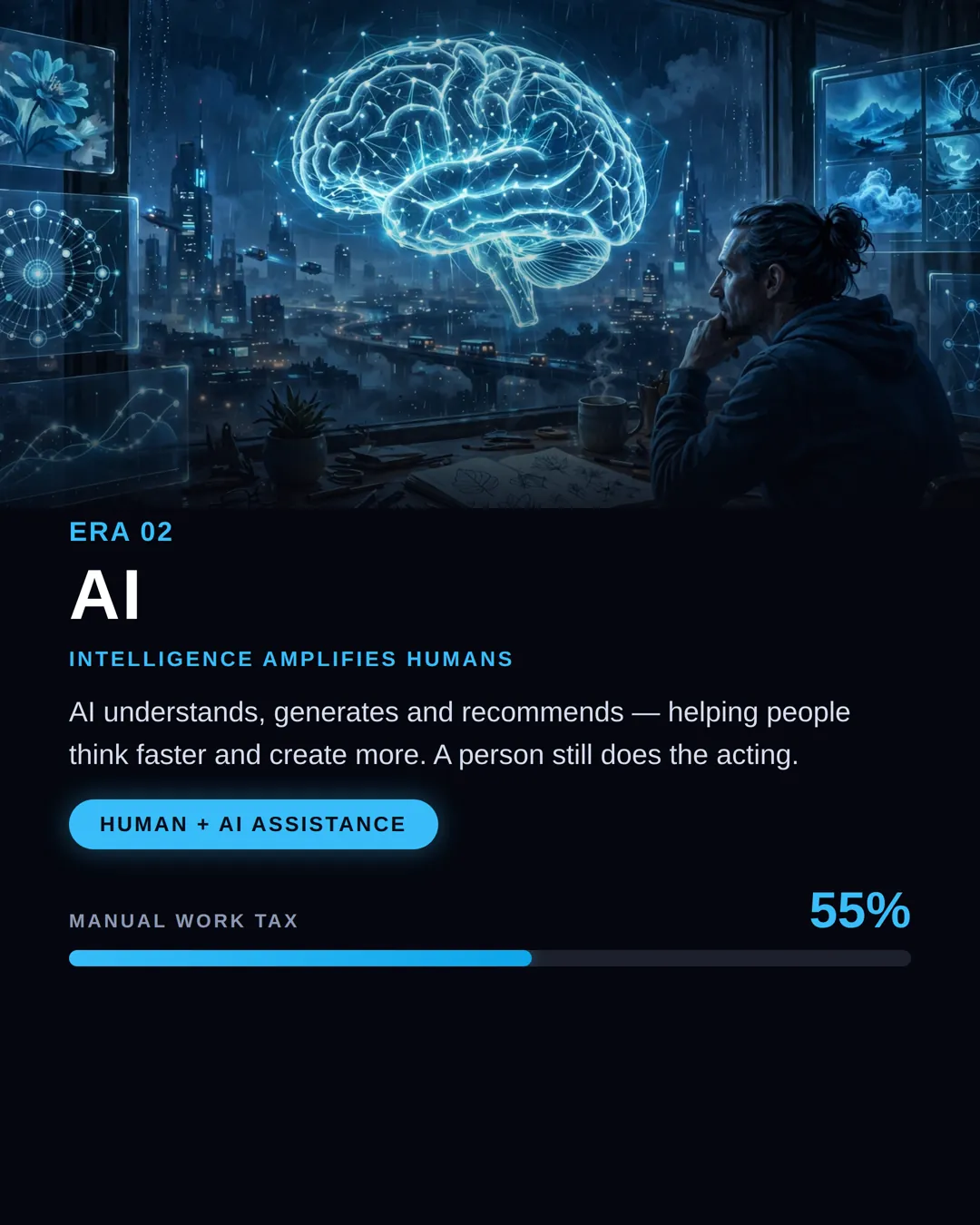
The AI era is the one most companies are in right now. AI understands, generates, and recommends. It drafts the email, summarizes the contract, suggests the next step, and writes the first version of the report.
That is real leverage. People think faster and produce more. But notice the limit: a person still does the acting. The AI suggests; the human copies, pastes, clicks, sends, and follows up. The work got smarter, but the hands on the keyboard are the same.
That is why the tax drops meaningfully here — call it roughly 55% — but does not collapse. You removed a lot of the thinking time. You did not remove the doing.
It is also where we see the most frustration. Companies roll out AI tools, usage goes up, and the operating numbers barely move. The reason is almost always the same: the tools were layered on top of the old process instead of changing it.
Era 3: Agents — Work That Gets Done Autonomously
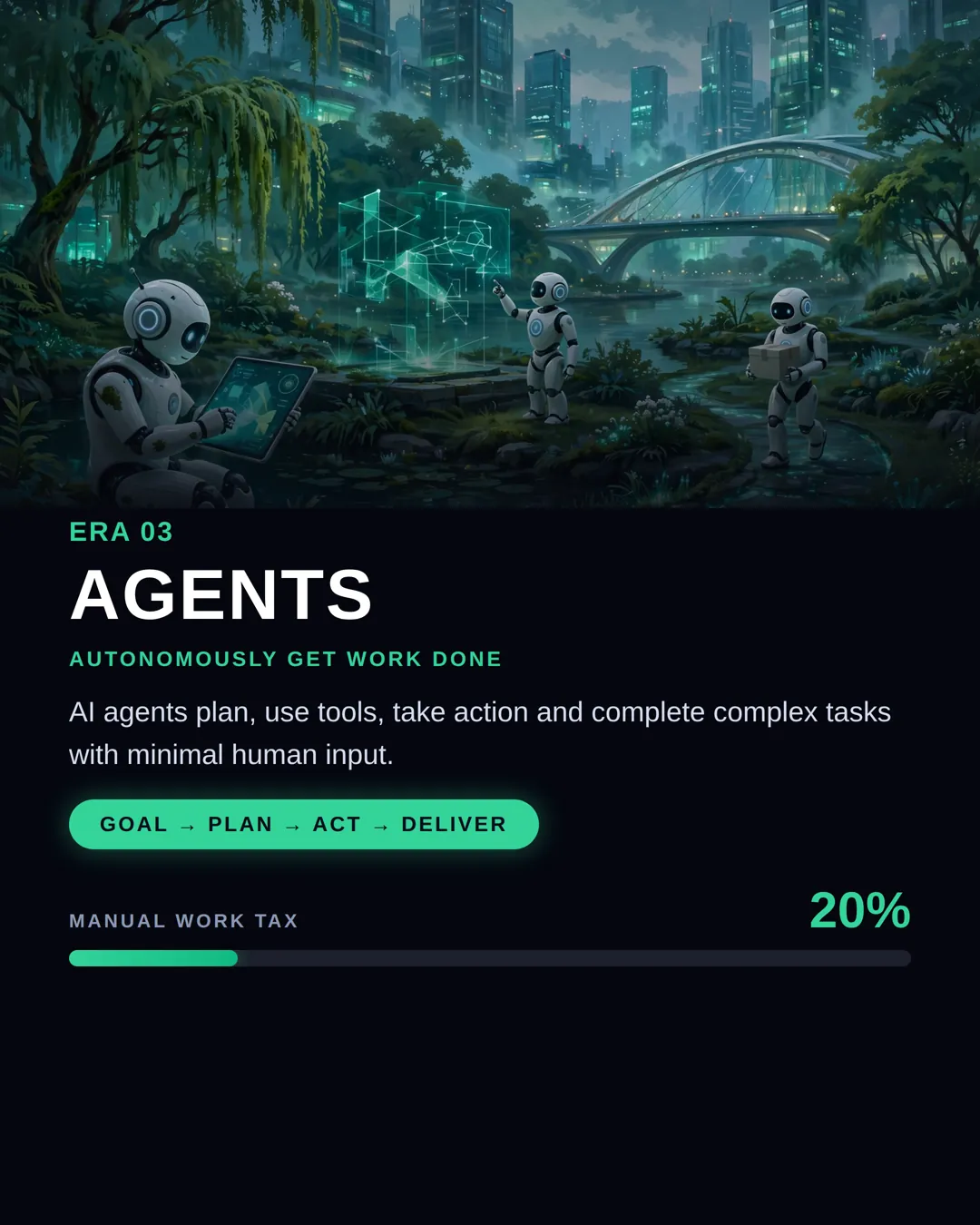
Agents are the break point. An agent does not just recommend the next step — it plans the work, uses the tools, takes the action, and finishes the task with minimal human input.
That is the move from assistance to delegation. Instead of an AI that drafts the follow-up email, you have an agent that notices the invoice is overdue, checks the account history, sends the right message, logs it in the CRM, and flags a person only when something looks wrong.
The Manual Work Tax falls to something like 20%. What is left is the work that genuinely deserves a person: judgment calls, exceptions, relationships, and decisions with real stakes.
Agents also raise the bar on everything underneath them. An agent can only act on systems it can reach, data it can trust, and rules someone actually wrote down. That is where most of the real work of this era lives — not in picking an AI model, but in making the business legible enough for an agent to operate in it safely.
Era 4: Super Intelligent Agents — A New Class of Digital Colleagues
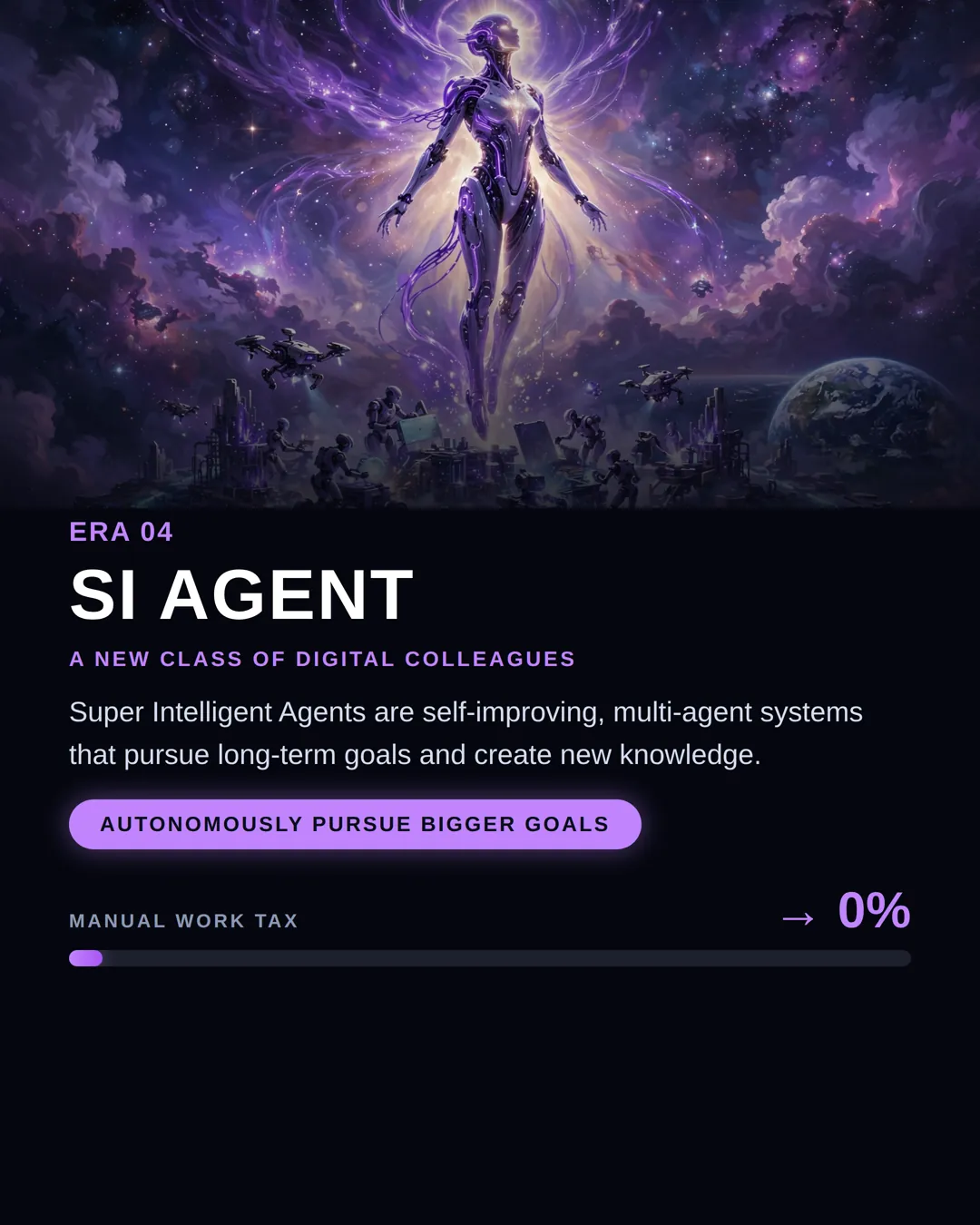
The next era is still arriving, but its shape is visible. Super intelligent agents are self-improving, multi-agent systems that pursue long-term goals rather than single tasks — and increasingly create new knowledge instead of only acting on what they are given.
Think less “tool” and more “digital colleague”: systems that own an outcome over weeks, coordinate with each other, learn from what worked, and get better at the job without being rebuilt.
This is where the Manual Work Tax heads toward zero. Not because people stop working, but because the work that remains for people is the work only people should do.
Nobody can promise exactly when this era fully lands. But the companies that benefit most will not be the ones that waited to see it clearly. They will be the ones whose operations were already built so that more capable agents could simply plug in.
The Real Lesson: This Is a Continuum, Not a Replacement
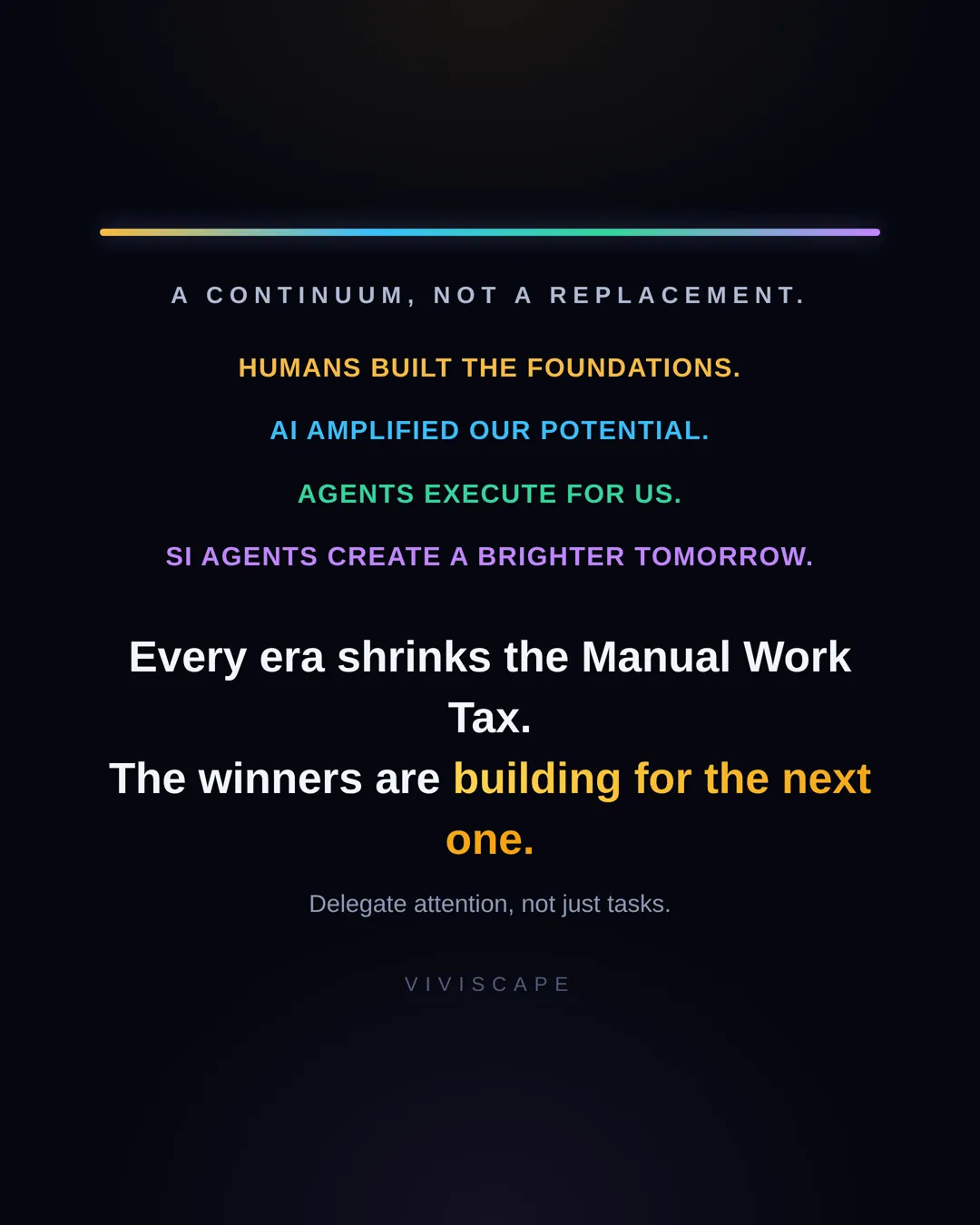
It is tempting to read this as a story about machines replacing people. It is not. Each era built on the one before it. Humans built the foundations. AI amplified what we could do. Agents execute for us. Super intelligent agents extend what is possible. The people are still there in every stage — what changes is where their attention goes.
That is the part most leaders miss. The companies winning right now are not the ones with the most AI tools. They are the ones redesigning the work itself — deciding, deliberately, what deserves human attention and letting everything else go.
It is also why the Manual Work Tax is the right way to measure progress. “How many AI tools did we deploy?” tells you almost nothing. “How many hours of retyping, chasing, and babysitting did we eliminate — and where did that attention go instead?” tells you exactly which era you are operating in.
So the question is not whether this shift happens. It is whether you are building for the era you are in, or the one that is already arriving.
Delegate attention, not just tasks.
Where Is Your Manual Work Tax Still Highest?
Find out in about two minutes. Our free calculator puts a dollar figure on the time drain, error correction, and headcount creep in your operations — and shows what it costs you over the next three years.
Calculate Your Manual Work Tax