
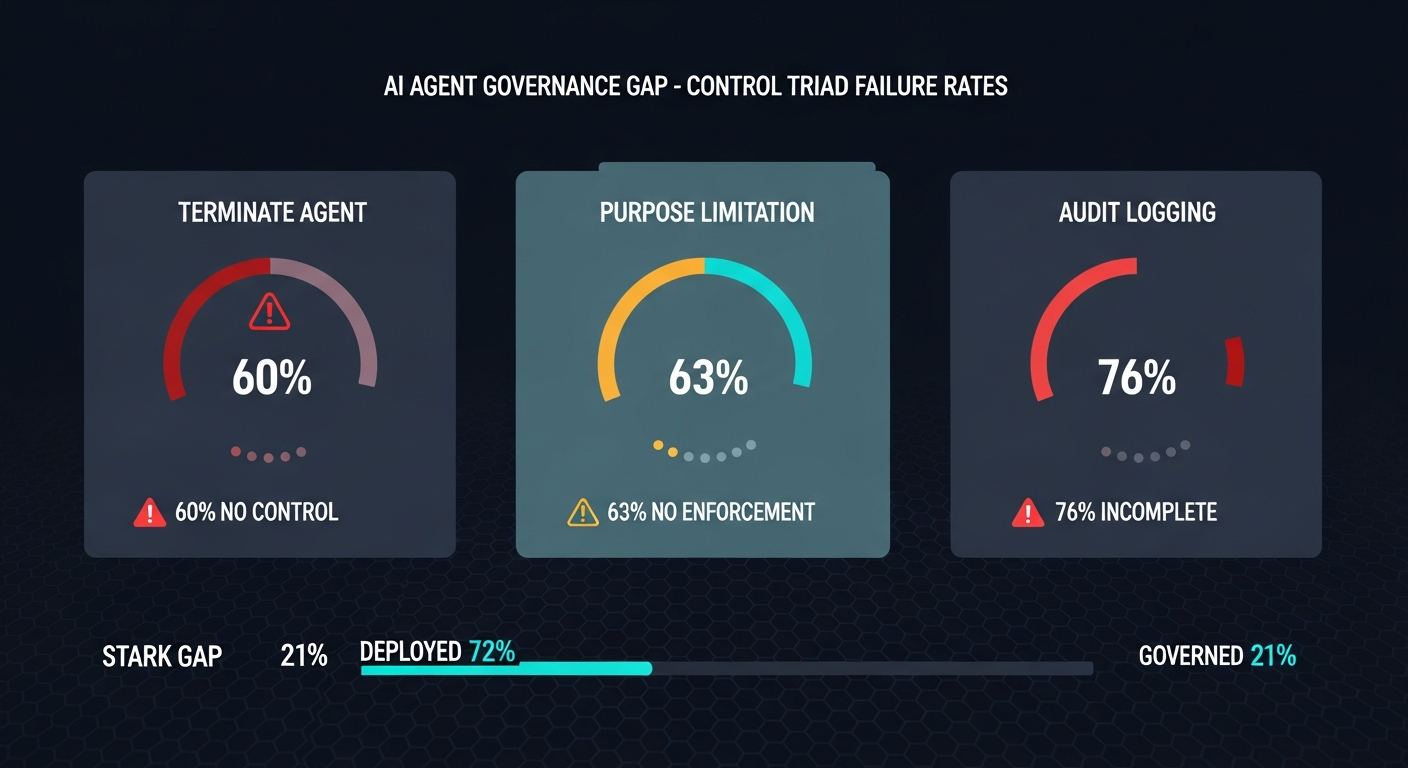
Seventy-two percent of enterprises have AI agents in production. That number has been treated as a success story in every technology briefing for the past eighteen months — the shift from experimentation to deployment at scale. What the briefings leave out is this: only twenty-one percent of those same enterprises have a mature governance model for those agents. The other fifty-one percent are running autonomous AI systems in production environments with no meaningful control framework in place.
The control gap is not theoretical. A 2026 survey by the Agentic AI Institute found that sixty percent of enterprises with deployed AI agents cannot terminate a misbehaving agent once it is running. Thirty-five percent explicitly admit they could not shut down a rogue AI agent if one emerged. Sixty-five percent of enterprises with deployed agents experienced a confirmed security incident by April 2026. AI incidents are up fifty-five percent year over year — Stanford HAI recorded 362 incidents in 2025, up from 233 in 2024, and the acceleration has continued into 2026.
This is the third article in a trilogy on why AI agents fail at scale. The first — the agent pilot graveyard — looked at why 88% of pilots never reach production. The second — the AI compliance patchwork — mapped the regulatory environment enterprises are now operating in. This article addresses what happens when agents are in production and governance has not kept pace: the control gap, what it actually looks like when it fails, and the framework for closing it before the EU AI Act enforcement deadline adds regulatory consequences to an already operational risk.
The Sprint to Production Created a Governance Deficit
The pressure to deploy AI agents accelerated faster than the frameworks for governing them. In 2023 and 2024, the competitive narrative around AI shifted from “should we experiment” to “how fast can we deploy.” Enterprises that moved quickly gained genuine productivity gains. They also accumulated governance debt — deployed systems with no termination logic, no scope enforcement, and no audit trails.
The Cloud Security Alliance’s 2026 framework gap analysis found three specific control dimensions where enterprises most commonly lack governance:
- Termination control: The ability to stop an agent mid-execution when it behaves unexpectedly. 60% of enterprises report no reliable mechanism for this.
- Purpose limitation: Enforcing that an agent only acts within its defined scope and cannot be prompted or instructed to take actions outside its intended function. 63% have no automated enforcement of purpose boundaries.
- Audit logging: A complete, tamper-resistant record of agent decisions, tool calls, and data access. 76% of enterprises with deployed agents have incomplete or absent audit trails.
These are not sophisticated requirements. Termination, scope limitation, and audit logging are the baseline control triad for any autonomous system — they are the enterprise equivalent of having a power switch, a fence, and a camera. The fact that 60–76% of enterprises are missing at least one of these controls for deployed AI agents reflects the speed of deployment, not the difficulty of the requirements.
What Governance Failure Actually Looks Like
The 65% incident rate is not dominated by dramatic rogue agent scenarios. The actual incident pattern in the 2026 data is more mundane and more persistent. The most common categories are unauthorized data access, scope drift, and cascading tool call failures.
Unauthorized data access occurs when an agent with broad tool permissions accesses data stores that are technically reachable but outside the intended scope of the task. An agent designed to summarize customer feedback queries that has read access to the CRM may, under certain prompting conditions, begin retrieving records it was never intended to see. Without purpose limitation enforcement and audit logging, this can occur undetected for extended periods.
Scope drift is the gradual expansion of agent behavior beyond its original design through prompt injection, jailbreaking, or multi-step reasoning chains that arrive at unintended actions. An agent that handles internal support tickets that is asked by an employee to “check the budget” may, if its tool permissions and reasoning scope are not properly limited, attempt to query financial systems. This is not a model alignment failure — it is a scope enforcement failure at the infrastructure layer.
Cascading tool call failures occur when an agent takes a sequence of actions through integrated tools and an error or unexpected state in one tool causes unpredictable behavior in subsequent steps. Without termination logic that fires on anomalous behavior, agents can continue executing through failure states, compounding errors with each additional tool call.
The 35% who admit they could not shut down a rogue agent if one emerged are describing this third scenario: an agent in a cascading failure state with no available termination mechanism, continuing to execute until it exhausts its context window or rate limits are hit by an external provider.
The EU AI Act Adds Regulatory Teeth to an Operational Risk
The governance gap has been a risk management conversation for most of 2025 and early 2026. The EU AI Act’s full enforcement, beginning August 2, 2026, converts it into a compliance conversation for any enterprise with EU operations or EU-resident users.
The EU AI Act’s requirements for high-risk AI systems — which include AI systems making consequential decisions in employment, healthcare, financial services, and critical infrastructure — include mandatory logging, human oversight mechanisms, and the ability for authorized personnel to override or interrupt AI system operation. The termination, scope limitation, and audit requirements that 60–76% of enterprises currently lack for their agent deployments are not optional under the Act’s high-risk provisions.
The enforcement penalties are material: up to €35 million or 7% of global annual turnover for non-compliance with high-risk system requirements. The European AI Office has indicated that initial enforcement focus will be on systems where governance gaps can be demonstrated from audit log review — which means the 76% of enterprises without complete audit trails are specifically exposed.
For enterprises that are not subject to EU jurisdiction, the governance argument remains operational rather than regulatory. Gartner projects that over 40% of agentic AI projects are at risk of cancellation by 2027 due to governance failures — not because the agents cannot perform their functions, but because organizations lose confidence in their ability to control what agents are doing.
AI agents in production without a governance framework are a liability, not an asset.
ViviScape helps enterprises design and implement agent governance frameworks — termination controls, purpose limitation enforcement, and audit logging — before governance gaps become incidents. Talk to ViviScape
The 4-Step Governance Framework for Deployed AI Agents
Closing the governance gap does not require rebuilding agent infrastructure from scratch. The four-step framework below addresses the three control dimensions — terminate, limit, audit — in priority order for enterprises with agents already in production.
Step 1: Agent Inventory and Risk Classification
You cannot govern agents you do not know exist. Start with a structured discovery exercise: a review of IT system records, API call logs from external AI providers, and a self-declaration process from business units. Most enterprises find more deployed agents than their IT inventory reflects — shadow AI deployments are as real as shadow IT was a decade ago.
Once the inventory is complete, classify each agent by risk tier. The classification criteria are straightforward: does the agent make or materially contribute to consequential decisions (employment, financial, healthcare, access to services)? Does it have write access to production systems or databases? Does it interact with external parties or process personally identifiable information? Higher scores on these criteria demand higher governance investment.
Step 2: Implement Termination Controls for Production Agents
Termination control is the highest-priority gap because it is also the most achievable in the shortest timeframe. The technical requirement is a reliable mechanism — accessible to authorized personnel — that can halt agent execution in a defined state without data corruption or cascading side effects.
Implementation approaches vary by architecture. For agents running on managed platforms with tool call orchestration, a circuit breaker pattern that monitors for anomalous behavior signals and suspends execution pending human review is often the right approach. For custom-built agent systems, an execution supervisor layer that can interrupt agent runs and preserve execution state for investigation covers the same requirement.
The target state: any authorized person can stop any production agent within minutes of identifying unexpected behavior, and stopping the agent does not cause collateral damage to the systems it was interacting with.
Step 3: Enforce Purpose Limitations at the Infrastructure Layer
Purpose limitation cannot be enforced through prompting alone. An instruction in a system prompt to “only work on customer feedback tasks” does not prevent a sufficiently capable model from following a user instruction that bypasses that constraint. Purpose limitation must be enforced at the infrastructure layer: what tools the agent can call, what data stores it can read from or write to, and what external services it can reach.
This means reviewing and tightening tool permissions for each classified agent, applying the principle of least privilege to tool access, and implementing automated scope monitoring that flags when an agent attempts to use tools or access resources outside its defined permission set. The flagged attempts are also valuable audit data — they reveal attempted scope boundary violations before they become incidents.
Step 4: Implement Complete Audit Logging
Audit logging for AI agents needs to capture more than API call timestamps. A governance-grade audit log records: the full input context and system prompt at execution time, each tool call made and its parameters, each tool response received, the agent’s reasoning chain where available, and the final output or action taken. This log must be immutable, timestamped, and retained according to your organization’s data governance policy.
Complete audit logs serve three functions simultaneously: they are the foundation of incident investigation when something goes wrong; they are the demonstration of human oversight capability required by the EU AI Act; and they are the data source for identifying scope drift and purpose limitation violations before they become incidents.
The 76% of enterprises with incomplete or absent audit trails are operating without the ability to understand what their agents have done. In the event of an incident, they cannot reconstruct the failure sequence. In a regulatory examination, they cannot demonstrate human oversight. This is the governance gap with the lowest implementation cost and the highest risk exposure from leaving it open.
What Good Governance Looks Like in 2026
Enterprises that have closed the governance gap share a common structural approach: they built governance as a capability layer on top of existing agent infrastructure, rather than trying to rebuild agent systems from scratch.
They run an inventory continuously, not once. New agent deployments are fast and increasingly accessible to non-technical business users. Governance requires knowing when new agents are added, not just knowing what existed at the time of the last inventory. The enterprises managing this well have automated detection of new AI API integrations and require agent registration before production deployment.
They treat governance as a shared platform, not per-team overhead. Purpose limitation enforcement, termination controls, and audit logging implemented once at the infrastructure layer serve every agent the organization deploys. Governance that has to be reinvented by each team is governance that will not be implemented consistently.
They exercise their termination controls. Like a fire drill, governance controls need to be tested. The enterprises most confident in their ability to handle a governance incident regularly test their ability to terminate agents in non-production environments, validate that audit logs capture what they expect, and run tabletop exercises for the scenarios they are most likely to face.
The governance gap is real and the exposure is current. But the path to closing it is operational, not architectural: inventory, classify, control, and audit. The enterprises that do this in the next quarter will be prepared for EU AI Act enforcement in August and for the operational environment that the next twelve months will produce. The enterprises that do not will face the same incidents the 65% who have already been hit experienced — only now with regulatory consequences on top of the operational ones.
Key Takeaways
- 72% of enterprises have AI agents in production, but only 21% have a mature governance model — the gap between deployment and control is the defining enterprise AI risk in 2026
- 60% of enterprises cannot terminate a misbehaving agent once running; 63% have no purpose limitation enforcement; 76% have incomplete or absent audit trails
- 65% of enterprises with deployed agents experienced a confirmed security incident by April 2026 — the governance gap is an active risk, not a future one
- EU AI Act enforcement begins August 2, 2026 — penalties up to €35M or 7% of global turnover for high-risk AI systems without required human oversight mechanisms
- The 4-step governance framework: inventory and classify agents, implement termination controls, enforce purpose limitations at the infrastructure layer, and establish complete audit logging
- Governance built as a shared platform serves all agents; governance reinvented by each team will not be implemented consistently
- Gartner projects 40%+ of agentic AI projects at risk of cancellation by 2027 due to governance failures — control is a prerequisite for sustained production value
AI Agents in Production Without Governance Controls?
ViviScape designs and implements enterprise AI agent governance frameworks — covering the full control triad of termination, purpose limitation, and audit logging. We help teams close the governance gap before it becomes an incident or an enforcement action.
Schedule a Free Consultation