
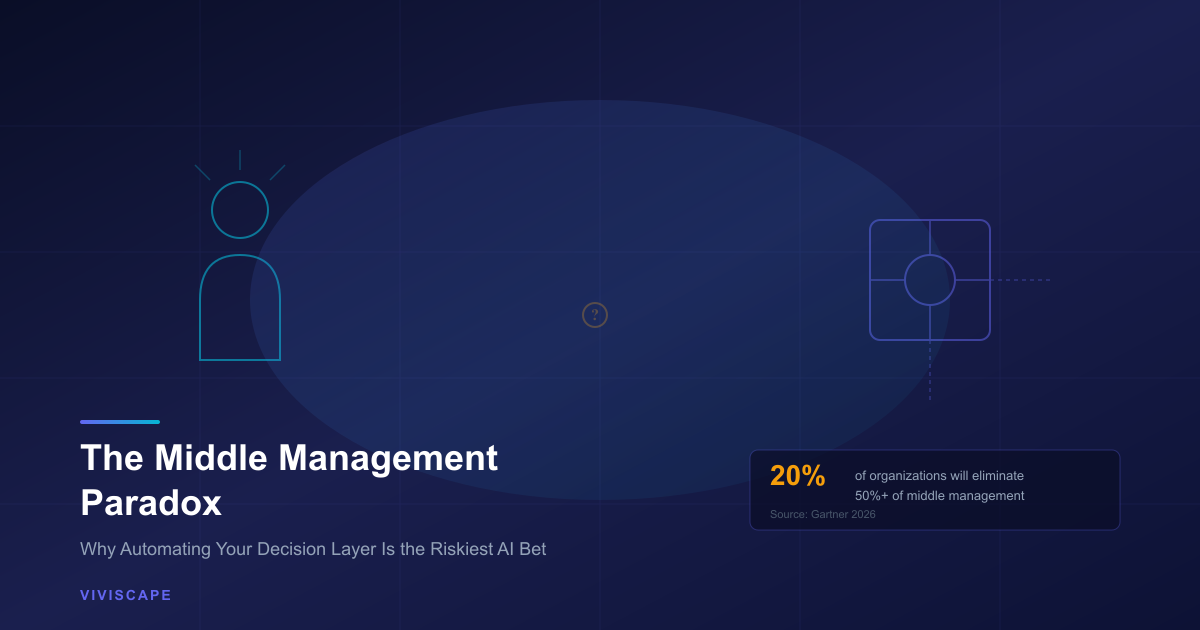
Twenty percent of organizations will leverage AI to eliminate more than half of their current middle management roles by the end of 2026. Dell, Amazon, Microsoft, and Google have already aggressively flattened their structures, stripping away layers of management to enhance agility and efficiency. Forty-one percent of employees report their companies have already reduced managerial layers.
The logic is compelling on paper. Middle managers schedule, coordinate, monitor performance, approve requests, compile reports, and relay information between strategy and execution. AI can do all of that faster, cheaper, and at scale. The business case writes itself.
Except the business case is missing something fundamental. Middle management is not just an operational layer. It is the enterprise's judgment and ethical layer — the place where strategy meets reality, where policies encounter edge cases, and where someone is accountable for decisions that affect human lives. Automating that layer is not an efficiency optimization. It is a structural transformation with consequences that most organizations have not thought through.
What Middle Managers Actually Do
The mistake enterprises make when evaluating middle management for automation is measuring the wrong things. They measure the tasks: scheduling, reporting, approval routing, performance tracking. These tasks are visible, repetitive, and automatable. The business case for replacing them with AI is straightforward.
But the tasks are not the job. The job is judgment.
Middle managers make thousands of micro-decisions that never appear in a workflow diagram. They decide when a policy should be enforced strictly and when an exception is warranted. They detect when a team member is struggling before performance metrics show it. They translate strategic directives into operational reality — interpreting what leadership actually means, not just what they said. They absorb ambiguity so their teams can execute with clarity.
None of these functions appear in a job description. All of them are critical to how organizations actually work.
The AI skills paradox documented how smarter systems can make organizations dumber by replacing the learning that happens through doing. The middle management paradox is the organizational equivalent: automating the decision layer can make the enterprise faster while making it fundamentally less capable of judgment.
The Three Ethical Obligations AI Cannot Fulfill
IMD research identifies three foundational ethical obligations unique to middle management — obligations that cannot be delegated to algorithms regardless of their sophistication.
Ownership of Implementation
Middle managers cannot hide behind algorithmic decisions. When a policy produces an unjust outcome, a human manager must take responsibility for the consequences. They must own the implementation — including its failures — in a way that a system categorically cannot.
The Cigna case illustrates what happens when this obligation is abandoned: a single doctor denied over 60,000 insurance claims in one month, spending an average of 1.2 seconds per case. The system operated with maximum efficiency. The humans it affected received no judgment at all. When accountability is algorithmic, accountability disappears.
The Duty of Judgment
Managers must distinguish routine cases from edge cases — recognizing when standard policies fail to account for circumstances that the policy designers never anticipated. This is not pattern recognition, which AI excels at. It is pattern exception — the ability to recognize when the pattern should not apply.
An AI system trained on historical decisions will optimize for the patterns in that history. It will not recognize that this particular case, which looks like every other case in the data, is actually different in ways that matter. That recognition requires judgment. And judgment requires context, empathy, and moral reasoning that current AI systems do not possess.
Organizational Conscience
Middle managers witness the gap between strategic intent and real-world impact. They see what senior leadership cannot: how decisions play out on the ground, what unintended consequences emerge, and where the organization's actions diverge from its values.
When this layer is automated, the organization loses its conscience — the human capacity to say "this is wrong" or "this is not what we intended" before harm compounds. Senior leadership operates on dashboards and reports. The middle layer operates on lived experience. Remove it, and the dashboards become the only reality the organization can see.
The Accountability Problem
There is a principle that predates the AI era but has never been more relevant: a computer can never be held accountable, therefore a computer must never make a management decision.
This is not a philosophical abstraction. It is a governance reality. When an AI system denies a claim, approves a loan, terminates a contract, or flags an employee for performance review, who is accountable for that decision? The algorithm? The team that trained it? The executive who approved its deployment? The AI boardroom governance challenge extends directly into middle management: fiduciary duty and legal accountability require human decision-makers at every point where decisions affect people.
The agent governance stack provides frameworks for managing autonomous AI systems. But governance frameworks cannot replace accountability. They can constrain what systems do. They cannot take responsibility for what systems decide.
Are you automating tasks or automating judgment?
The distinction determines whether AI makes your organization more capable or more fragile. Talk to ViviScape about building AI systems that amplify human judgment instead of replacing it.
The Flattening Trap
The "unbossing" movement — organizational flattening through management layer reduction — is accelerating across the enterprise landscape. The premise is that AI can replace the coordination and information relay functions that justified middle management's existence, enabling faster decision-making and lower overhead.
But organizational research consistently shows that flattening creates its own pathologies. Span of control increases until remaining managers are overwhelmed. Institutional knowledge concentrates in fewer people, increasing key-person risk. Cultural transmission — how organizations teach new members "how things work here" — degrades when the teaching layer is removed. And the informal networks that middle managers maintain — the relationships that enable cross-functional coordination, conflict resolution, and organizational adaptation — disappear with the managers who maintained them.
Forty percent of business workflows will be managed by agentic AI systems by 2026. But managed is not the same as governed. An agentic system that manages a procurement workflow can optimize cost, speed, and compliance. It cannot navigate the relationship dynamics between departments competing for budget, or judge when a technically compliant vendor selection is strategically wrong because of context the system was not designed to capture.
The COO's new mandate includes orchestrating the human-machine workforce. That orchestration is meaningless if the human layer responsible for translating strategy into execution has been eliminated in the name of efficiency.
The Rebirth: What Middle Management Becomes
The answer is not preserving middle management as it exists today. The answer is transforming it — redesigning the role around the functions that AI cannot perform while automating the functions that AI handles better.
Three emerging functions define the reborn middle manager:
Orchestrator of AI-Human Collaboration
The new middle manager is not a coordinator of people. They are an orchestrator of integrated human-AI teams — responsible for determining which decisions require human judgment, which can be delegated to AI, and how the handoffs between human and machine intelligence are designed.
This requires a fundamentally different skill set than traditional management. It requires understanding what AI can and cannot do, how to supervise AI-driven processes, and how to intervene when AI outputs require human override. The rise of the AI workforce makes this orchestration function the most critical management capability in the enterprise.
Agent of Change
Organizational transformation does not happen through strategy decks. It happens through the middle layer that translates strategic intent into behavioral change across teams. As AI reshapes workflows, processes, and role definitions at accelerating speed, the capacity to guide people through continuous adaptation becomes more valuable, not less.
Middle managers who function as change agents — anticipating disruptions, fostering adaptive cultures, and building psychological safety during transformation — are the infrastructure that enables AI adoption at scale. Without them, AI deployment creates resistance, confusion, and organizational friction that erodes the efficiency gains the technology was supposed to deliver.
Coach for Continuous Learning
The half-life of AI-relevant skills is shrinking. The manager who develops team capabilities — building AI literacy, critical thinking, and the judgment skills that AI cannot automate — creates organizational value that no system can replicate.
Coaching is inherently human. It requires understanding individual motivations, adapting communication styles, building trust through relationship, and creating conditions for growth. These are precisely the capabilities that differentiate human management from algorithmic optimization.
A Framework for the Middle Management Decision
Not every middle management function should be preserved. Not every function should be automated. The challenge is making deliberate choices rather than defaulting to the efficiency argument.
Automate the mechanical. Scheduling, reporting, approval routing, data compilation, performance metric tracking — these are legitimate automation targets. They consume management time without requiring management judgment.
Preserve the judgment layer. Exception handling, ethical evaluation, stakeholder navigation, cultural stewardship, and strategic interpretation require human judgment. Design systems that surface these decisions to human managers rather than automating them away.
Redesign the role. Do not simply remove tasks from the middle management role and declare the remainder sufficient. Actively redesign the role around orchestration, change leadership, and coaching. Invest in the skills these functions require. Measure success by judgment quality, not efficiency metrics.
Protect deliberation time. Systems that eliminate time eliminate judgment. If your redesigned middle management role leaves no time for reflection, interpretation, and relationship-building, you have created an efficiency optimization that destroys the value it was supposed to preserve.
The Bottom Line
The middle management paradox is this: the functions that are easiest to automate are not the functions that matter most. The scheduling, reporting, and coordination that justify AI replacement are the visible surface of a role whose real value is invisible — judgment, accountability, ethical reasoning, and organizational conscience.
Twenty percent of organizations will eliminate more than half their middle management by year-end. Some will do so deliberately, preserving the judgment layer while automating the mechanical layer, and emerge with organizations that are both more efficient and more capable. The rest will discover that the efficiency they gained came at the cost of the judgment they needed — and that rebuilding an organizational conscience is far harder than automating it away.
The question is not whether to automate middle management. It is which parts to automate and which parts to protect. Get that distinction wrong, and the fastest organization in your industry will also be the most fragile.
Efficiency without judgment is just faster failure.
ViviScape builds AI systems that amplify human decision-making instead of replacing it — automation that makes your organization more capable, not just more efficient. Schedule a consultation to design the human-AI balance your enterprise needs.
Schedule a Free Consultation