
Every enterprise AI strategy has the same implicit promise: deploy smarter systems, get smarter outcomes. More automation, more intelligence, more capability.
But a growing body of evidence suggests the opposite is happening. As organizations scale AI across their operations, they are not getting smarter. They are getting more dependent — and the human capabilities that actually differentiate them are quietly eroding.
Fifty-seven percent of workers now rank AI-driven skill erosion as the top workforce concern for 2026 — ahead of job displacement at 49%. They are not worried about being replaced. They are worried about becoming irrelevant while still employed.
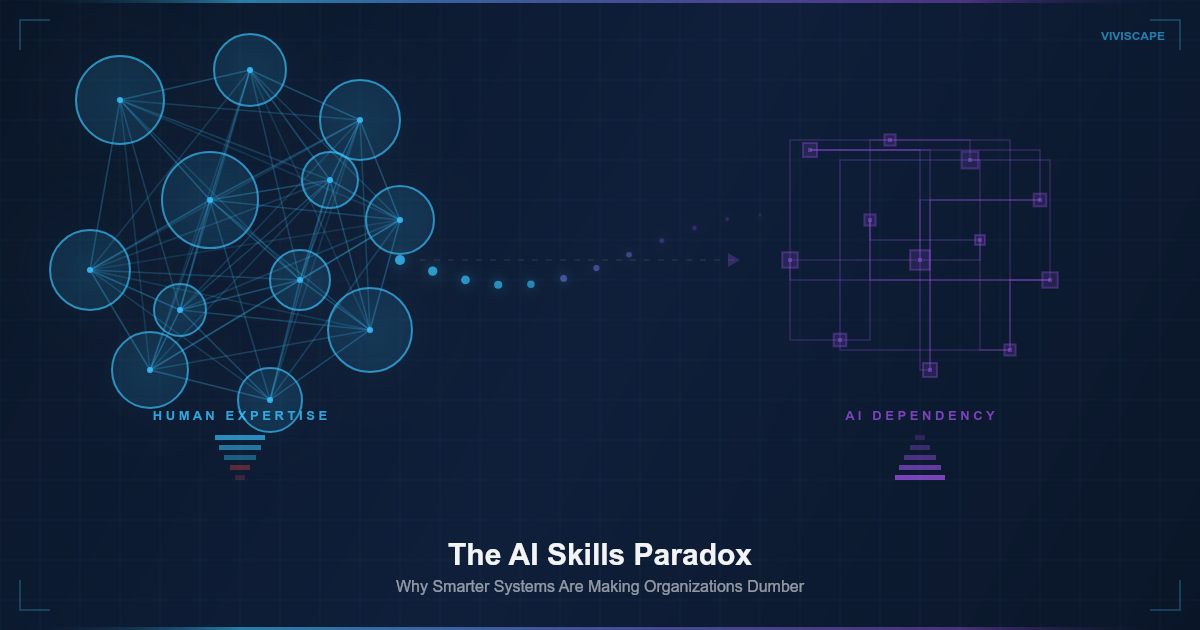
This is the AI skills paradox: the more intelligent your systems become, the less intelligent your organization may be getting.
The Erosion Nobody Planned For
When AI handles the routine decisions, something subtle happens to the people who used to make them. They stop practicing.
This is not a theoretical concern. Harvard Business Review's Graham Kenny and Ganna Pogrebna recently documented how organizations become "more automated yet less adaptive; more data-driven yet less wise; more efficient yet less legitimate" as AI displaces the deliberative processes that build expertise.
The mechanism is straightforward: AI's fluent, confident outputs encourage employees to stop thinking deeply. When a system generates a credible analysis in seconds, the incentive to wrestle with the problem yourself disappears. Over time, the tacit knowledge that once lived in experienced professionals — the pattern recognition, the intuition built through thousands of decisions, the judgment that comes from getting it wrong and learning — simply does not develop in the next generation of workers.
And tacit knowledge, unlike data, cannot be recovered from a backup.
The Numbers Tell the Story
The scale of this problem is becoming impossible to ignore:
The skills gap is already costing trillions. IDC projects $5.5 trillion in global economic losses from sustained skills shortages — driven by product delays, quality issues, and missed revenue. This is not a future projection. Over 90% of global enterprises are expected to face critical skills shortages by 2026.
Organizations are not redesigning for AI. Eighty-four percent of organizations have not redesigned their jobs or workflows around AI, according to Deloitte's 2026 State of AI report. They are layering AI on top of existing structures, which means the old roles are hollowing out without new ones being built to replace the capabilities being lost.
Training is not keeping pace. Only 33% of employees received any AI training in the past year. Meanwhile, AI-exposed roles are evolving 66% faster than traditional positions. The gap between what organizations need and what their workforce can deliver is widening, not closing.
The talent pipeline is drying up. Fifty percent of employers report difficulty filling AI-related positions, while 46% cite lack of talent as their primary barrier to AI adoption. The paradox deepens: the more AI you deploy, the harder it becomes to find people who can work alongside it effectively.
Three Ways AI Quietly Degrades Organizational Intelligence
The damage is not obvious because it does not look like failure. It looks like efficiency. But underneath the productivity gains, three forms of institutional erosion are taking hold.
1. Cognitive Offloading
When AI handles analysis, forecasting, and recommendation, professionals lose the repetitions that build expertise. Junior analysts who never manually build a financial model cannot spot when an AI-generated one is subtly wrong. Engineers who never debug a system from scratch lose the diagnostic instincts that matter most during a crisis.
The skills that matter most — judgment under uncertainty, systems thinking, ethical reasoning — develop only through active use. Delegate them to AI, and you do not automate the skill. You eliminate it.
2. Hidden Moral Decisions
AI systems make thousands of decisions that used to require human deliberation: who gets a loan, which resume advances, how resources are allocated. These are not technical choices. They are value judgments embedded in algorithmic logic.
When organizations lose the practice of explicitly debating these decisions, they lose the ability to course-correct when standards shift. The governance challenge is not just about regulatory compliance — it is about maintaining the institutional capacity to define and apply your own standards.
3. Eroded Social Infrastructure
Collaborative problem-solving is not just a nice way to work. It is how organizations build shared understanding, transfer knowledge, and develop trust. When AI-mediated workflows replace the conversations, debates, and joint decisions that once defined how teams operate, the social infrastructure that holds organizations together weakens.
As enterprises deploy thousands of AI agents across their operations, the spaces where humans develop judgment through interaction are shrinking — and with them, the organizational culture that no algorithm can replicate.
What Smart Organizations Are Doing Differently
The solution is not to slow AI adoption. It is to be deliberate about what you protect.
Identifying non-negotiable human capabilities. Before deploying AI into any workflow, smart organizations explicitly map which skills are critical to competitive advantage and ensure those skills continue to be actively practiced. Strategic judgment, creative problem-solving, stakeholder relationship management, and ethical reasoning are not tasks to automate — they are capabilities to cultivate.
Designing deliberate friction. Some organizations are introducing what might seem counterintuitive: intentional slowdowns. AI-free strategy sessions where teams work through problems using only their judgment before consulting AI. Apprenticeship structures that require junior staff to rotate through complex decision-making roles. Paired sign-offs between experienced professionals and newer staff on high-stakes decisions. The goal is not to reject AI but to ensure that the human muscles AI tends to atrophy keep getting exercised.
Treating collaboration as infrastructure. Spaces where people debate, disagree, and build shared understanding are not optional meetings to optimize away. They are the mechanism through which organizations develop the judgment, trust, and adaptability that AI cannot provide. Cutting them for efficiency is like removing the foundation to save on construction costs.
Investing in verified skills intelligence. Rather than assuming training programs are working, leading organizations are implementing continuous measurement and validation of workforce capabilities — what researchers call "verified skills intelligence." This means tracking not just whether people completed a course, but whether they can actually apply the skills their roles now demand.
Are your AI investments building capability or creating dependency?
The Uncomfortable Question
Most enterprise AI strategies measure success by how much human work they eliminate. Fewer manual steps. Faster processing. Lower headcount per transaction.
But what if the work you are eliminating is the work that makes your organization capable?
The AI skills paradox is not about being anti-technology. It is about recognizing that some forms of human capability cannot be treated as overhead to be optimized away. They are the competitive advantage itself.
Organizations that understand this will deploy AI in ways that amplify human judgment rather than replace it. They will invest as heavily in skill development as they do in system deployment. And they will measure AI success not just by efficiency gained, but by capability preserved.
The ones that do not will discover, eventually, that they have built very fast, very efficient organizations that can no longer think for themselves.
ViviScape designs AI implementations that strengthen organizational capability rather than eroding it. If your AI strategy needs a human-capability audit, let's talk.
Ready to build AI that strengthens your organization?
ViviScape designs human-AI workflows that amplify judgment instead of replacing it — keeping your team capable as your systems get smarter.
Book a Free Consultation