
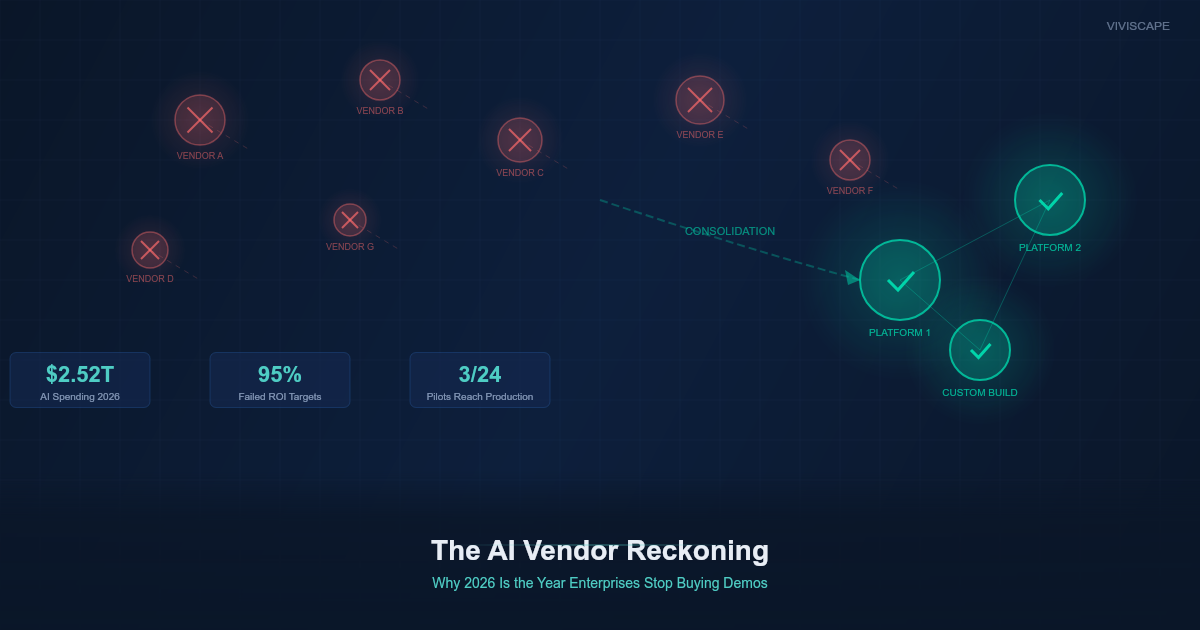
- Worldwide AI spending will hit $2.52 trillion in 2026 (+44% YoY), yet 95% of enterprise AI investments missed ROI targets and only 31% of use cases reached full production. Enterprises are buying from fewer vendors, not more.
- The era of buying demos is ending. Vendors promise 6–8 week implementations; actual deployments average 5–9 months. "Agent washing" — rebadging legacy automation as autonomous agents — is eroding vendor credibility across the market.
- Three forces are collapsing the market: CFOs taking control of AI procurement, incumbent software providers winning distribution by bundling AI into existing platforms, and consolidation replacing best-of-breed toolchains.
- To survive the reckoning, buyers should demand outcome-based contracts tied to renewal cycles, require production references (not demos), and consolidate toward fewer vendors with demonstrated integration into their stack.
Worldwide AI spending will reach $2.52 trillion in 2026 — a 44 percent increase over 2025. Enterprise technology investment will hit $5.6 trillion globally. Eighty-six percent of organizations say their AI budget is increasing.
And yet, enterprises are buying from fewer vendors, not more.
That is the defining shift of 2026: the era of AI procurement through demonstration, proof of concept, and innovation theater is ending. What is replacing it is outcome-driven buying — where measurable business results, not impressive demos, determine which vendors survive the next budget cycle.
Welcome to the AI vendor reckoning.
The Pilot Graveyard
The scale of enterprise AI experimentation over the past two years has been extraordinary — and extraordinarily wasteful. In Asia-Pacific markets, companies launched an average of 24 generative AI pilots annually. Only three reached production. Ninety-five percent of enterprise AI investments have failed to meet ROI targets. Only 31 percent of AI use cases have reached full production deployment.
The math is brutal: for every dollar spent on AI pilots, most organizations got a demo, a deck, and a depreciated proof of concept that never made it to production.
The problem is not that enterprises are under-investing. It is that they are over-experimenting — spreading budgets across too many vendors, too many use cases, and too many proofs of concept that were never designed to scale. As one Databricks Ventures VP predicted, 2026 is the year enterprises "start consolidating their investments and picking winners."
The best-of-breed rationale for adding new AI suppliers has hit a two-year low. CIOs are no longer assembling toolchains. They are pruning them.
The Promise-Reality Gap
At the center of the vendor reckoning is a credibility crisis. Vendors promise six-to-eight-week implementations. Actual enterprise deployments average five to nine months. Vendors sell "self-learning" systems that require continuous human feedback and periodic retraining. Vendors demo seamless integration while internal teams discover months of custom middleware work ahead.
As MindFinders reported: "The gap between promise and reality is where enterprise AI budgets go to disappear."
The credibility crisis extends beyond timelines and costs. The shadow agent governance crisis has exposed how many "AI agent" solutions are what industry analysts now call "agent washing" — legacy automation tools with conversational interfaces that operate according to predefined workflows, not systems that actually reason about goals and adapt to context.
Enterprises that bought the demo are discovering they purchased sophisticated chatbots, not autonomous agents. And they are not renewing.
How many of your AI vendor contracts delivered the outcomes they promised at the proof-of-concept stage?
If the answer is uncomfortable, you are not alone — and the solution is not more vendors.
What Changed in 2026
Three forces are converging to end the demo-buying era:
1. CFOs Took Control
The AI ROI Reckoning is not just a measurement challenge — it is a procurement revolution. Seventy-three percent of CEOs now own AI decisions, double the rate from a year ago. But it is CFOs who are reshaping how those decisions translate into vendor contracts.
Direct financial impact has nearly doubled as the primary ROI metric for AI investments, rising to 21.7 percent. Productivity gains — the vague, hard-to-verify justification that sustained years of experimental spending — fell from 23.8 percent to 18 percent as the top justification. Boards are done with productivity proxies. They want revenue, margin, and cost reduction tied to specific vendor deliverables.
Gartner positions 2026 within the "Trough of Disillusionment" — the phase where procurement controls planning rather than innovation departments. ROI must be measurable within renewal cycles to secure continued funding.
2. Incumbents Won the Distribution War
Gartner's forecast reveals a structural shift: AI will most often be sold to enterprises by their incumbent software providers rather than bought as part of new moonshot projects. The implication is devastating for standalone AI vendors: enterprises are not looking for new relationships. They are looking for AI capabilities bundled into the platforms they already use.
The bundling advantage is real. Incumbent vendors offer coterminous agreements, committed-use discounts, and integrated security reviews. A standalone AI vendor competing against an incumbent's bundled offering needs to demonstrate dramatically superior outcomes — not just marginally better technology.
By 2026, CIOs are trading sprawling AI toolchains for platform SKUs and fewer invoices. The consolidation is not about reducing innovation. It is about reducing integration complexity, security surface area, and vendor management overhead.
3. Data Readiness Became the Gating Factor
Sixty-five percent of organizations lack AI-ready data infrastructure. This single statistic explains more vendor failures than any technology limitation. Vendors who sell AI solutions without addressing the data debt problem are selling into a foundation that cannot support what they are building.
The enterprises that are successfully scaling AI are the ones investing in data foundations before vendor selection — not the other way around. AI infrastructure will consume $1.366 trillion in 2026, more than half of total AI spending. The market has spoken: compute and data infrastructure come first. Application-layer AI vendors come second.
The New Procurement Playbook
The enterprises navigating the vendor reckoning successfully are adopting a fundamentally different procurement approach:
Outcome-First Evaluation
Instead of evaluating vendors on capability demonstrations, leading organizations define measurable business outcomes before the first vendor conversation. The evaluation criterion is not "can this tool do X?" but "will this tool deliver $Y in measurable impact within Z months?"
Ninety-one percent of enterprise buyers now prioritize technical expertise over feature lists. Eighty-eight percent require proven track records with comparable use cases. Seventy-nine percent rate integration capability as a top criterion — not because integration is exciting, but because integration failures are the leading cause of pilot-to-production collapse.
Build Where It Differentiates, Buy Where It Does Not
The vendor consolidation trend does not mean enterprises should build everything in-house. It means they should be strategic about the boundary between buy and build. Commodity capabilities — document processing, basic classification, standard analytics — are best sourced from incumbent platforms. Differentiating capabilities — custom orchestration, domain-specific agent workflows, proprietary process intelligence — are best built.
The organizations achieving the highest AI ROI are those that build custom where competitive advantage demands it and consolidate vendors where standardization reduces cost. The last mile problem is not solved by buying more tools. It is solved by building the integration and change management infrastructure that makes tools actually work.
Due Diligence Over Demos
Enterprise AI procurement in 2026 requires a due diligence discipline that most organizations lacked during the experimentation phase. Eight questions should precede any vendor contract:
- Can the vendor provide reference customers in your specific industry with comparable data complexity?
- Who owns the data, the model outputs, and the intellectual property generated during the engagement?
- What is the realistic integration scope — not the demo scope — for your existing systems?
- Are performance SLAs contractually binding with financial consequences for non-delivery?
- What is the exit strategy? Can you extract your data and models if the relationship ends?
- How many internal FTEs will be required for ongoing operation — honestly?
- Has legal reviewed the AI-specific contract terms, including liability for autonomous decisions?
- How will the vendor's product roadmap affect your existing deployment if priorities shift?
If a vendor cannot answer these questions clearly, the demo is irrelevant.
The Consolidation Forecast
The next twelve months will reshape the enterprise AI vendor landscape. The dynamics are clear:
Budgets will increase for a narrow set of AI products that clearly deliver results. They will decline sharply for everything else. A small number of vendors will capture a disproportionate share of enterprise AI budgets while many others see revenue flatten or contract.
Contract cycles will drive strategy. Enterprise scaling now depends on demonstrating concrete operational improvements — whether in contact center efficiency, sales cycle acceleration, or incident reduction — tied directly to renewal timelines.
Custom integration partners will gain share. As enterprises consolidate platform vendors and build differentiating capabilities in-house, the demand shifts from product vendors to integration and orchestration partners who can connect platforms, customize workflows, and ensure the resilience that off-the-shelf solutions cannot guarantee.
The Bottom Line: Stop Buying Demos, Start Buying Outcomes
The AI vendor reckoning is not a correction. It is a maturation. The organizations that thrived during the experimentation era — the ones with the most pilots, the most vendor relationships, the most proofs of concept — are not necessarily the ones that will thrive in the consolidation era.
The winners in 2026 are the enterprises that can distinguish between vendors who deliver outcomes and vendors who deliver demos. That distinction requires procurement discipline, technical due diligence, and a clear-eyed assessment of where to build and where to buy.
Two-point-five-two trillion dollars will be spent on AI this year. The question is not whether your enterprise will spend. It is whether your spending will produce results — or another round of pilots that never ship.
Stop buying demos. Start buying outcomes.
ViviScape builds custom AI solutions designed around your business outcomes — not vendor feature lists. If your AI procurement strategy needs a reset, let's start with what you actually need.
Ready to stop buying demos and start building outcomes?
ViviScape designs custom AI solutions with measurable business results baked in from day one — not bolted on after the vendor contract is signed.
Book a Free Consultation