
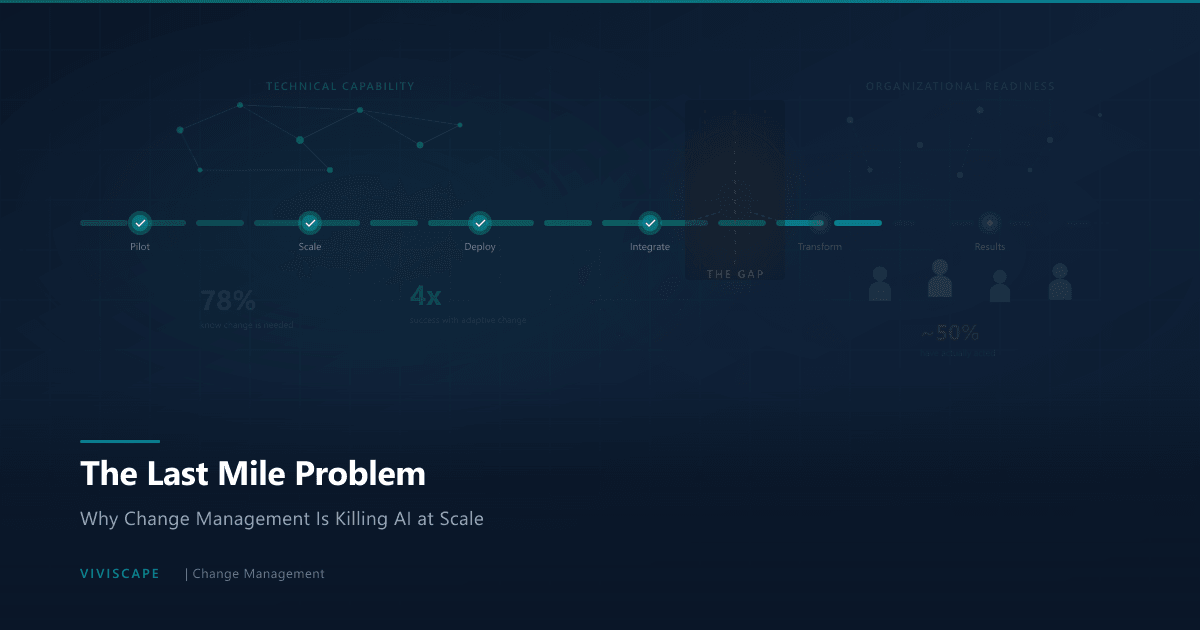
- 78% of CHROs agree workflows and roles must change to realize AI value, but only just over half of organizations have actually redesigned them. Most AI transformations die in this gap.
- 66% of organizations report AI productivity gains, but only 34% are truly reimagining the business (Deloitte). Enterprises are "pilot-rich, transformation-poor" — accumulating use cases without operating-model change.
- Seven structural frictions block the last mile. Three biggest: process debt (AI layered on pre-AI workflows), the identity problem (experts hoarding tribal knowledge as AI threatens professional identity), and pilot proliferation without integration.
- The 4x multiplier: organizations that continuously adapt change plans based on employee response are 4x more likely to achieve change success. Routinized change beats inspired mandates.
A global investment bank has deployed over 250 LLM applications connected to enterprise systems. A global payments network reports 99% employee copilot adoption. By any technical measure, these organizations have succeeded at AI deployment.
Yet the gains remain, as Harvard Business Review documents, "trapped inside individual workflows."
This is the last mile problem. The technology works. The models are capable. The infrastructure is in place. But the organizational design — the workflows, roles, decision rights, and cultural habits that determine how work actually gets done — has not changed to absorb what the technology makes possible.
And it is killing AI at scale.
Pilot-Rich, Transformation-Poor
Most enterprises have no shortage of AI initiatives. The problem is that those initiatives exist as isolated improvements that never compound into business transformation.
HBR identifies this as being "pilot-rich but transformation-poor" — a state where organizations accumulate hundreds of AI use cases, each delivering modest gains within its own workflow, while the overall operating model remains unchanged. The primary obstacle, the research concludes, "is rarely model quality or data availability, but rather the 'last mile' of transformation where technical capability must meet organizational design."
The numbers confirm the gap:
Leadership knows change is needed. Seventy-eight percent of CHROs agree that workflows and roles must change to realize AI value, according to a Gartner survey of 110 chief human resources officers.
Most have not acted. Only just over half of organizations have actually redesigned or redefined roles because of AI. The majority acknowledge the need while continuing to operate with pre-AI organizational structures.
The efficiency trap persists. Sixty-six percent of organizations report AI-driven productivity gains, but only 34% are "truly reimagining the business," per Deloitte's 2026 State of AI in the Enterprise report. Two-thirds are still in the efficiency phase — the same trap that optimizes for current conditions without building adaptive capacity.
Seven Frictions That Block the Last Mile
HBR's research identifies seven structural frictions that prevent AI deployments from becoming AI transformations. Three are particularly relevant for enterprise leaders:
1. Process Debt
Just as data debt accumulates from fragmented infrastructure, process debt accumulates from decades of incremental workflow modifications. Most enterprise processes were designed for a world without AI — layering AI on top of them produces faster versions of outdated workflows, not fundamentally better operations.
The solution is what HBR calls "clean-sheet process redesign" — asking not "how can AI improve this process?" but "if we built this today with AI agents, how would we do it?" This reframing consistently produces dramatically different — and dramatically better — outcomes than incremental automation.
2. The Identity Problem
When AI takes over tasks that previously defined someone's professional identity, resistance is not irrational — it is predictable. Knowledge workers who built careers on expertise that AI can now replicate face a genuine threat, not to their employment, but to their sense of professional value.
This manifests as tribal knowledge hoarding — experts who withhold the institutional knowledge AI needs to function effectively. Not out of malice, but out of self-preservation. Organizations that fail to address this dynamic find their AI systems permanently limited by the knowledge their people choose not to share.
The response is not to dismiss the concern, but to redefine professional value around the capabilities AI cannot replicate: judgment under uncertainty, creative problem-solving, and stakeholder relationships that require human trust.
3. Pilot Proliferation Without Integration
Every successful pilot creates organizational momentum — toward more pilots. Without deliberate integration strategy, enterprises accumulate dozens of AI tools, each solving a narrow problem, none connected to the others, and collectively creating a fragmented landscape that is harder to govern and more expensive to maintain than the systems they replaced.
The shadow agent crisis is partly a symptom of this pattern: when AI deployment is distributed across teams without centralized orchestration, ungoverned proliferation is the inevitable result.
What Changes Everything: The 4x Multiplier
Gartner's research reveals a striking finding: organizations that continuously adapt their change plans based on employee responses are four times more likely to achieve change success.
Not organizations with bigger budgets. Not organizations with better technology. Organizations that treat change management as an ongoing, responsive process rather than a one-time plan.
Similarly, leaders who "routinize change" — embedding adaptation into regular operational cadence rather than relying on inspiration or top-down mandates — are three times more likely to achieve healthy AI adoption.
This suggests the last mile problem is not fundamentally about resistance to change. It is about how change is managed. The organizations failing at AI transformation are not failing because their people cannot adapt. They are failing because they treat organizational change as a project with an end date rather than a continuous operating capability.
Is your AI strategy outpacing your organizational readiness?
The Talent Remix
The change management challenge is about to intensify. Gartner advises CHROs to prepare for a "talent remix" — a period of simultaneous layoffs, redeployments, and reskilling at scale that will test every organizational design assumption enterprises currently hold.
The AI skills gap is already the number one barrier to integration, according to Deloitte. Worker access to AI tools rose 50% in 2025, but skill development and role transformation have not kept pace. Most organizations responded to the skills challenge with education — training programs and courses — rather than the role redesign that Gartner's data shows is actually needed.
This mirrors the broader pattern: organizations address the last mile problem with the tools they are comfortable with (training, communication, project management) rather than the structural changes the problem actually requires (workflow redesign, role redefinition, decision-rights redistribution, and governance transformation).
Only 42% of organizations report high strategic preparedness for AI transformation. Fewer feel ready on infrastructure, data, risk, and talent dimensions. The last mile is not getting shorter — it is getting longer as AI capabilities accelerate while organizational readiness stalls.
Five Principles for Closing the Last Mile
For organizations ready to move from pilot-rich to transformation-ready:
1. Redesign processes before automating them. Ask "how would we build this from scratch with AI?" before asking "how can AI make this faster?" Clean-sheet redesign consistently outperforms incremental optimization.
2. Treat change management as infrastructure, not a project. Build continuous adaptation into operational cadence — regular feedback loops, responsive plan adjustments, embedded change leadership at the team level. The 4x success multiplier comes from making change a routine, not an event.
3. Redefine professional identity around irreplaceable capabilities. Help knowledge workers shift their sense of value from tasks AI can do to judgment AI cannot. This is not a communications exercise — it requires structural changes to roles, career paths, and performance evaluation.
4. Integrate before you proliferate. Every new AI pilot should include an integration plan that connects it to existing systems and governance frameworks. Isolated pilots become shadow agents and process debt.
5. Pair AI-proficient teams with early deployment. Gartner recommends establishing regular cadences between HR leadership and AI teams, and placing AI-skilled staff alongside the first wave of deployments to bridge the gap between technical capability and organizational adoption.
The Bottom Line
The last mile of AI transformation is not a technology problem. It is an organizational design problem — and it is the reason most enterprises are generating productivity statistics instead of business results.
The technology to transform enterprise operations exists today. The ROI is proven for organizations that reach production scale. The models are capable, the infrastructure is available, and the use cases are clear.
What is missing is the organizational readiness to absorb what the technology makes possible. And until enterprises treat that readiness as seriously as they treat the technology itself, the last mile will remain the longest mile.
ViviScape pairs AI deployment with organizational transformation — because technology that does not change how you work does not change your results. If your AI pilots are not becoming AI outcomes, let's close the gap.
Ready to close the last mile?
ViviScape pairs AI deployment with organizational transformation — so your technology investments actually change how your business operates.
Book a Free Consultation