
Enterprise AI has a dirty secret. Organizations are running more AI pilots than ever — proof-of-concepts, hackathons, innovation sprints, internal demos — and most of them go nowhere.
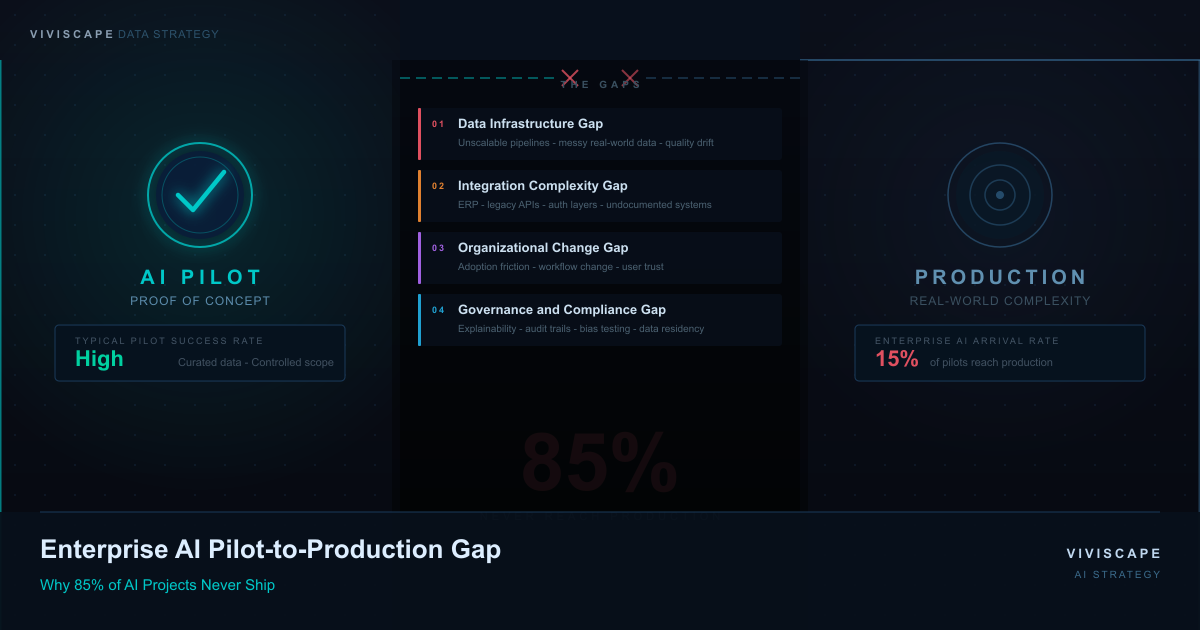
Industry research consistently finds that between 80–87% of enterprise AI initiatives fail to reach production. This is not a talent problem or a technology problem. It is a gap problem: the chasm between what works in a controlled pilot and what survives contact with production reality.
Understanding this gap — and how to cross it — is the defining challenge for enterprise AI programs in 2026.
What a Pilot Proves (And What It Does Not)
A well-run pilot proves one thing: the model can produce useful outputs on curated data in a controlled environment.
That is actually valuable. But it leaves a long list of production questions unanswered:
Does it work on messy real-world data? Pilots typically use cleaned, representative datasets assembled by engineers who know what the model needs. Production systems encounter data that is incomplete, inconsistently formatted, schema-shifted, and sometimes just wrong.
Can it scale? Demonstrating accuracy at 500 queries is meaningless if the system falls over at 50,000. Latency, throughput, and infrastructure costs all behave differently at scale.
Will it stay accurate over time? Model performance degrades as data distributions shift. A pilot captures a snapshot. Production requires ongoing monitoring, retraining pipelines, and drift detection.
Can it integrate with existing systems? The pilot likely ran in isolation. Production means integrating with data warehouses, ERP systems, authentication layers, compliance tooling, and APIs that nobody documented.
Does it meet regulatory requirements? Financial services, healthcare, insurance, and a growing list of other industries have specific requirements for explainability, audit trails, data residency, and model governance. These requirements are expensive to retrofit.
The Four Gaps That Kill AI Projects
Gap 1: The Data Infrastructure Gap
Pilots get the good data. Production gets everything else.
In a pilot, engineers manually curate the training and evaluation sets. They know which records are reliable, which columns are actually populated, and which edge cases to exclude. This curation work is often heroic — and completely unscalable.
Production AI systems need automated data pipelines: ingestion, validation, transformation, and feature engineering, running continuously, with monitoring and alerting. Building that infrastructure is a 6–18 month engineering project at most enterprises, completely separate from the AI work itself. The data debt most enterprises carry from years of analytics-first investment makes this even harder to unwind.
Organizations that skip this step find their production models degrading within weeks as data quality drifts below what the model was trained to handle.
The signal you are in this gap: Your data team spends more time preparing data for model runs than your ML team spends on model work.
Gap 2: The Integration Complexity Gap
Enterprise software environments are accumulated. Systems were bought, built, and bolted together over decades. They speak different protocols, have different authentication schemes, and contain data that partially overlaps in inconsistent ways.
Pilots sidestep this by pulling a flat file export or using a direct database connection. Production needs the AI system to be a live participant in the enterprise software ecosystem — reading from and writing to systems that were not designed with AI in mind.
The integration work is typically 3–5x more effort than the AI work itself, and it is usually invisible until the pilot hits the production planning stage.
The signal you are in this gap: The pilot worked great on a CSV export. Now you are trying to figure out how to get that data in real time.
Gap 3: The Organizational Change Gap
AI systems change how people work. That is usually the point. But most pilots treat adoption as someone else’s problem.
The AI team builds the model. The business unit is expected to use it. Nobody owns the process of helping people understand the new workflow, trust the system outputs, or know when to override it. This is the last-mile change management problem that consistently derails technically successful AI deployments.
This gap is particularly insidious because it is invisible in the metrics. The model runs. Predictions are generated. The system looks healthy from the outside. But users have quietly stopped using the outputs, or they are cherry-picking results that confirm what they already believed.
The signal you are in this gap: Usage metrics look fine, but when you talk to actual users, they describe working around the AI system rather than with it.
Gap 4: The Governance and Compliance Gap
Regulatory requirements do not apply to pilots. They apply to production systems that make or inform decisions.
For most enterprises, this means explainability requirements (can you audit why the model made a specific decision?), data lineage requirements (can you demonstrate what data the model was trained on and when?), consent and privacy requirements (was the data used in the way users consented to?), and model bias requirements (has the model been tested for discriminatory outcomes?).
Retrofitting these requirements onto a deployed system is painful and expensive. Building them in from the start requires governance expertise that most AI teams do not have and that most pilots do not budget for. The agent governance stack that enables compliant AI deployment needs to be established before the first production system, not after it.
The signal you are in this gap: Legal gets involved after the pilot is done, and the conversation starts with discussing what this system actually does.
Your AI pilots prove the model works. The gaps determine whether it ships.
ViviScape builds AI programs designed to cross the pilot-to-production gap — data infrastructure, integration, governance, and change management built in from day one. Talk to ViviScape
The Architecture of a Production-Ready AI Initiative
Crossing the pilot-to-production gap requires treating it as a distinct project phase with its own deliverables, not as what happens after the pilot succeeds.
Phase 0 (Before the Pilot): Define production requirements first. What data infrastructure does production need? What integrations? What governance requirements? Build the pilot to prove the AI concept within those constraints, not despite them.
Data infrastructure as a prerequisite: If you do not have automated data pipelines, feature engineering workflows, and data quality monitoring, you do not have production-ready infrastructure. Build it before — or concurrently with — the AI development, not after.
Integration design at pilot stage: The pilot should test against production data sources (read-only) and production-adjacent systems. If the integration does not work in the pilot, it will not work in production.
Organizational change as a first-class workstream: Identify the process changes required on day one. Assign ownership to someone in the business unit, not the AI team. Budget for training, communication, and the performance dip that comes with any workflow change.
Governance by design: Involve legal, compliance, and risk from the project kickoff. Build audit trails, explainability, and bias testing into the development process, not as a post-deployment check.
The 3x Rule for Production Timelines
A rule of thumb that survives contact with reality: whatever the pilot team estimates for production deployment, multiply by three. This mirrors the broader pattern in enterprise AI roadmap planning — the same external dependencies and governance loops drive systematic timeline slippage across all phases of AI deployment.
This is not pessimism. It is accounting for the hidden work:
- Data infrastructure build-out: typically underestimated by 2–4x
- Integration complexity: typically underestimated by 3–5x
- Testing at scale: typically underestimated by 2x
- Organizational change management: typically not estimated at all
- Regulatory review: typically not estimated at all
The teams that hit production timelines are the ones that include all of this work in their plans from the beginning.
What Separates the 15% That Ship
Organizations that successfully move AI from pilot to production share consistent characteristics:
Executive sponsorship with budget authority. Not interest, not enthusiasm — actual budget authority for the infrastructure, integration, and change management work that pilots never need.
Cross-functional ownership. The AI team builds the model. A separate team or workstream owns integration, infrastructure, and change management. These do not naturally live in the same team, and pretending they do leads to this work never happening.
Production-first thinking. The pilot is designed to prove production viability, not to produce impressive demo results. Evaluation criteria for pilot success include data pipeline feasibility, integration complexity assessment, and governance compliance, not just model accuracy.
Realistic timeline planning. The production plan is written before the pilot completes, with full resource allocation for all workstreams, including the ones the AI team does not own.
Starting From Where You Are
If you have AI pilots that have stalled on the path to production, the first step is diagnosis. Which of the four gaps is the actual blocker?
For most enterprises, the honest answer is gap 1 (data infrastructure) combined with gap 4 (governance). The integration and organizational change gaps are usually visible earlier and get addressed during the extended pilot phase.
The data infrastructure and governance gaps are harder to see because they are not in the AI team’s field of vision. They are upstream (data) and compliance-adjacent (governance). Fixing them requires pulling those stakeholders into the conversation early — ideally, before the next pilot starts.
The 15% of enterprise AI initiatives that reach production did not get there by accident. They got there by treating the gap as a project, not a handoff.
Key Takeaways
- 80–87% of enterprise AI pilots never reach production — the gap is not the model, it is data infrastructure, integration, organizational change, and governance
- Pilots prove the AI concept under controlled conditions; they do not prove the production system
- The 3x rule: production timelines are approximately three times pilot team estimates when all workstreams are included
- The 15% that ship define production requirements before scoping the pilot, not after it succeeds
- The gap is a project, not a handoff — it requires dedicated resources, ownership, and timeline from day one
85% of AI pilots stall on the path to production. Yours doesn’t have to.
ViviScape designs AI programs built for production from day one — data infrastructure, integration architecture, governance, and change management included. Schedule a consultation to assess where your AI initiative stands.
Schedule a Free Consultation