

- If something takes 3 days that should take 10 minutes, your system is broken. No qualifiers.
- The Manual Work Tax is the operational cost every business pays when it runs critical processes through people, spreadsheets, and disconnected systems instead of integrated software.
- It does not appear on any P&L. It accumulates in the gaps between systems and the handoffs between people — and it compounds with growth.
- It inflates headcount, delays leadership decisions, and erodes operating margin without ever surfacing as a single line item.
- It is not a people problem. It is a system design failure that gets blamed on people.
- There is no neutral position. Every quarter you tolerate the tax, the operators who systemized last quarter widen the gap on you. The window to compete on equal footing is closing — and what is lost is not recovered.
The Manual Work Tax has a tell.
It shows up the same way in every business we walk into: a simple-sounding request that takes far longer than it should. A report. A data pull. A client packet. Hours pass. Days pass. Work gets duplicated. Context gets lost. Three days later, the task is finally complete.
The instinct is to find the slow person.
There is no slow person. The work is slow because the system around the work is broken, and the people inside it are absorbing the breakage in real time.
Let's name it directly.
If something takes 3 days that should take 10 minutes, your system is broken.
No qualifiers. The operators who keep saying "we just need more capacity" keep paying the tax. The ones who say "the system is broken" go fix it. The difference between those two groups is about to become the difference between who is still competing in three years and who is not.
Five Truths You Cannot Argue With
- Manual work is not an efficiency issue. It is a system design failure.
- If your team is coordinating work, your systems are not doing their job.
- Hiring is how companies hide the Manual Work Tax.
- The faster you grow, the more expensive this gets.
- It gets worse every year you do not fix it.
If any of those land, you have a Manual Work Tax problem. The size of the problem is the only open question.
The Manual Work Tax Is a Real Cost Category
Most operating costs sit on a P&L. The Manual Work Tax does not.
It accumulates in the gaps:
- Data scattered across systems that do not share a source of truth
- Processes that exist only in the heads of specific people
- Approvals routed through email, chat, and tribal knowledge
- Manual handoffs filling every space between two pieces of software
- Spreadsheets running production logic no one else can read
Each of these is a small inefficiency. Together, they form a structural cost that scales with the business. The more volume you have, the more expensive your manual work becomes — because every additional unit of revenue rides on the same fragile coordination layer.
That cost has a name. It deserves to be named.
Where the Manual Work Tax Hides
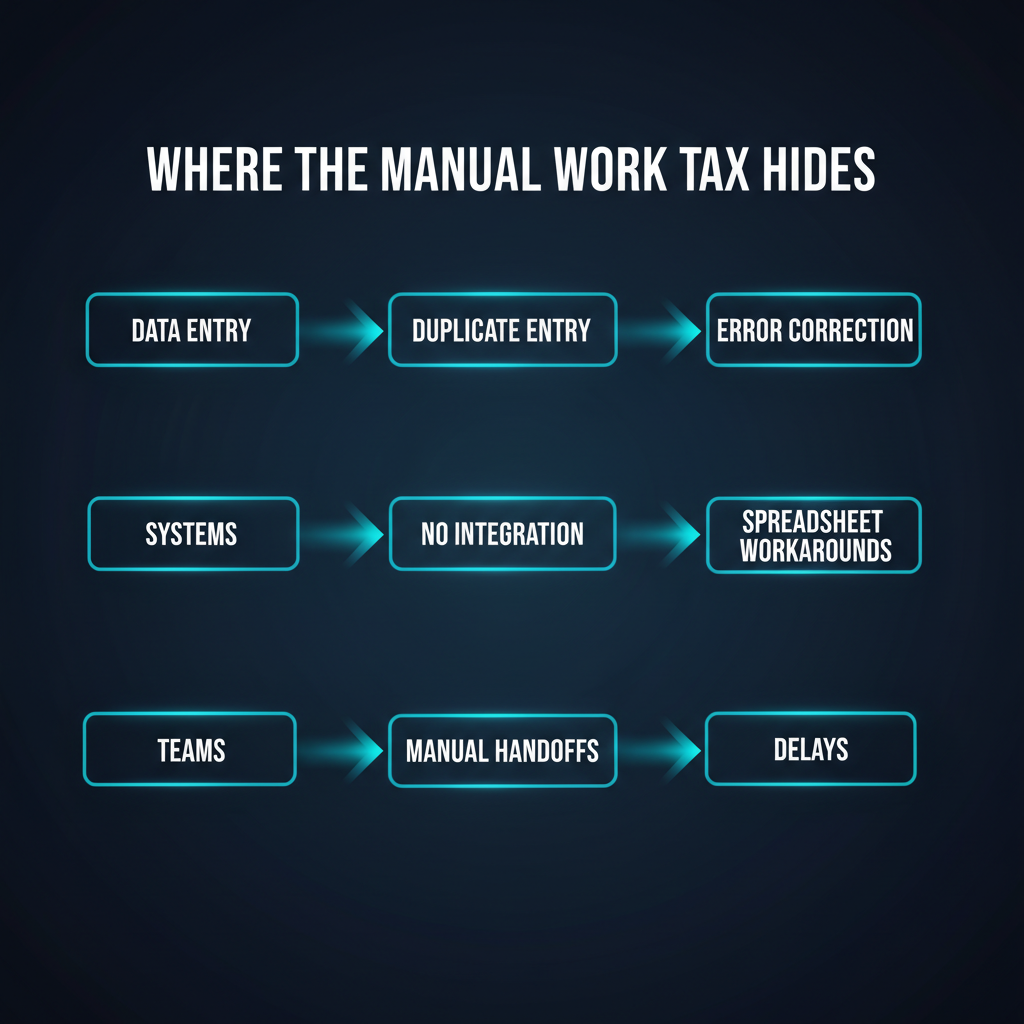
The patterns repeat across industries:
- Data Entry → Duplicate Entry → Error Correction
- Systems → No Integration → Spreadsheet Workarounds
- Teams → Manual Handoffs → Delays
If a process in your business runs through any of those chains, that process is paying tax every time it runs.
This Is Not a People Problem
The default response to slowness is to add people.
More coordinators. More analysts. More project managers. The leadership team frames it as a capacity problem and signs another offer letter.
It does not work, and it does not work for a reason that is structural rather than personal: hiring does not eliminate the friction. It distributes it.
You now have more humans paying the same tax — and the coordination overhead between them grows alongside the headcount. Each new hire creates new handoffs, new approvals, new context to maintain. Six months later, the same task still takes three days. The team is just larger.
The pattern repeats because the underlying system never changed.
Hiring more people to absorb a broken system is not a strategy. It is a confession.
How a 10-Minute Task Becomes 3 Days
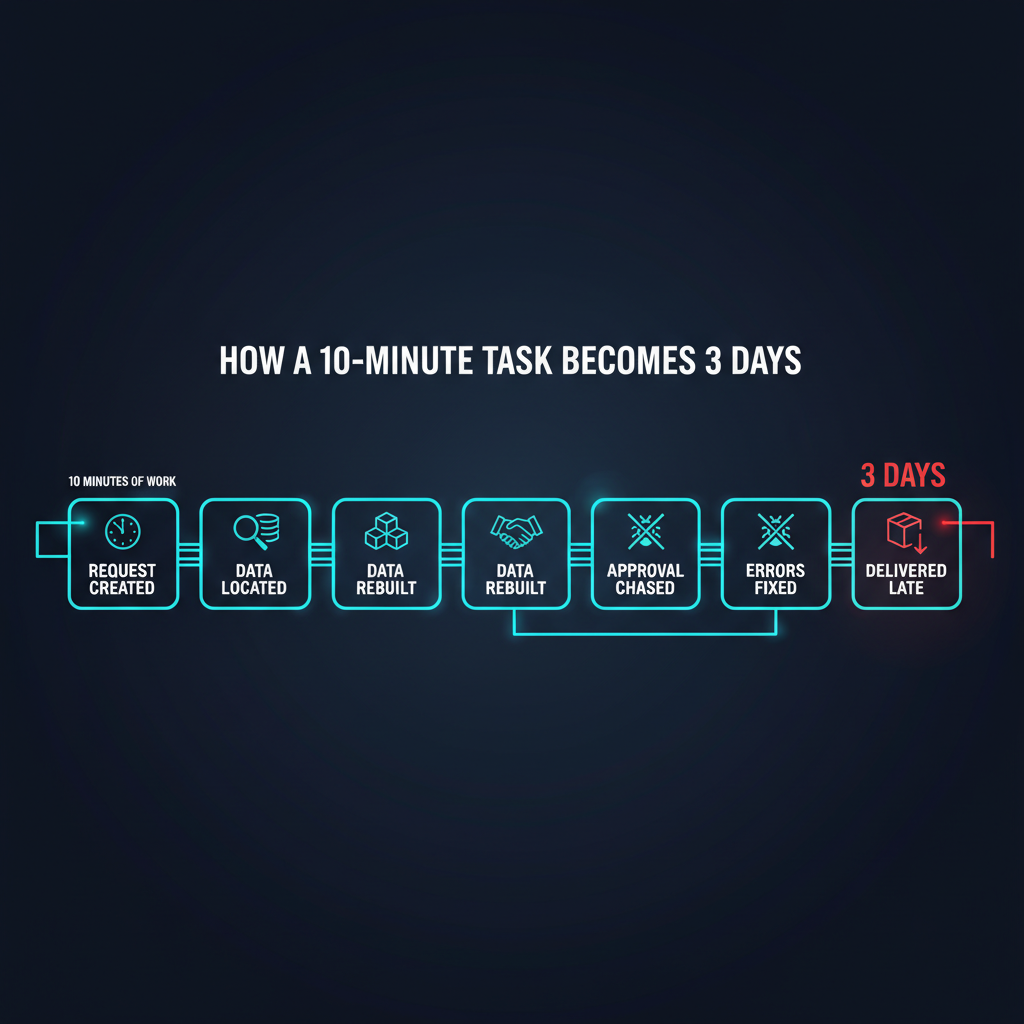
The actual work, when it finally happens, is ten minutes. The other two days, twenty-three hours, and fifty minutes are the tax. Look at where it goes.
- Request Created. Someone asks for a report, a pull, or a deliverable.
- Data Located. The assignee opens three systems that do not share an identifier and starts stitching context by hand.
- Data Rebuilt. They reconstruct a version of something a colleague already built last quarter, because no one knows where it lives.
- Approval Chased. The result routes through an approver who is in meetings. Slack pings. Email follow-ups. Hours lost.
- Errors Fixed. Two systems disagreed on a customer ID. Corrections take another half-day.
- Delivered Late. The deliverable goes out three days after the request. The decision it was meant to inform has already moved.
None of those steps is anyone's fault. All of them are predictable outputs of a system that was never designed to run end-to-end.
This is what a system design failure looks like in practice. The output is exactly what the design predicts.
Manual Work vs System-Driven Operations
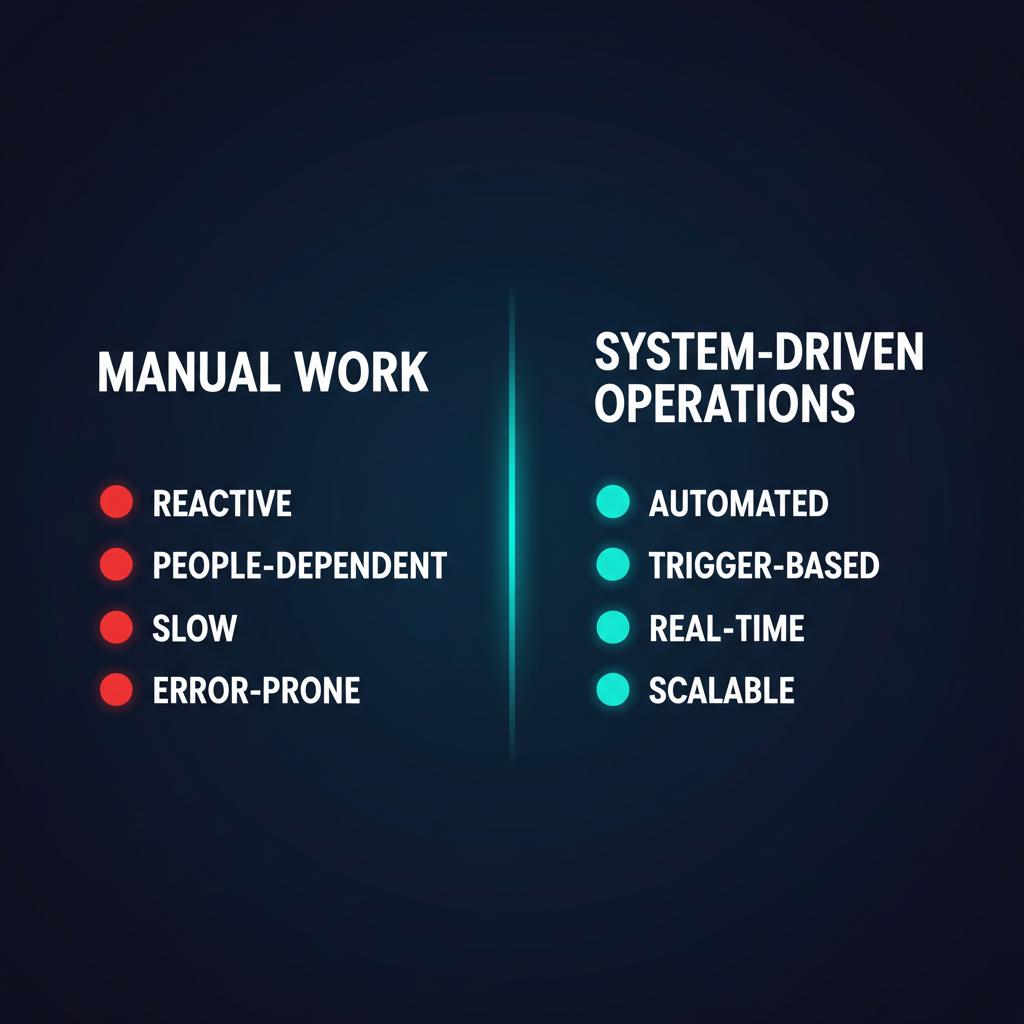
The companies pulling ahead in 2026 are not working harder. They are running their operations on a fundamentally different design.
In a system-driven operation, the same request triggers a workflow rather than a chase. Data flows automatically across systems that share a contract. Approvals route to the right person with full context. Exceptions surface at defined control points instead of being discovered three days late. People spend their time on judgment, not retrieval.
The 3-day task becomes a 3-hour task. Then a 30-minute task. Then it runs on its own.
Not because anyone is faster. Because the work no longer depends on anyone chasing it.
This is not a stylistic preference. It is a structural advantage that compounds, and the operators who have it are not giving it back.
The Bill You Are Already Paying
The Manual Work Tax compounds in three directions at once.
It inflates headcount. Every new customer adds manual coordination, which adds operational hires, which adds manager hires to manage them. Capacity grows linearly with cost — exactly the model a software-driven operation is engineered to avoid.
It delays decisions. Leadership is making calls on data that is three days old, often longer. By the time the report arrives, the question has moved.
It erodes margin. The work that should compress as the business scales instead expands. Gross margin holds, but operating margin slips quarter over quarter, and no single line item explains why.
It punishes growth. The faster you grow, the more expensive this gets. Volume that should reduce unit cost instead multiplies coordination overhead. Companies that do not fix this get slower as they scale, not faster — and the slowdown is the part competitors notice first.
Compound those four over twelve months in a growth year and the picture is clear. The business runs harder, hires more, decides slower, and ends the year less profitable than the same revenue should have produced. The gap shows up in your benchmarks before it shows up in your P&L. By the time the P&L tells the story, your competitors already know.
The Companies Fixing This Are Pulling Away — Permanently
The companies that have already done this work are not standing still. Every additional process they systemize widens the gap. There is no neutral position here. Either you are closing the gap or someone else is widening it on you.
A competitor whose 3-day task is now a 30-minute task is not just faster. They have lower unit costs, more capacity per head, and management decisions made on real-time data. They can absorb a price war you cannot. They can take on a customer cohort you do not have the operational headroom to serve. They can quote tighter, ship faster, and reinvest the margin you are still spending on coordination. They will outpace you without hiring a single additional person.
The window in which a manually-run operation can compete on equal footing is closing. It will close faster in the next twelve months than it has in the last twenty-four. The operators who decide this is a priority next quarter will be one quarter behind the operators who decided this quarter — and that quarter is not coming back.
Where Is This Happening in Your Business?
Pick the simplest-sounding request your team handled last week — the one that took three days when it should have taken thirty minutes.
- What systems did the person open?
- How many of them shared data automatically?
- How many handoffs sat between the request and the deliverable?
- What was the work, and what was the tax?
The answer is the design problem. The cost is what you have been paying every day to keep working around it.
The decision in front of you is not whether to fix it. It is whether you fix it before your competitors finish doing the same.
Every quarter you wait, you pay the tax twice — once in margin, once in market position.
Stop paying the tax. Quantify it first.
The Manual Work Tax Diagnostic identifies where your operation is still running on humans, quantifies the tax in annualized dollars, and ranks the three highest-leverage processes to systemize before your competitors do. Board-ready. Human-led. Five business days. From $497.
Get the Diagnostic Talk to Our Team