
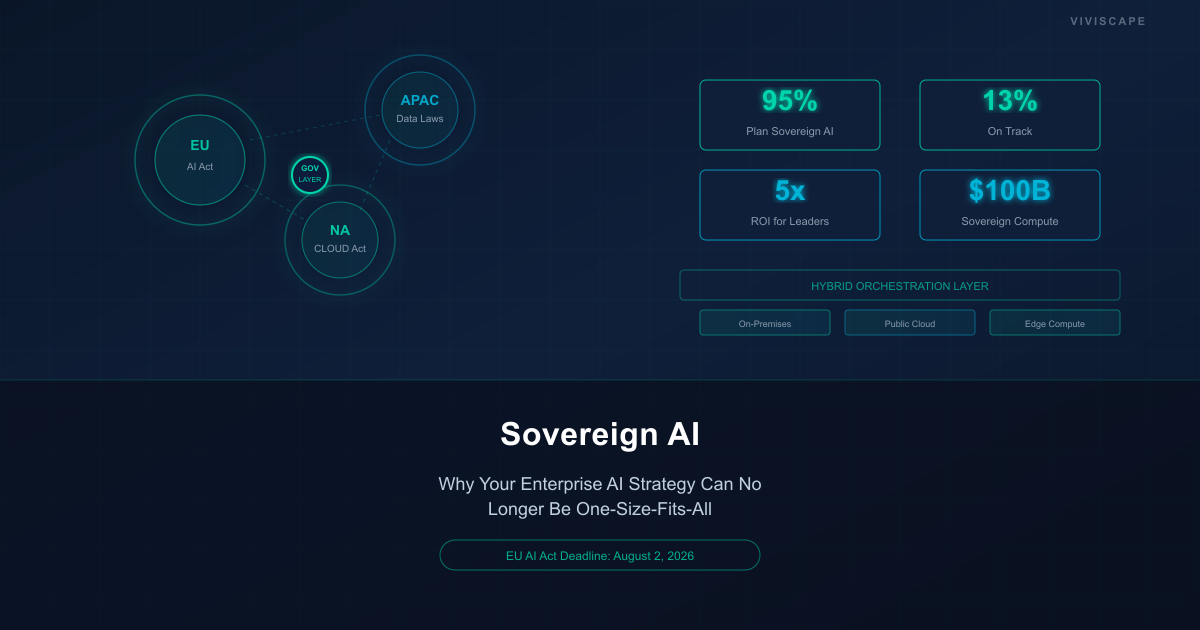
Ninety-five percent of enterprise leaders plan to build their own AI and data platform within the next thousand days. Only 13 percent are currently on track. The leaders who are on track are realizing up to five times the return on investment of their peers.
That gap — between intention and execution — is the defining strategic challenge of 2026. And it is driven by a force that most enterprise AI strategies still fail to account for: sovereignty.
Not sovereignty as a political abstraction. Sovereignty as an architectural requirement — the ability to control where your AI runs, where your data lives, who can access it, and under what legal jurisdiction your models operate. The era of deploying AI through a single global cloud provider and assuming compliance will follow is ending. What is replacing it is a world where your AI infrastructure must be as regional, governed, and intentional as the markets you operate in.
The Regulatory Collision
On August 2, 2026, the EU AI Act's most consequential provisions take effect. High-risk AI systems — in biometrics, critical infrastructure, employment, law enforcement, and more — must demonstrate compliance or face penalties of up to 35 million euros or 7 percent of global annual turnover.
This is not a hypothetical compliance risk. It is a deadline with a number attached.
But the EU AI Act is only one layer of a regulatory stack that is compounding faster than most enterprises can track. GDPR governs data protection. NIS2 mandates cybersecurity standards. The Data Act regulates data sharing. The emerging Cloud and AI Development Act adds infrastructure-level requirements. And underneath all of it sits a fundamental legal contradiction that no amount of contractual language can resolve.
The United States CLOUD Act of 2018 gives American authorities the power to compel US-based technology companies to provide data regardless of where that data is physically stored. Data held in the EU by a US cloud provider can be accessed under US law — even when it belongs to non-US citizens. This creates a direct, irreconcilable conflict with GDPR, which explicitly restricts such transfers.
Over 70 percent of European businesses still rely on US hyperscalers. Seventy-two percent say data control is a top priority. Those two numbers cannot coexist indefinitely — and the AI compliance countdown is making that contradiction impossible to ignore.
Why One Cloud No Longer Fits All
The traditional enterprise AI deployment model — train in the cloud, deploy from the cloud, store everything in the cloud — was designed for a world where regulatory environments were simpler, AI workloads were experimental, and sovereignty was someone else's problem.
That world no longer exists.
A global enterprise operating in the EU, Asia-Pacific, and North America now faces a reality where each region imposes different requirements on where AI can be trained, where data can be stored, who can access model outputs, and what audit trails must exist. A single-cloud AI strategy cannot satisfy these requirements simultaneously without legal risk, architectural compromise, or both.
Gartner predicts that 75 percent of enterprises outside the United States will adopt a digital sovereignty strategy by 2030. Sixty-five percent of governments will introduce technological sovereignty requirements by 2028. The question is not whether your enterprise will need a sovereign AI strategy. The question is whether you will build one proactively — or be forced into one reactively when a regulation, audit, or incident makes the current approach untenable.
The investment landscape confirms the direction: nearly 100 billion dollars is expected to flow into sovereign AI compute by 2026 alone. This is not a niche trend. It is a structural shift in how enterprise AI infrastructure gets built.
The Architecture of Sovereignty
Sovereign AI does not mean abandoning the cloud. It means abandoning the assumption that one cloud configuration works everywhere. The architectural shift has three dimensions:
Bring AI to Governed Data
The traditional model moves data to AI — shipping sensitive information to cloud endpoints where models process it. The sovereign model inverts this: bring the AI to the governed data. Deploy models within compliant, controlled environments where data never leaves the jurisdictional boundary it was generated in.
This is not a theoretical preference. It is becoming a regulatory requirement. Enterprises that process EU citizen data through US-hosted AI endpoints face GDPR exposure that no data processing agreement fully mitigates — because the CLOUD Act conflict is structural, not contractual.
The practical implication is that enterprises need the capability to deploy AI workloads in multiple regions simultaneously, each operating under the governance framework required by that region's regulatory environment. A single deployment pipeline. Multiple sovereign instances.
Right-Size the Model
The sovereign AI movement is accelerating a parallel shift in model architecture. Massive general-purpose language models — hundreds of billions of parameters, trained on the open internet, hosted in centralized cloud infrastructure — are giving way to specialized models in the 7-to-20 billion parameter range, trained on proprietary enterprise data, and deployable on local or regional infrastructure.
This is not a step backward in capability. For most enterprise use cases, a domain-specific model trained on your organization's data outperforms a general-purpose model that knows everything about nothing relevant. And smaller models can run on infrastructure you control — eliminating the sovereignty problem at the architecture level rather than trying to solve it through legal agreements.
The data debt challenge becomes even more critical in this context. Sovereign AI is only as good as the data it is trained on. Organizations with fragmented, ungoverned data infrastructure cannot build effective sovereign models — they can only replicate their data problems in a different location.
Hybrid Orchestration
The practical reality for most enterprises is that sovereign AI requires a hybrid architecture — some workloads in public cloud, some on-premises, some at the edge, each governed according to its data classification and regulatory exposure.
This is where orchestration becomes the differentiating capability. The challenge is not running AI in multiple locations — any major cloud provider can do that. The challenge is orchestrating AI workloads across locations with consistent governance, unified observability, and coherent policy enforcement. Without orchestration, "sovereign AI" is just AI running in more places, ungoverned in more jurisdictions.
Does your AI strategy account for data sovereignty?
With the EU AI Act deadline approaching in August 2026 and the CLOUD Act creating ongoing compliance conflicts, enterprises need sovereign AI architecture — not just sovereign AI intentions.
The 120-Day Framework
For enterprises that have not started, the gap between intention and execution may feel insurmountable. It is not — but it requires a structured approach rather than a boil-the-ocean strategy.
Days 0 to 30: Unified Foundation. Establish integrated AI and data infrastructure that connects your major data sources while enforcing consistency. The goal is not to move all data — it is to create a coherent view of what data exists, where it lives, and what governance applies to it.
Days 30 to 90: Governance Layer. Introduce policy controls: encryption, data lineage tracking, auditability, and regulated access frameworks. This is the layer that transforms raw infrastructure into compliant infrastructure. Without it, you have sovereign hardware running ungoverned workloads.
Days 90 to 120: AI Operationalization. Integrate model preparation, vector indexing, inference pipelines, and hybrid-cloud controls within the governed environment. This is where sovereign AI becomes functional — models running on governed data, producing auditable outputs, within jurisdictional boundaries.
This framework is aggressive but achievable. The organizations that complete it will be positioned for the August 2026 EU AI Act deadline. The organizations that do not will be scrambling to retrofit sovereignty into AI systems that were never designed for it.
The Talent Gap
Sovereign AI requires capabilities that most enterprise AI teams were not hired to provide. Training domain-specific models on proprietary data, deploying across hybrid infrastructure, implementing governance-as-code, managing regional compliance — these are not extensions of existing cloud AI skills. They are different skills.
AI talent demand currently exceeds global supply by more than three to one. The enterprises competing for this talent are not just competing with each other — they are competing with the hyperscalers, the AI labs, and the startups that offer the most interesting problems. Building a sovereign AI capability internally means either winning that talent competition or partnering with organizations that have already built it.
Eighty-seven percent of enterprises risk falling behind if they do not commit to building sovereign AI capability. The risk is not just competitive — it is structural. Once regulations take effect and competitors have sovereign infrastructure in place, retrofitting sovereignty becomes exponentially more expensive and disruptive than building it from the start.
The Bottom Line
The one-cloud-fits-all era of enterprise AI is over. Not because the technology failed — but because the regulatory, geopolitical, and competitive environment outgrew it. Sovereignty is no longer a feature request. It is an architectural requirement.
The 13 percent of enterprises on track to build sovereign AI capability are not just compliant. They are realizing five times the return of their peers — because sovereign architecture forces the discipline that most AI strategies lack: clear data governance, intentional model design, and infrastructure that reflects how the business actually operates across regions and jurisdictions.
The other 87 percent have a window — measured in months, not years — to close the gap. The EU AI Act deadline is August 2026. The CLOUD Act conflict is not going away. And the market is not waiting for enterprises that cannot control where their AI runs.
Sovereignty is not a constraint on your AI strategy. It is the foundation your AI strategy has been missing.
ViviScape builds sovereign AI infrastructure tailored to your regulatory environment, data architecture, and operational footprint. If your AI strategy needs to work across jurisdictions — not just across departments — let's build it right.