
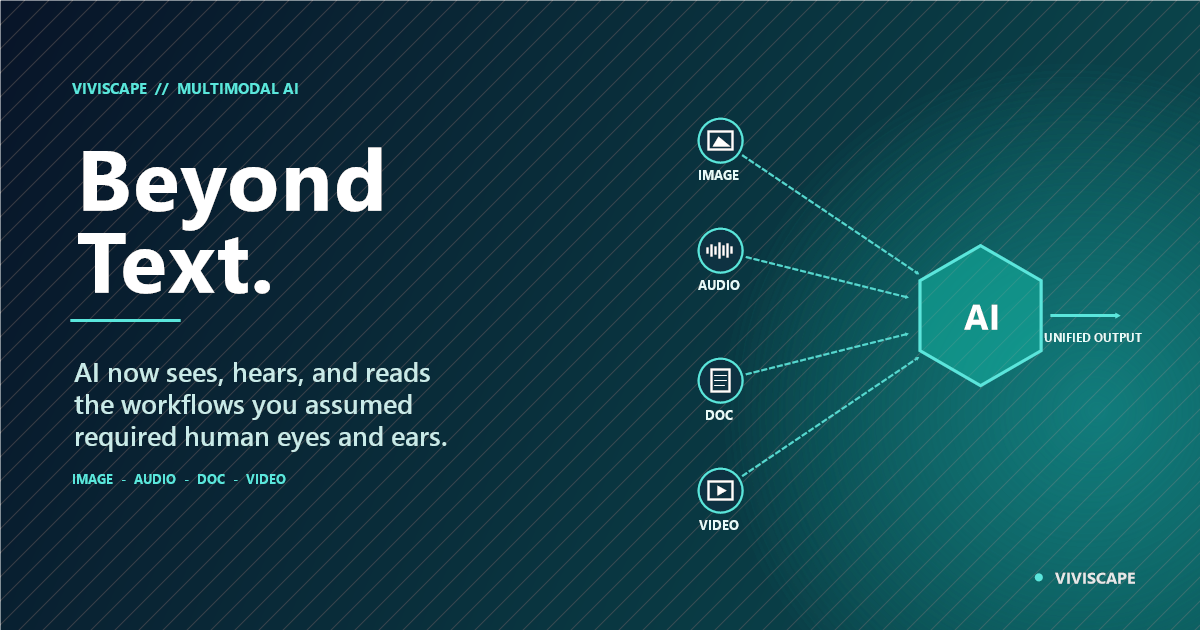
Ask most enterprises what percentage of their critical workflows involve plain text, and the answer is surprisingly low. Purchase orders arrive as PDF scans. Quality inspections generate photos. Customer calls produce audio recordings. Engineering reviews require diagrams. Field technicians submit handwritten forms photographed on phones.
Enterprise AI has been predominantly built to handle text. The workflows that were never automated — the ones still consuming significant human time and judgment — are often not text workflows at all. They are image workflows, audio workflows, document workflows, and video workflows. And the reason they stayed manual is not that automation was impossible. It is that the AI capable of handling them at enterprise quality was not available until recently.
That window has closed. Multimodal AI — systems that process images, audio, video, and documents alongside text — has matured from research capability to production-grade enterprise tooling. The organizations mapping their non-text workflows to this new capability are finding automation opportunities that did not exist two years ago.
What Multimodal AI Can Do That Text AI Cannot
The practical capabilities that define current enterprise-grade multimodal AI are different from the image captioning and basic visual question answering that characterized earlier generations.
Today's systems can extract structured data from handwritten or printed documents that do not conform to a consistent layout — invoices, receipts, contracts, forms — with accuracy that approaches and in some domains exceeds human performance. They can analyze photographs for specific defects, measurements, or conditions and produce structured outputs that feed directly into quality management systems. They can transcribe and analyze audio calls not just for content but for sentiment, compliance flags, key disclosures, and action items — simultaneously and in real time.
The unifying characteristic is that multimodal AI produces structured outputs from unstructured non-text inputs, which is precisely what makes it useful in enterprise workflows. A system that looks at an inspection photo and produces a JSON record with defect type, severity, location, and recommended action is a different category of tool than one that produces a text description of what it sees.
The Workflows That Were Always Off the Automation Map
Three categories of enterprise workflow have historically resisted automation because they required human visual or auditory interpretation. Each is now a realistic target.
Document Processing Beyond OCR
Traditional OCR extracts text from documents but cannot interpret context, layout, or handwritten content with useful accuracy. Multimodal AI processes documents as images — understanding layout, inferring relationships between fields, interpreting handwritten additions, and extracting structured data regardless of document format variation.
The enterprise application is not limited to invoices and receipts. Engineering drawings, inspection certificates, medical records, legal exhibits, historical records, and any class of document that varies too much in format for traditional OCR-plus-template approaches becomes processable. Organizations running manual document review workflows with 10 to 50 FTE can typically find 70 to 85% automation potential in this layer.
Visual Quality and Inspection Workflows
Manufacturing, logistics, construction, and field service operations generate enormous volumes of photographic documentation that humans currently review for quality, compliance, and condition assessment. Multimodal AI can be trained on domain-specific imagery to identify defects, assess conditions, verify compliance with standards, and flag anomalies — consistently, at scale, without fatigue.
The economics are compelling. A human quality inspector reviewing 200 photos per day requires full-time allocation for what a well-configured multimodal AI system processes in minutes. More importantly, AI inspection is consistent: it applies the same criteria to every image, without the variation that accumulates across shifts, reviewers, and fatigue levels.
The AI ROI reckoning is clearest in visual inspection workflows because the cost displacement is measurable and the quality improvement is quantifiable. Error rates from human inspection are documented; AI performance against the same criteria is testable before deployment.
Audio and Video Analysis
Call centers, sales organizations, compliance teams, and HR functions produce audio and video content at volumes that make comprehensive human review economically impossible. Multimodal AI changes the economics: every call can be analyzed for compliance adherence, every sales conversation can be scored against best practices, every training video can be indexed and searchable.
The compliance application is particularly significant. Financial services, healthcare, and regulated industries face audit requirements that translate directly into manual review labor. Automated audio analysis that flags potential violations, extracts required disclosures, and produces audit trails is not a convenience — it is a risk management tool that changes the economics of compliance operations.
Why Generic Tools Are Not Enough
The availability of capable multimodal AI models does not automatically translate into enterprise workflow automation. The gap between what a general-purpose multimodal model can do and what an enterprise workflow requires is the same gap that exists in text-based AI: the model can interpret the content, but the enterprise needs structured outputs that fit specific systems, specific quality thresholds, specific exception handling, and specific integration points.
An invoice processing system that extracts data with 92% accuracy still requires a process for the 8% it gets wrong. A visual inspection system that identifies defects with high confidence needs to be connected to the work order system that triggers remediation. An audio compliance system that flags potential violations needs a human review workflow for the flagged items and an audit trail for regulatory purposes.
Generic multimodal tools provide the AI capability. Enterprise deployment requires the workflow architecture around it — input validation, confidence thresholds, exception routing, system integration, and the human oversight layer that the AI without a strategy problem makes invisible until something goes wrong.
This is where domain-specific implementation creates durable value. A multimodal system configured for pharmaceutical inspection — trained on domain imagery, calibrated to regulatory standards, integrated with quality management systems, and designed with the right human review thresholds — is a different tool than a general-purpose vision model with a prompt. The difference is the same distinction that separates enterprise software from consumer apps: not capability, but fitness for the operational context.
Your non-text workflows are your largest untapped automation opportunity.
ViviScape helps enterprises map their image, audio, and document workflows to multimodal AI capabilities and build production-grade automation that fits their operations. Talk to us about what you have not been able to automate yet.
The Data and Integration Challenge
Multimodal AI introduces data requirements that text-based AI does not have. Image and video data volumes are significantly larger than text equivalents. Audio files require processing pipelines different from document workflows. The storage, transmission, and processing infrastructure for multimodal data is a real engineering consideration that organizations used to text-based AI often underestimate.
Access controls and data governance become more complex with multimodal data. An image of a patient record, a recording of an employee conversation, or a video of a facility inspection may carry privacy, compliance, or security requirements that text equivalents do not. The data protection framework needs to extend to these new data types — including where they are processed, how long they are retained, and who has access to the AI systems analyzing them.
Integration with existing enterprise systems — ERP, QMS, CRM, HRIS — is typically the constraining factor in multimodal deployment timelines. The AI capability can be configured faster than the integration layer can be built. Organizations that underestimate integration complexity will have working AI systems with no path to operational use.
How to Start
The organizations that successfully deploy multimodal AI in enterprise operations share a common starting approach: they identify one workflow where the current state is well-documented, the output requirements are clearly defined, and the volume is high enough to justify the investment.
That starting workflow becomes the template. The integration patterns, quality thresholds, exception handling, and human oversight model developed for the first deployment inform every subsequent one. The hyperautomation imperative is that enterprises need to build automation capacity systematically — not as isolated projects but as a compounding organizational capability. Multimodal automation adds a new class of workflow to that system.
The assessment questions that identify the right starting workflow: Where are humans currently spending time interpreting non-text inputs? Which of those interpretations produce structured outputs that feed other systems? Which have the highest volume, lowest variation in what good output looks like, and clearest exception criteria? The answers typically point to two or three workflows that represent 60 to 80% of the non-text automation opportunity in a given function.
The Bottom Line
Enterprise automation has captured most of the available text workflow opportunity. The frontier is non-text workflows — the image, audio, video, and document processes that have absorbed human labor for decades because the AI to handle them was not ready.
It is ready now. The organizations building multimodal automation capabilities in 2026 are accessing workflow categories that their competitors cannot yet touch. The window before this becomes table stakes is measured in years, not decades — but it is still open.
The constraint is not the AI capability. It is the workflow architecture, integration engineering, and domain-specific configuration that turns capable models into operational systems. That constraint is addressable. It requires the same systematic approach that made text-based enterprise AI work: clear workflow definition, structured outputs, explicit exception handling, and integration designed for production, not proof of concept.
Most enterprise automation stops at text. The next wave is everything else.
ViviScape builds multimodal AI systems that automate the workflows enterprises assumed would always require human eyes and ears — configured for your domain, integrated with your systems, and designed for operational use from day one. Schedule a consultation to map your non-text automation opportunity.
Schedule a Free Consultation