
The most revealing data point in enterprise AI right now is not about model performance or spending levels. It is about what happens after the AI gets deployed.
Nearly half of organizations that have introduced AI tools have done so without redesigning the workflows or roles those tools are supposed to improve. They bought the technology. They did not change the work. That is the AI workflow redesign gap — and it is the primary reason the vast majority of enterprise AI investments are delivering below expectations.
The Numbers That Tell the Story
The failure rate data for enterprise AI is striking, but it only makes sense when you understand the mechanism behind it. RAND research found that 80.3% of AI projects deliver no measurable business value. MIT data shows 95% of generative AI pilots never scale beyond initial deployment. Only 5% of organizations have successfully integrated AI into workflows at scale — despite 65% now having dedicated AI budgets.
The common explanation is that AI is overhyped, the technology is immature, or enterprise adoption is always slow. Those explanations are not wrong, but they are incomplete. The more specific explanation is process-level. Organizations are deploying AI into workflows designed for human execution, human judgment, and human capacity. They are layering new technology onto existing processes rather than redesigning those processes for human-AI collaboration. The result is a tool that technically works but does not actually change what the work costs or how it performs.
Deloitte’s 2026 State of AI in the Enterprise put a number on the redesign advantage: organizations that redesigned workflows before selecting AI tools are 2x more likely to report significant financial returns from their AI investments. Only 12% of organizations have redesigned at scale with a new operating model. The other 88% are still running old processes on new technology.
What Workflow Redesign Actually Means
Here is where a lot of the conversation goes wrong. Workflow redesign in the context of AI does not mean eliminating jobs or building autonomous systems that replace human decision-making. For most enterprise applications, that is not the right model and not what delivers value.
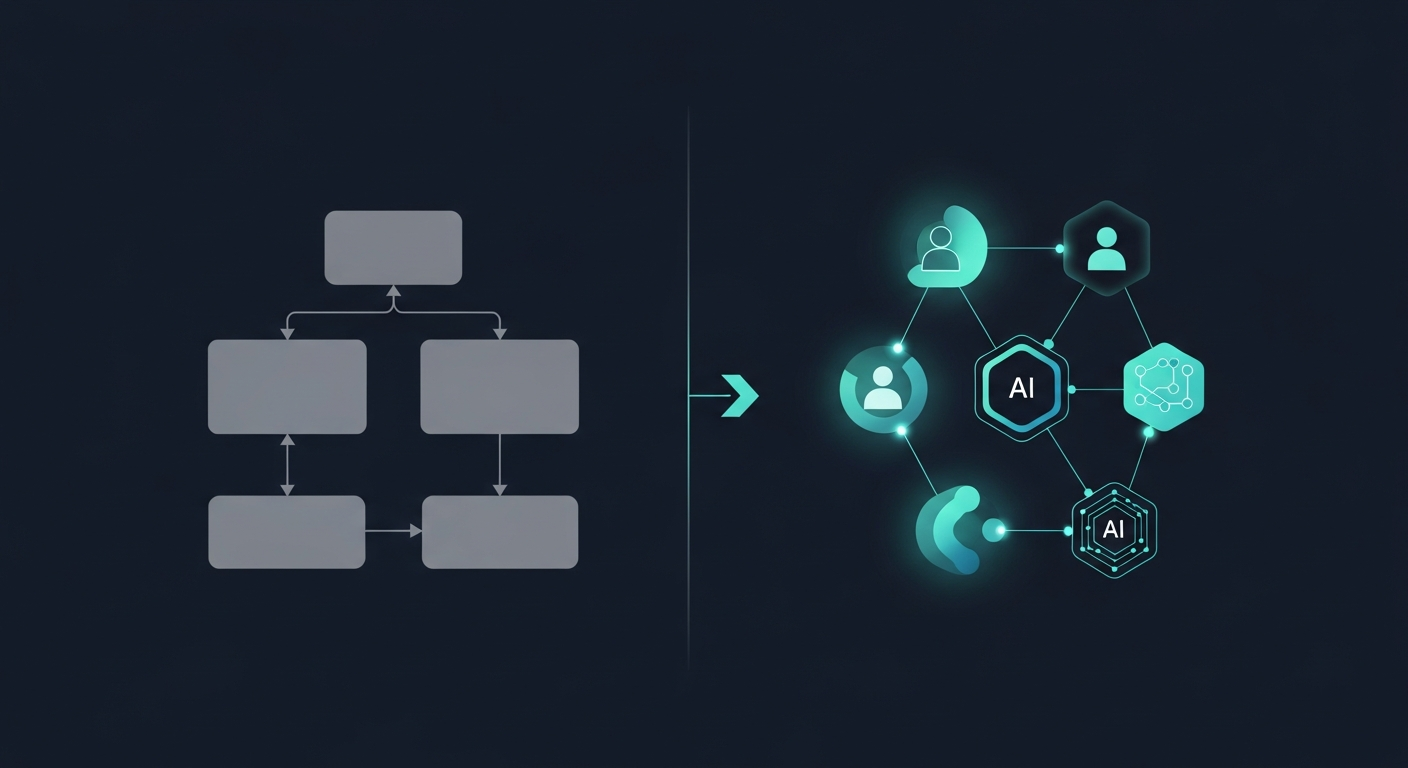
What it means is more specific: mapping the actual steps in a work process and identifying where AI can improve speed, accuracy, or consistency — then restructuring the process to take advantage of that improvement rather than just adding AI as one more step in an unchanged sequence.
A practical example. A sales team deploys an AI tool that generates first drafts of proposals based on customer data and past wins. If the workflow remains unchanged, reps receive the AI-generated draft and edit it the same way they would have edited a blank document — losing most of the efficiency gain. If the workflow is redesigned, the AI draft becomes the starting point for a fundamentally shorter review-and-customize process, with the rep’s role explicitly defined as validation and judgment rather than composition. Same tool, very different outcome. The difference is not the technology. It is the deliberate redesign of how work gets done.
Why Organizations Skip Redesign
The workflow redesign gap is not caused by ignorance. Most enterprise leaders understand conceptually that processes need to change when technology changes. The gap exists for more practical reasons.
Speed pressure. Organizations under pressure to show AI progress treat deployment as the milestone and redesign as a future-state problem. Deployment is visible. It generates executive announcements. Redesign is invisible, iterative, and unglamorous. Organizations optimize for what they can show, not what actually changes.
Structural resistance. Workflow redesign touches roles, responsibilities, and performance metrics — politically complex territory in most organizations. AI deployment does not require anyone to agree on how jobs should change. Redesign does. When the choice is between a politically difficult conversation and a technology purchase, organizations choose the purchase.
Unclear ownership. AI deployment often belongs to IT or a dedicated AI team. Workflow redesign belongs to operations, HR, and individual business functions. In organizations without strong cross-functional coordination, these communities never actually collaborate on the same problem. The technology gets deployed; the process stays unchanged because nobody owns the redesign.
Misunderstood scope. Many organizations believe that deploying good AI is itself a form of workflow improvement — that the tool will organically change how work gets done because it makes individual tasks easier. That is sometimes true for consumer applications and almost never true for enterprise workflows, where collaboration patterns, approval structures, data flows, and management expectations all need to adapt alongside the individual task.
What the Redesign Process Looks Like in Practice
The organizations closing the workflow redesign gap are not running multi-year transformation programs. They are applying a more disciplined approach to individual deployments.
They start with process mapping before technology selection. What is the actual sequence of steps in this workflow today? Where are the handoffs, the bottlenecks, and the error-prone steps? This analysis frequently reveals that organizations want to automate steps that should not exist at all — and that the automation project would be better served by eliminating the step first.
They define explicit human-AI boundaries. For every AI-assisted task, they specify what the AI produces, what humans validate, and what constitutes a handoff trigger. These definitions prevent the most common failure mode: AI output becoming just another input into an unchanged decision process, where humans re-do the cognitive work the AI was supposed to handle.
They measure at the workflow level, not the tool level. The relevant metrics are not accuracy scores or adoption rates. They are time-to-completion for specific work products, error rates at the workflow output, and capacity per person. Measuring at the tool level tells you whether the AI is being used. Measuring at the workflow level tells you whether the work has actually improved.
They treat redesign as an ongoing discipline rather than a one-time implementation. Workflows that integrate AI well at launch tend to see further improvement as teams develop judgment about where human intervention adds value and where automation can expand. The initial redesign is a starting point, not a finished state.
The Organizational Implication
The workflow redesign gap is ultimately a capability question. The organizations closing it are not necessarily doing more sophisticated AI — they are doing more disciplined implementation. That discipline requires a combination of process design expertise, change management capability, and technical understanding that most organizations do not have sitting in one place.
That combination is why implementation partnerships tend to produce better workflow redesign outcomes than internal deployments working from vendor instructions. The technology knowledge, the process knowledge, and the change management knowledge need to be integrated in the same project, applied to the same workflow, and accountable for the same result.
Only 15% of U.S. employees say their workplace has communicated a clear AI strategy, according to recent workforce surveys. That number is not a technology failure. It is a change management failure — one that compounds every deployment decision made without a workflow redesign plan attached to it.
The organizations still deploying AI without redesigning workflows will continue to generate reports about AI investment without commensurate returns. The organizations that close the gap will generate returns quietly, without press releases — because redesigned workflows do not announce themselves. They just produce better results.
Ready to Close Your Workflow Redesign Gap?
ViviScape helps organizations move from AI deployment to AI integration — mapping real workflows, defining human-AI boundaries, and building the implementation discipline that turns technology investment into measurable returns. Let us start with your current state.
Schedule a Free Consultation