
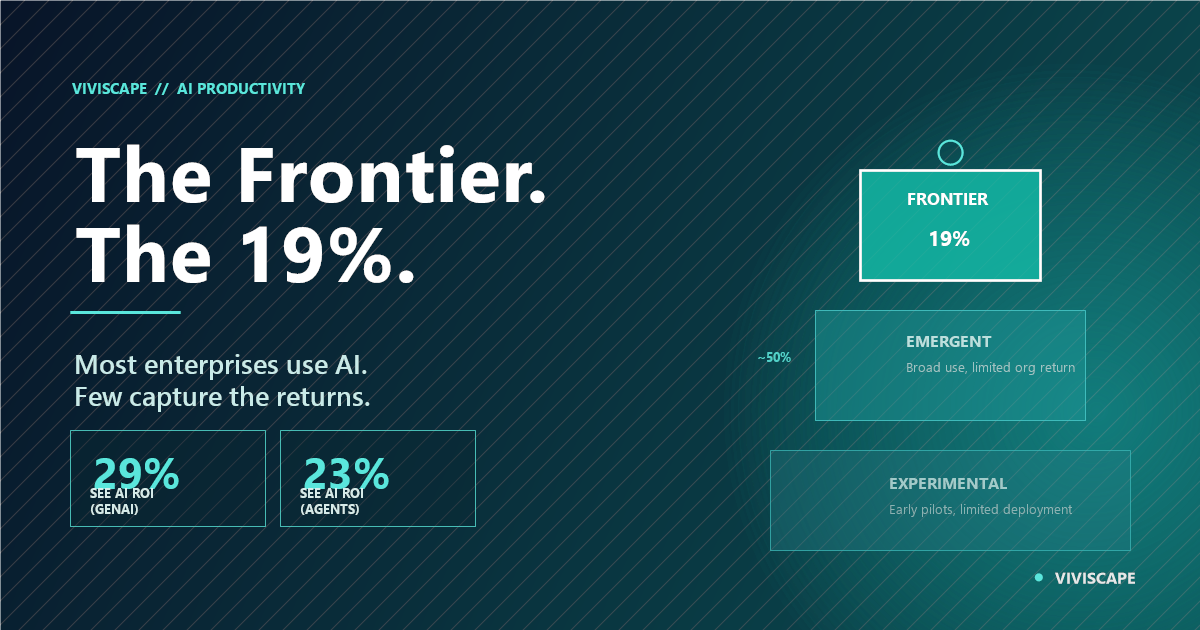
Only 19% of organizations have crossed into what researchers are calling the AI frontier zone — the group where AI is genuinely redesigning how work gets done, productivity gains are measurable and compounding, and the technology is becoming infrastructure rather than experiment. The remaining 81% are in the emergent or experimental stages: using AI tools, running initiatives, and spending budget, but not seeing returns that match the investment or the aspiration.
The paradox is that most of the 81% are not failing for obvious reasons. They have tools deployed. Their employees are using them. Individual productivity wins are real and measurable. The Microsoft Work Trend Index for 2026 confirms that AI is producing genuine gains at the individual level — but also identifies that those individual wins are not translating to organizational productivity improvements at anywhere near the same rate. Only 29% of organizations see significant ROI from generative AI, and just 23% from AI agents, despite widespread deployment and high individual usage.
This gap — between individual wins and organizational returns — is the defining enterprise AI problem of 2026. Understanding why it exists is the precondition for crossing to the other side of it.
The Frontier vs. Emergent Divide
The frontier zone is not defined by which AI tools an organization uses. The major foundation model providers — and the application layer tools built on top of them — are broadly accessible. The organizations in the frontier zone are using the same tools as the organizations in the emergent zone. What differs is not the technology but the deployment approach.
Frontier organizations have done something that emergent organizations have not: they have moved from AI as a productivity supplement to AI as a workflow redesign catalyst. In emergent organizations, AI is layered on top of existing workflows. Employees use AI tools to go faster on tasks they were already doing. The workflow itself remains unchanged. The AI is faster drafting, faster summarizing, faster searching — but the underlying process structure, approval flows, information routing, and decision architecture remain the same.
Frontier organizations have used AI deployment as a forcing function to ask a more fundamental question: given what AI can now do, what should this workflow look like? This question produces qualitatively different outcomes. Instead of AI-assisted email drafting, you get restructured communication flows that reduce total communication volume. Instead of AI-assisted report generation, you get restructured reporting processes that eliminate reports that were only being generated because they were easy to generate, not because they were being read. The AI is not just making the old process faster. It is making a different, better process possible.
The distinction sounds straightforward but is organizationally difficult. Workflow redesign requires process authority, change management capacity, and leadership willingness to absorb short-term disruption for long-term gain. Most organizations deployed AI without that organizational infrastructure in place. They deployed the tool without deploying the capability to change the underlying work around it.
Why Individual Wins Don’t Aggregate to Organizational Returns
The individual-to-organizational translation problem is more structural than it appears. Individual productivity gains from AI tools are real and measurable: a knowledge worker who uses AI effectively for drafting, research, and summarization genuinely accomplishes more in a given hour. The problem is that individual capacity gains do not automatically become organizational output gains — they become absorbed into the existing organizational constraints that limit output.
Consider a simple example. A team of ten analysts uses AI tools to improve their individual research productivity by 30%. If the team’s output was previously constrained by analyst capacity, this improvement should produce 30% more analytical output. But if the team’s output is actually constrained by how many research requests come in, how quickly stakeholders review findings, or how many final decisions get made based on analysis, then the 30% individual gain produces no change in organizational output. The work gets done faster and then waits in the next bottleneck in the process.
Most enterprise workflows have multiple bottlenecks. AI tools remove one bottleneck — the speed at which individual tasks are completed — while leaving the others intact. The result is that work piles up at the next constraint, which was previously invisible because the first constraint was the binding one. This is why organizations see high AI usage and individual satisfaction without corresponding business results. The AI is genuinely helping at the task level. The organizational system is absorbing that help without producing more output.
Frontier organizations have addressed this by mapping their full workflow constraints before deploying AI, rather than deploying AI and then discovering the remaining constraints later. They know where their output bottlenecks are, and they prioritize AI deployment in areas where it addresses the binding constraint rather than just the most visible one.
The Proficiency Gap and Why It Compounds
Within most organizations, AI proficiency is not evenly distributed. A small number of employees — the AI super-users — are getting dramatically larger productivity gains than the median employee. This creates an internal divide that compounds over time.
Research from 2026 confirms that the gap between AI-proficient employees and everyone else is large, growing, and steeper than any normal productivity distribution. AI proficiency is not linearly distributed — it follows a power law. The most proficient users are not 20% or 30% more productive than median users. They are getting 5x, 10x, or more improvement on certain task types because they have learned how to structure problems in ways that make AI tools dramatically more effective.
This proficiency gap creates organizational dysfunction that most AI programs do not account for. When AI super-users are embedded in teams with lower AI proficiency, they become bottlenecks: work routes to them because they can use AI to complete it faster, while lower-proficiency teammates continue working in the old way. The team’s output depends on a small number of AI-proficient individuals rather than on a broadly capable team. This is not scalable, and it creates retention risk — the AI super-users are your most productive employees and they know it.
Frontier organizations have addressed this by treating AI proficiency as a core organizational capability rather than an individual skill. They have structured programs to raise the floor of AI capability across teams, not just to celebrate the ceiling. They measure median AI effectiveness, not just whether AI is being used. And they design workflows around the level of AI capability the team can broadly maintain, rather than around what is possible for their most skilled practitioners.
The Structural Factors That Actually Determine Which Zone You Are In
Across the organizations that have crossed into the frontier zone, three structural factors appear consistently. None of them are primarily about technology selection.
First, they have leadership that treats AI as an operational redesign initiative rather than a technology initiative. The CEO or COO is engaged in decisions about which workflows to transform, not just which tools to approve. This matters because workflow redesign requires cross-functional authority that technology teams do not have. The decision to change how a sales team qualifies leads, or how a finance team produces monthly close reports, or how a customer service team handles escalations is not a technology decision. It is a business process decision that requires business leadership to make and enforce.
Second, they have change management infrastructure that can actually move people through the transition from old workflows to new ones. Deploying AI without change management produces AI that supplements old workflows rather than replacing them — which is the defining characteristic of the emergent zone. Change management for AI is different from traditional enterprise change management because the change is ongoing rather than episodic. AI capabilities are improving continuously, which means the optimal workflow design is also changing continuously. Organizations need change management capability that can run as a continuous function, not as a project management effort with a defined endpoint.
Third, they have measurement infrastructure that captures organizational outcomes rather than individual usage. They know whether AI deployment is producing more output, better decisions, or lower cost at the process level — not just whether employees are using the tools and finding them valuable. The measurement infrastructure is how they identify which AI deployments are producing organizational return and which are producing individual satisfaction without aggregate benefit.
At ViviScape, we have worked with organizations across both zones, and the pattern is consistent: the structural factors matter more than the technology choices. The question is not which AI platform will get you to the frontier zone. The question is whether your organization has the workflow redesign capability, change management infrastructure, and measurement discipline to capture the value the technology can deliver. Those are buildable capabilities, and they are the actual constraint for the 81% of organizations that have not yet broken through.
Ready to Move from Emergent to Frontier?
ViviScape helps organizations identify their binding workflow constraints, design AI deployments that address them directly, and build the change management and measurement infrastructure that turns individual AI wins into organizational returns. If you’re in the 81% and want to understand what crossing the divide actually requires, let’s talk.
Schedule a Free Consultation