
Six months ago, an AI coding tool was something that autocompleted your line of code. Today, AI agents are writing entire features, refactoring million-line codebases, and coordinating with each other across parallel workstreams.
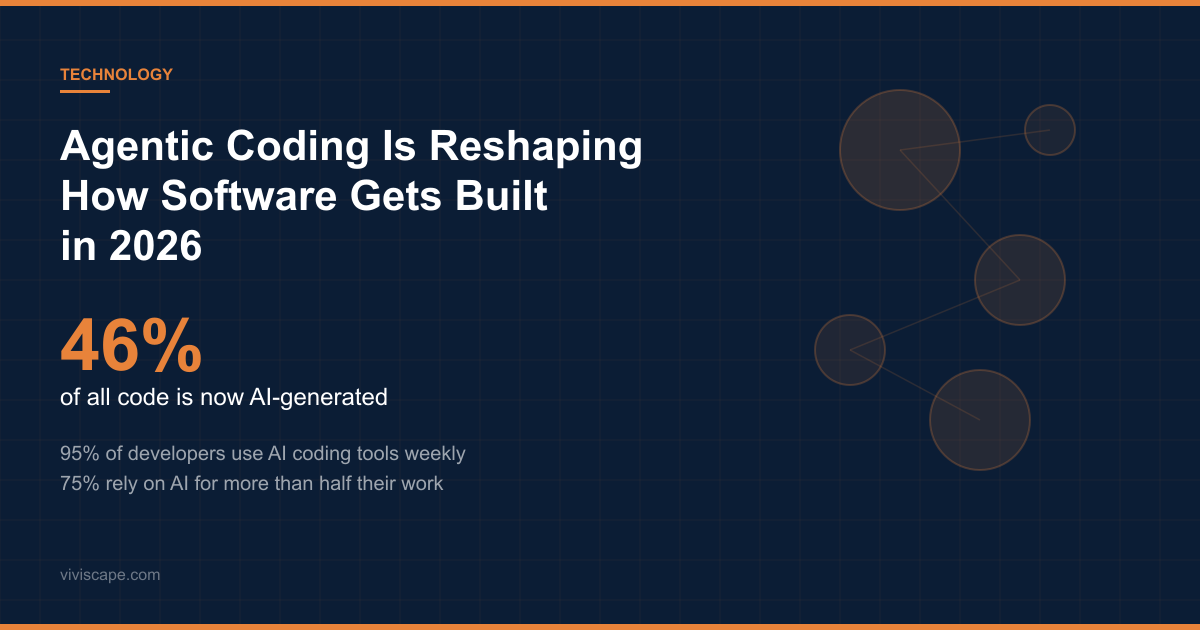
The numbers are hard to ignore. 46% of all code written by active developers in 2026 is AI-generated. Gartner forecasts that will reach 60% by year end. And according to Anthropic's 2026 Agentic Coding Trends Report, 95% of professional developers now use AI coding tools at least weekly, with 75% relying on AI for more than half their engineering work.
This is not a marginal productivity bump. It is a structural change in how software gets built, and it has major implications for every business that depends on custom technology.
From Autocomplete to Orchestration
The evolution happened fast. In 2024, AI coding meant tab-to-accept suggestions, one line at a time. In early 2025, tools like GitHub Copilot could handle simple functions and tests. By mid-2025, agentic coding tools emerged that could work autonomously across entire codebases.
Now, in 2026, the landscape looks entirely different:
- Complex task usage has surged. Six months ago, code design and planning represented just 1% of AI coding tool usage. Today it is 10%. Feature implementation jumped from 14% to 37%
- Multi-agent systems are mainstream. Gartner reported a 1,445% surge in multi-agent system inquiries from Q1 2024 to Q2 2025. By 2026, coordinated AI agent teams that divide complex projects into parallel workstreams are in production at major enterprises
- The tools have consolidated. Claude Code is now used by 41% of professional developers and holds a 46% "most loved" rating. GitHub Copilot retains 42% market share. Cursor crossed $500 million in annual recurring revenue. Developers average 2.3 tools simultaneously
The practical result: engineers are shifting from writing code to orchestrating agents that write code. Their value is in architecture, system design, strategic decisions, and validating output, not typing syntax.
What This Means for the Cost and Speed of Custom Software
If you are a business leader evaluating a custom software project in 2026, this shift changes the math in three important ways.
1. Delivery Timelines Are Compressing
When an AI agent can implement a feature that used to take a developer two days in a matter of hours, project timelines shrink. Not by 10 or 20%, but often by 30% or more. TELUS, a major telecom, reported a 30% acceleration in engineering code delivery after deploying AI coding agents at scale, saving over 500,000 hours across the organization.
For a mid-market business commissioning a custom platform, this means getting to production faster with fewer budget surprises.
2. Code Quality Is Going Up, Not Down
There is a natural concern that AI-generated code means lower quality. The data shows the opposite. In one documented case, an AI agent completed a complex task across a 12.5-million-line codebase in seven hours of autonomous work, achieving 99.9% numerical accuracy without human code contribution during execution.
The reason is straightforward: AI agents do not get tired, do not cut corners on Friday afternoons, and do not forget to write tests. When paired with experienced engineers who review architecture and validate output, the combined quality exceeds what either could produce alone.
3. The Definition of "Team" Is Changing
A custom software project in 2024 might have required eight developers working for six months. In 2026, the same scope might need four senior engineers orchestrating AI agents for three months. The team is smaller, more senior, and more focused on architecture and business logic than on writing boilerplate.
This does not mean software is cheap now. Senior engineering talent that can effectively orchestrate AI agents is more valuable than ever. But it does mean the economics of custom software have shifted in the buyer's favor.
The Developer's Role Has Fundamentally Changed
The most important shift is not in the tools. It is in what it means to be a software developer.
Developers in 2026 spend less time writing foundational code and more time on:
- System architecture: Designing how components interact, defining boundaries, and making trade-offs that AI agents cannot reason about in isolation
- Agent orchestration: Defining precise objectives and guardrails for AI coding agents, breaking complex work into tasks agents can execute in parallel
- Quality validation: Reviewing AI-generated code for security, performance, edge cases, and alignment with business requirements
- Domain translation: Bridging the gap between what the business needs and what the technical system should do, a skill that AI amplifies but cannot replace
As we explored in our piece on the evolution of AI from chat to agentic workforce, this pattern of AI handling execution while humans handle judgment is playing out across every industry. Software development just happens to be the canary in the coal mine.
What to Look for in a Development Partner
If you are evaluating software development firms in 2026, the agentic coding revolution creates a new set of questions you should be asking.
- Do they use AI coding tools in production? A firm that has not adopted agentic coding workflows is leaving speed, quality, and cost efficiency on the table. This is no longer optional
- How do they validate AI-generated code? The tools are powerful but not infallible. Look for teams that have rigorous review processes, automated testing pipelines, and senior engineers who understand the limitations
- Are they passing the savings to you? If a development team delivers in three months what used to take six, but still quotes six months of billing, the efficiency gains are not reaching your budget
- Can they handle the architecture? AI agents write code well. They do not design systems well. The strategic decisions, which make good software good, still require experienced humans who understand your business, your users, and your technical constraints
The Democratization Effect
One of the most interesting developments is how agentic coding is expanding who can build software. Agent support is now extending into legacy and niche languages, including COBOL and Fortran, making decades-old systems easier to maintain and modernize. New interfaces are also opening these tools to professionals in security, operations, design, and data roles who are not traditional developers.
For businesses sitting on aging technology stacks, this is significant. The barrier to modernization just dropped. Systems that were too expensive to touch because no one remembers the original language are suddenly accessible again.
Zapier exemplifies where this is heading: 97% AI adoption across the entire organization as of January 2026, with 800 or more internal AI agents deployed across engineering and operations. When AI-powered development extends beyond the engineering team, the pace of digital transformation accelerates across the entire business.
The Risks That Matter
This is not all upside. Agentic coding introduces new risks that businesses and development teams must manage.
- Security surface expansion: AI-generated code can introduce vulnerabilities that a human developer might instinctively avoid. Every line of AI-generated code needs the same security scrutiny as human-written code, arguably more
- Over-reliance on generation: Teams that treat AI output as finished product rather than first draft will accumulate technical debt faster than they realize. The review step is not optional
- Intellectual property questions: As AI agents generate more of the codebase, organizations need clear policies on IP ownership, licensing compliance, and attribution
- Skill atrophy: If junior developers never learn to write code from scratch, the industry risks losing the deep understanding that makes senior architects effective. The best firms are balancing AI augmentation with deliberate skill development
These are manageable risks, but only if they are managed deliberately. As we noted in our AI compliance countdown, governance cannot be an afterthought when AI is embedded in your core development process.
The Bottom Line
Software development in 2026 looks fundamentally different than it did 18 months ago. The best development teams are not the ones typing the fastest. They are the ones who know how to direct AI agents toward the right problems, validate the output rigorously, and make the architectural decisions that no AI can make alone.
For businesses, this means better software, delivered faster, at a more favorable cost structure. But it also means the gap between development firms that have embraced agentic workflows and those that have not is widening fast.
The question is not whether AI will change how your software gets built. It already has. The question is whether your development partner has kept up.
Building something in 2026?
ViviScape uses agentic coding workflows every day to deliver custom software faster without sacrificing quality. Let us show you what a modern development process looks like.
Book a Free Consultation