
If you blinked, you might have missed it. In less than four years, artificial intelligence went from a novelty that could write a passable email to a technology that runs multi-step business processes autonomously, collaborates across departments, and manages itself.
For business leaders, this isn't an abstract technology story. It's a practical question: where does your organization sit on this curve, and what do you need to do next?
Let's break down the three eras of AI in business — what changed, why it matters, and where the real opportunities are right now.
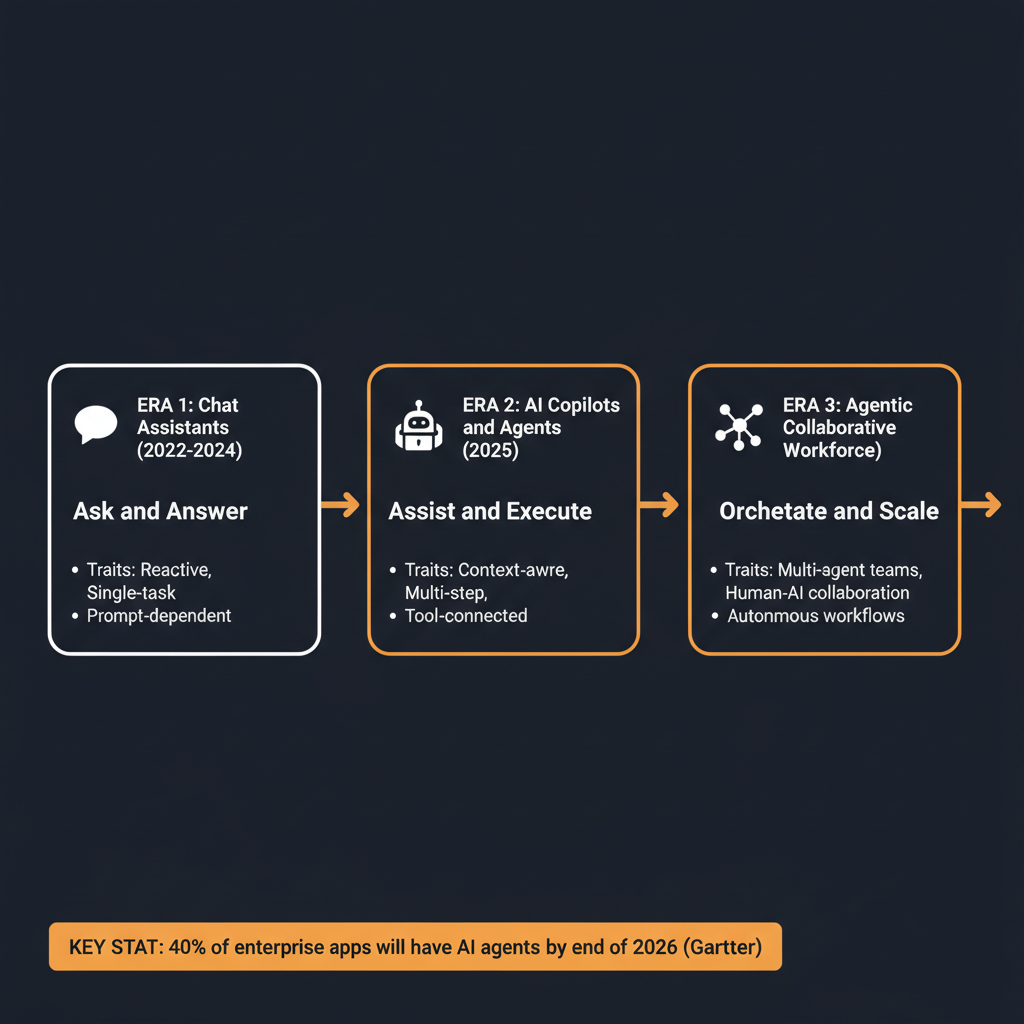
Era 1: Chat Assistants (2022–2024) — Ask and Answer
When ChatGPT launched in late 2022, it felt like magic. You could ask a question in plain English and get a coherent, often useful answer. Businesses scrambled to figure out what this meant for them.
This first era was defined by reactive, single-task interactions. You prompted, it responded. Need a first draft of a marketing email? Done. Want to summarize a 40-page report? Handled. Have a customer FAQ that needs answers? Easy.
But the limitations became clear fast:
- No memory. Every conversation started from scratch. The AI didn't know your business, your customers, or what you asked it yesterday.
- No action. It could write a response but couldn't send it. It could suggest a workflow but couldn't execute it.
- No integration. Chat assistants lived in their own tab — disconnected from your CRM, ERP, email, and every other system that actually runs your business.
For most organizations, this era delivered individual productivity gains — saving a few hours here and there on drafting, research, and brainstorming. Valuable, but limited. The chatbot could explain, and automation could execute, but nothing could do both with context.
Era 2: AI Copilots & Agents (2025) — Assist and Execute
The second era arrived fast. As Microsoft's Judson Althoff put it at Ignite 2025: "Copilot was chapter one. Agents are chapter two."
This shift was about three fundamental upgrades:
Context Awareness
AI stopped being a blank slate. Copilots and agents could access your internal data — your CRM records, your documents, your project history — and use that context to give answers that actually applied to your business. Not generic advice. Specific, grounded recommendations.
Multi-Step Execution
Instead of answering one question and waiting, agents could chain tasks together. "Research these five leads, draft personalized outreach emails, schedule them for Tuesday, and log everything in the CRM." One instruction, multiple actions, no babysitting.
Tool Connection
This was the real unlock. Through APIs and protocols like the Model Context Protocol (MCP), agents could connect directly to business systems — databases, cloud services, communication tools — and take real-time actions. Not just suggest what to do. Actually do it.
The impact was measurable. Companies using AI agents for content and marketing tasks reported saving 5–15 hours per week. AI-powered customer service handled 40–60% of routine inquiries autonomously. Document processing automation cut manual data entry by up to 80%.
But this era also revealed a new problem: agent sprawl. Organizations deployed AI agents across departments without coordination. According to Salesforce research, 50% of agents operated in isolated silos — disconnected workflows, redundant automations, and the growing risk of shadow AI.
Era 3: Agentic Collaborative Workforce (2026+) — Orchestrate and Scale
This is where we are now — and it's a fundamentally different paradigm.
The defining shift of 2026 isn't better individual agents. It's agents working together as coordinated teams, supervised by humans, operating as a genuine extension of your workforce.
Deloitte's 2026 Tech Trends report frames it clearly: agents are becoming a "silicon-based workforce" that complements and enhances the human workforce. Every employee — from analysts to VPs — becomes a human supervisor of agents. Instead of performing every mundane task themselves, their primary role is managing a team of specialized agents grounded in the company's own data, customer history, and knowledge bases.
What Multi-Agent Collaboration Actually Looks Like
Think of it as a digital assembly line. A specialized team where each AI agent does one thing perfectly, and together they handle complex workflows end-to-end:
- A research agent monitors market trends and competitor activity
- A analysis agent processes the data and identifies opportunities
- A content agent drafts recommendations and communications
- A scheduling agent coordinates meetings and follow-ups
- An orchestration layer manages the handoffs, resolves conflicts, and escalates to humans when judgment is needed
No single agent could do all of this. But a coordinated team of agents, each operating within defined guardrails and connected through a shared context layer, can run processes that previously required multiple human roles and days of calendar time — in hours.
The Numbers Behind the Shift
This isn't theoretical. The data shows a clear acceleration:
- Gartner predicts 40% of enterprise applications will feature task-specific AI agents by end of 2026 — up from less than 5% in 2025
- Organizations currently use an average of 12 AI agents, with that number projected to climb 67% within two years
- The AI agent market is growing at a 46.3% CAGR, expanding from $7.84 billion in 2025 to a projected $52.62 billion by 2030
- McKinsey estimates AI agents could add $2.6 to $4.4 trillion in value annually across business use cases
- By 2028, 38% of organizations will have AI agents as formal team members within human teams
What This Means for Mid-Size Businesses
Here's what most coverage of agentic AI gets wrong: this isn't just an enterprise story. In fact, mid-size businesses — 50 to 500 employees — stand to gain the most from this evolution.
Why? Because you have the operational complexity to benefit from AI agents, but you're not buried under the legacy infrastructure and bureaucratic approval chains that slow down larger organizations. You can move faster.
The Practical Starting Points
You don't need to build a multi-agent workforce overnight. The businesses seeing real results in 2026 are following a proven pattern:
- Start with one high-impact workflow. Pick the process that eats the most manual hours — invoice processing, customer onboarding, report generation, lead qualification. Automate that one thing well.
- Measure for 90 days. Track time saved, error reduction, and team satisfaction. Build the business case with real numbers, not projections.
- Expand to connected workflows. Once one agent is working, connect it to adjacent processes. The invoice agent talks to the reconciliation agent. The lead qualification agent feeds the outreach agent. This is where the compounding value kicks in.
- Establish governance early. Define who supervises which agents, what decisions require human approval, and how you audit agent actions. The companies that skip this step are the ones that end up with shadow AI problems.
The Trust Gap Is Real — But Closing
Let's be honest about the friction. In 2025, only 22% of executives expressed confidence in fully autonomous AI agents, and 60% didn't fully trust AI to manage tasks without oversight. That skepticism is healthy.
But it's also evolving. The shift isn't from "no trust" to "full trust." It's from "no trust" to "trust with guardrails." The most successful implementations in 2026 give agents clear boundaries: what they can do autonomously, when they must escalate, and how their work gets audited.
This mirrors how organizations already manage human teams. You don't give a new hire unlimited authority on day one. You define their scope, review their work, and expand their autonomy as they prove reliable. The same model works for AI agents.
Where ViviScape Fits In
At ViviScape, we've been building custom software and AI solutions for mid-size businesses throughout this entire evolution. We've seen firsthand what works — and what doesn't.
The pattern is consistent: the companies that get the most value from AI are the ones that start with their specific workflows, not generic tools. A chatbot that doesn't know your business is a toy. An agent that's connected to your systems, trained on your data, and designed for your processes is a competitive advantage.
Whether you're still in Era 1 (using ChatGPT for ad hoc tasks), ready to move to Era 2 (deploying your first AI agents), or thinking about Era 3 (building a coordinated AI-augmented workforce), the path forward starts with understanding where you are today.
Our AI Readiness Assessment evaluates your organization across four dimensions — data, processes, team, and strategy — and gives you a clear picture of your next step.
The Bottom Line
The evolution from chat assistants to agentic collaborative workforces isn't just a technology trend. It's a fundamental shift in how work gets done. The organizations that recognize this shift early — and invest in building the right foundation — will operate faster, leaner, and smarter than competitors who are still copying and pasting from ChatGPT.
The question isn't whether AI agents will become part of your workforce. It's whether you'll be ready when they do.
Find Out Where You Stand
Take our free AI Readiness Assessment to see how prepared your business is for the agentic era — or book a consultation to map your AI strategy.