
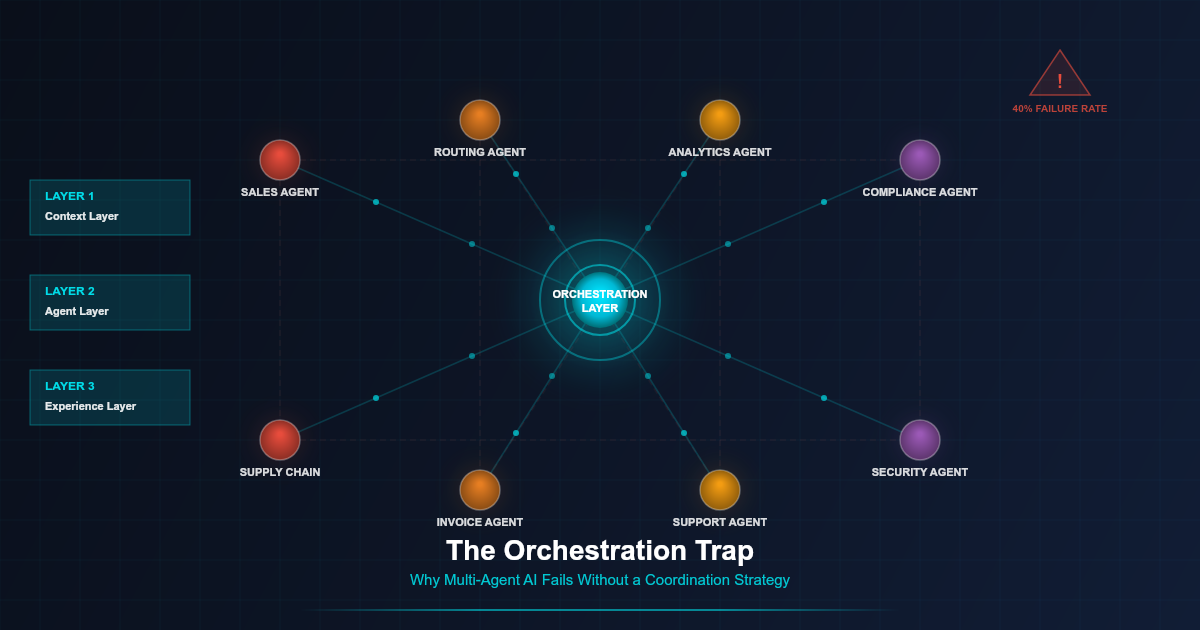
- Gartner predicts 40% of enterprise applications will feature embedded AI agents by end of 2026 — but most enterprises are designing for full autonomy when controlled autonomy is what actually works.
- The EU AI Act's high-risk oversight requirements take effect August 2, 2026, making human-in-the-loop design a compliance requirement, not just a best practice, for regulated industries.
- Escalation volume grows faster than human capacity: teams that plan for 10 agent handoffs per day routinely face 100 as agent adoption scales. The architecture must account for this from day one.
- Three handoff patterns — confidence thresholds, action reversibility tiers, and async approval queues — cover the majority of real-world agentic workflow design decisions.
Somewhere in an enterprise right now, an AI agent just approved something it should not have approved. Not because the agent malfunctioned. Because no one told it when to stop and ask.
This is the autonomy trap. Businesses deploy agentic AI because they want less manual work. They design workflows for maximum automation. And then they discover that "fully autonomous" and "reliably autonomous" are not the same thing — usually at the worst possible moment.
Gartner projects that 40 percent of enterprise applications will feature embedded AI agents by the end of 2026, up from less than 5 percent in 2025. That is an extraordinary acceleration. And it means that the question of when AI agents should act independently and when they should hand off to a human is no longer a theoretical design consideration. It is an operational necessity that most enterprises have not yet solved.
The Autonomy Trap
The appeal of full autonomy is obvious. If an agent handles a procurement workflow end-to-end — evaluating vendors, comparing prices, routing approvals, issuing purchase orders — you have eliminated significant manual coordination. The efficiency gains are real.
The problem is that "end-to-end" includes the edge cases. A vendor relationship with a history of disputes. A purchase order that exceeds a threshold not captured in the system. A contract term that changed last week but has not propagated to the agent's knowledge base. These are not failure modes in the agent's reasoning. They are situations where the agent genuinely does not have enough information to make the right call — and without a handoff mechanism, it makes a call anyway.
The orchestration trap in multi-agent systems is a related failure: complexity multiplies faster than oversight. A single agent making an autonomous decision is manageable. Five agents coordinating on a workflow, each making autonomous sub-decisions, creates compounding exposure that no one is watching.
Full autonomy is not the goal. Controlled autonomy is. The distinction is architectural: controlled autonomy means agents operate independently within defined boundaries, escalate when those boundaries are reached, and integrate human judgment exactly where it adds the most value — not everywhere, not nowhere.
Three Handoff Patterns That Work
Most enterprises deploying agentic AI in production are converging on three core design patterns for human-AI handoffs. None of them are mutually exclusive. The best implementations use all three in combination.
1. Confidence Thresholds
The most common pattern is confidence-based routing: the agent evaluates its own certainty before acting, and routes to human review when confidence falls below a defined threshold. Initial threshold standards emerging in production environments set the bar at 0.85 for irreversible actions and 0.70 for reversible ones. These are not universal rules — they require calibration against actual performance data from your specific workflows. But they provide a principled starting point.
The critical implementation detail is that thresholds are not static. They must be reviewed regularly against live performance metrics. An agent escalating too frequently is creating poor user experience and generating cost. An agent escalating too rarely is taking risks the organization has not explicitly accepted. The threshold is a business decision, not a technical one, and it should be owned by someone with accountability for the workflow outcomes.
2. Action Reversibility Tiers
Not all agent actions carry equal risk. Sending a summary email is reversible. Issuing a purchase order is not. Updating a customer record is recoverable. Deleting data from a partner system might not be. Designing handoffs around action reversibility — rather than treating all actions the same — creates a risk-proportionate oversight model.
A practical implementation uses three tiers: low-risk reversible actions that agents execute autonomously, moderate-risk actions that route to an async human approval queue, and high-risk irreversible actions that require explicit human authorization before execution. The tier assignment for each action type is a business policy decision, not an agent decision. It must be defined in the workflow design, not inferred by the agent at runtime.
3. Async Approval Queues
The common misconception about human-in-the-loop design is that it requires the agent to stop and wait. In a synchronous handoff model, every escalation adds latency proportional to human response time — measured in minutes or hours, not milliseconds. At scale, this destroys the efficiency case for agentic AI entirely.
Async approval queues solve this. The agent parks the action requiring human review, generates a clear summary of what it is asking and why, continues executing other tasks without that constraint, and resumes the parked action once approval is received. The human experience is a notification and a decision interface — not an interruption requiring context re-establishment from scratch. This pattern keeps the workflow moving while ensuring human judgment is applied where it matters.
The Scaling Problem Nobody Plans For
Here is the operational reality that catches most enterprises off guard: escalation volume grows faster than human capacity.
A team that deploys an agent handling 100 transactions per day might plan for 10 escalations — a 10 percent exception rate that seems manageable. As agent adoption grows, the same team is now running 1,000 transactions per day. At the same 10 percent rate, they face 100 escalations. The human review team has not grown proportionally. The queue backs up. Approvals are delayed. The agent cannot proceed. The efficiency gains evaporate.
This is not a hypothetical. It is the pattern that plays out consistently when agentic workflow design does not account for scale. The fix requires two things: designing escalation to be as lightweight as possible for the humans receiving it, and building a feedback loop that reduces escalation rates over time as the agent's confidence calibration improves.
Tiered escalation helps here too. Not every escalation needs to go to the same person. Moderate-confidence situations with moderate risk can route to front-line reviewers with fast SLAs. High-stakes or ambiguous situations route to specialists. The agent's escalation summary should contain everything the reviewer needs to make a fast decision — no context-gathering required. Designing for reviewer efficiency is as important as designing for agent efficiency.
The Compliance Dimension
For enterprises in regulated industries, human-in-the-loop design is moving from best practice to legal requirement. The EU AI Act's high-risk AI system obligations take effect August 2, 2026. High-risk systems — including AI used in hiring, credit, insurance underwriting, critical infrastructure management, and several other domains — require qualified human oversight as an architectural feature, not an optional add-on.
The practical implication: if your agentic workflows touch any of these domains, you cannot retrofit human oversight after the fact. The oversight mechanism must be built into the system design, documented, and auditable. Regulators are not going to accept a post-deployment explanation that the agent was generally reliable. They will ask to see the design, the thresholds, the escalation paths, and the logs.
The AI compliance timeline is not abstract. August 2026 is not far away, and the gap between "we have an AI agent in this workflow" and "we have a compliant agentic workflow with documented human oversight" is larger than most organizations currently recognize.
The ViviScape Perspective
Every agentic system we build at ViviScape includes an explicit handoff architecture — not because it is a box to check, but because it is the only design that holds up in production. The first question in any agentic workflow design is not "what should the agent do?" It is "what should the agent not decide on its own?"
That question forces the right conversations. It surfaces assumptions about risk tolerance that are usually implicit until something goes wrong. It identifies the actions where the cost of an error — reputational, financial, operational — is high enough that human judgment should always be in the loop. And it defines the escalation design before the agent is ever deployed, when those decisions are cheap, instead of after an incident, when they are not.
The organizations we see handling this best treat handoff design as a first-class product requirement, not a technical afterthought. They involve operations and compliance stakeholders in defining thresholds and tiers, not just engineering. They build escalation interfaces that reviewers actually want to use. And they instrument the escalation rate as a key performance metric — tracking it over time as evidence that the system is learning and improving, not just running.
Controlled autonomy is harder to design than full autonomy. But it is the only kind that earns organizational trust — and trust is what determines whether an agentic deployment expands or gets shut down after the first serious mistake.
Building an agentic workflow and unsure where the handoffs should be?
ViviScape designs agentic systems with human oversight built in from the architecture level — including confidence thresholds, reversibility tiers, and async approval queues that scale. Let's talk through your workflow design.
Book a Free Consultation